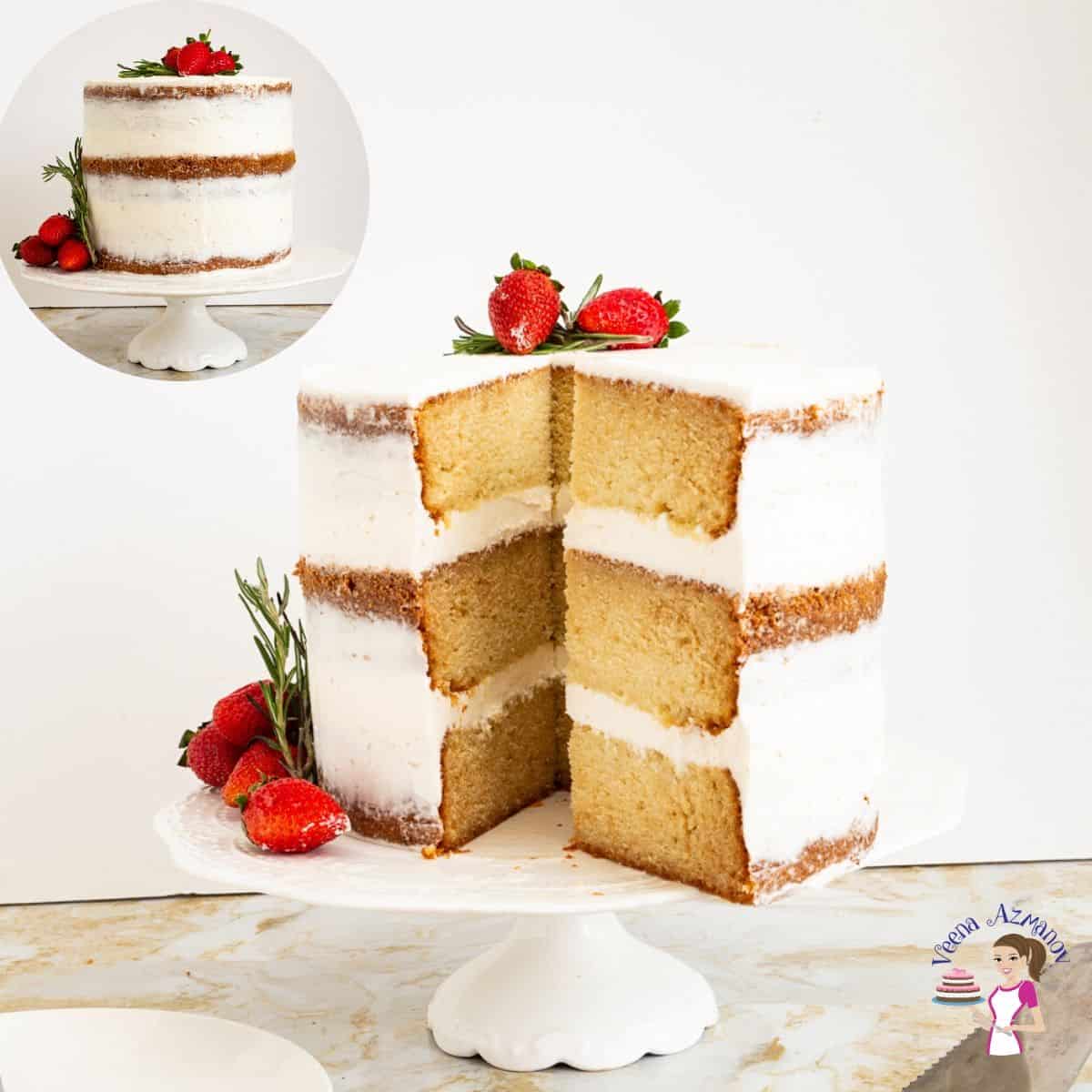
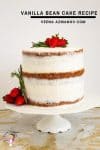
This moist vanilla bean cake is my butter-based cake batter flavored with wonderful vanilla bean paste. Delicious on its own and can also be accompanied by many different fillings and frostings. Today, I make it a naked cake so the rich vanilla flavor can shine through.

Every baker, whether a home baker or a professional, needs to master the art of the perfect vanilla bean cake. It’s the ultimate test of baking skills—simple yet incredibly rewarding.
As someone who ran her own cake business for years, I was always amazed by how often people chose this classic flavor, despite all the other exciting options on my menu. There’s just something timeless about the rich, buttery aroma of real vanilla beans and the moist, tender crumb of a perfectly baked vanilla cake.
It’s the kind of cake that shines on its own or becomes the perfect canvas for endless creative possibilities. If there’s one recipe you should perfect, it’s this one—it’s a true crowd-pleaser every single time!
Why make this cake?
- Rich Vanilla Flavor: Made with real vanilla beans, this cake boasts an authentic, luxurious vanilla flavor that’s unmatched by extracts alone.
- Tender, Moist Crumb: The perfect balance of ingredients creates a soft, fluffy texture that melts in your mouth while staying moist for days.
- Versatile and Reliable: Whether you’re baking it as a standalone cake, a layered masterpiece, or a cupcake, this recipe delivers consistently beautiful results every time.
- Perfect for Any Occasion: From elegant weddings to casual birthdays, this classic vanilla bean cake is a timeless choice that never goes out of style.

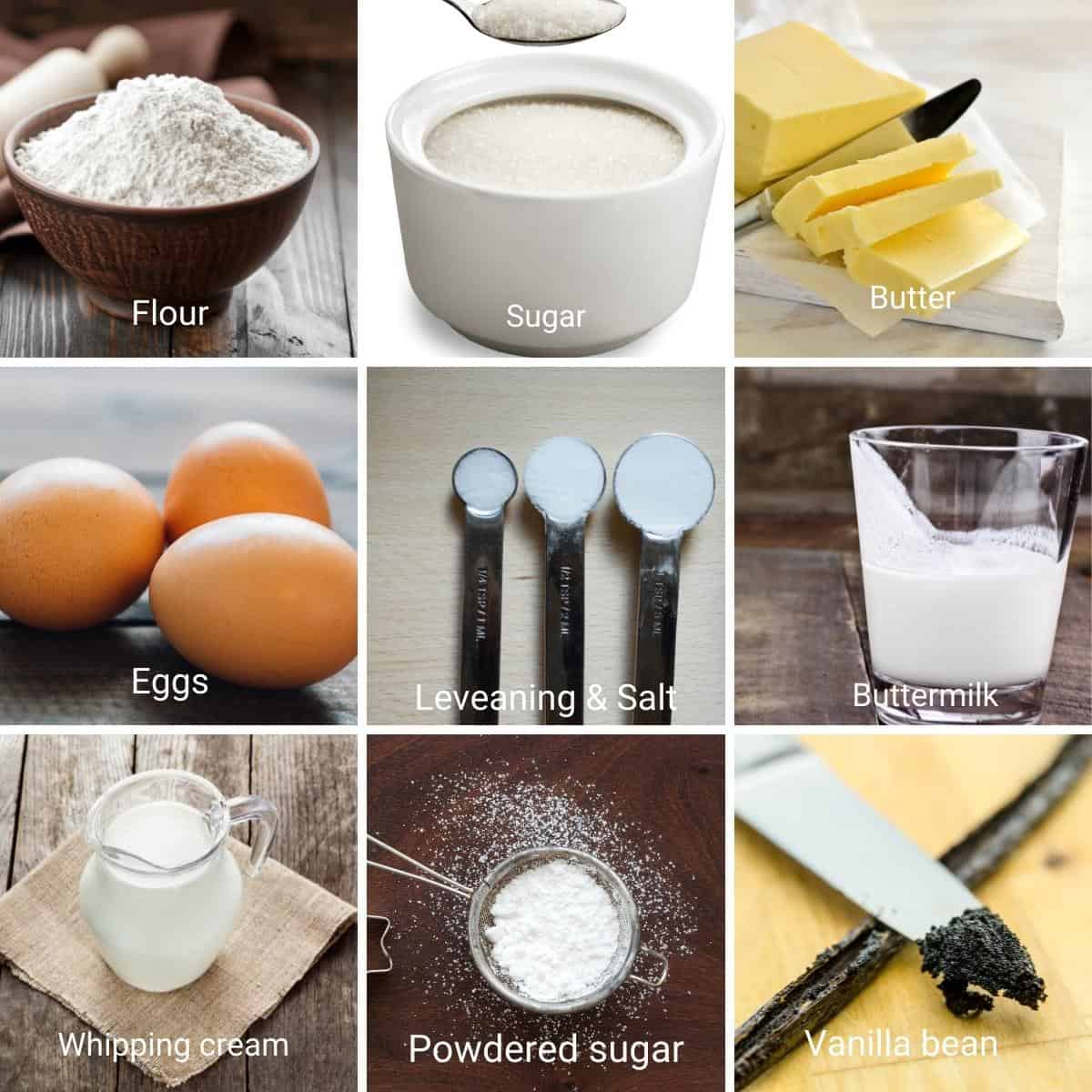
Ingredients and substitutes
- Cake flour – Cake flour gives the cake a wonderfully soft crumb. But you can certainly use all-purpose flour. And if you have only self-raising flour on hand, use it, but reduce the baking powder by half.
- Unsalted butter – I always use unsalted so I can control the amount of salt. And yet, if salted butter is all you have, use it and omit salt in the recipe.
- Sugar – I’m using white sugar so I can have a white cake. It’s always best to use fine-grain white sugar, so it dissolves easily in the butter.
- Buttermilk – If you don’t have buttermilk on hand, don’t worry. It takes just 5 minutes to make homemade buttermilk for baking.
- Vanilla bean paste – High-quality vanilla is very important, especially in a vanilla cake. I’m using vanilla bean paste, but you can use vanilla bean scrapings or a good-quality vanilla extract.
- Substitutions – If you’re missing any of these ingredients, don’t worry – there are substitutes you can use. For example, you can use vegetable oil instead of butter, or soy buttermilk instead of dairy buttermilk. Just keep in mind that these substitutions may affect the flavor and texture of the cake.
Step-by-step instructions: Moist vanilla bean cake
Cake
- Oven and Pans – Preheat the oven to 325°F/165 °C/Gas Mark 3. Grease and line 3 x 8-inch round baking pans with parchment paper.
Pro tip – You can make 2 x 8-inch round cakes and divide them into 4 layers.
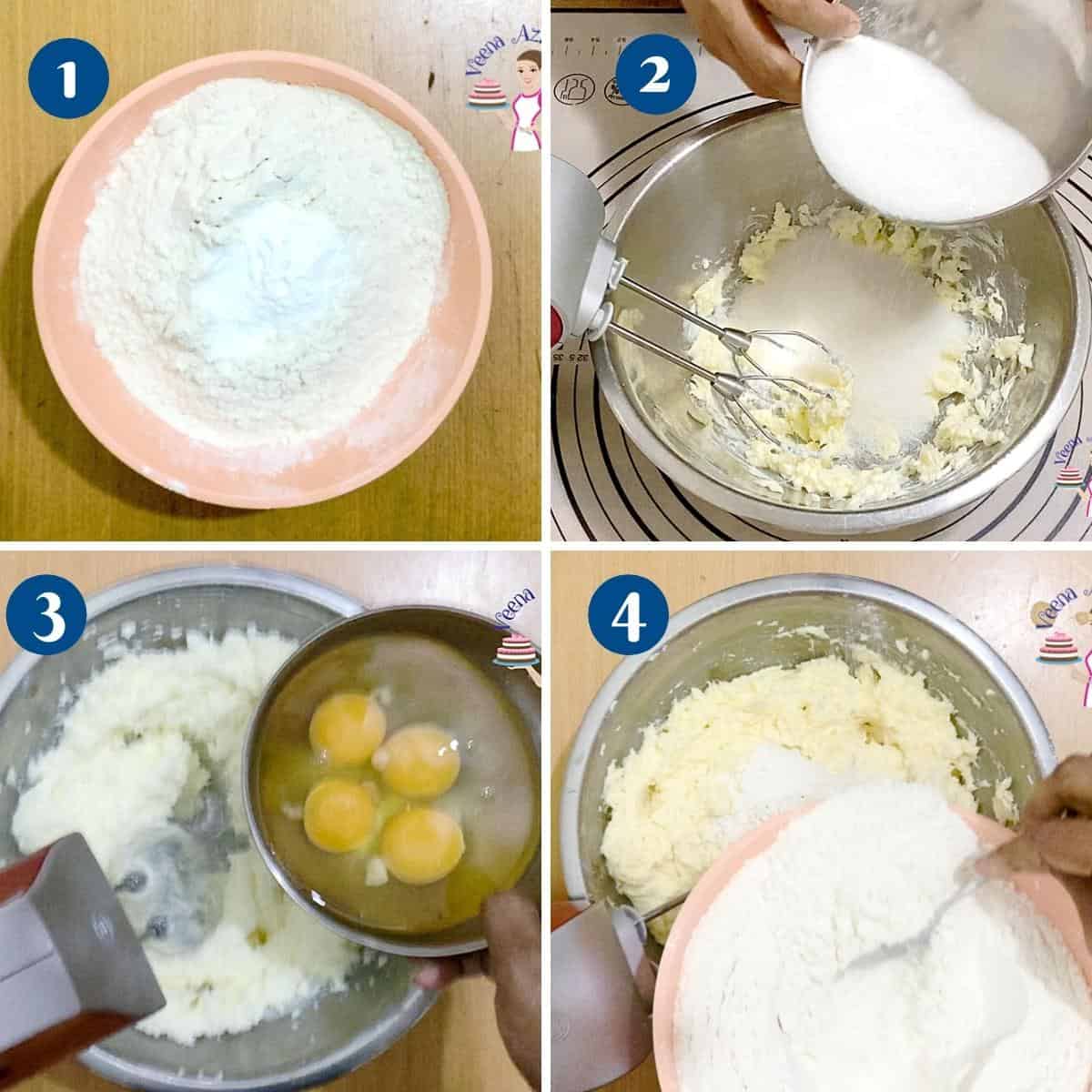
- Dry ingredients – In a medium bowl, combine the flour, baking powder, baking soda, and salt.
- Wet ingredients – In the bowl of a stand mixer fitted with the paddle attachment, cream the butter and sugar on medium speed until light and fluffy. Next, add the eggs, one at a time, followed by the vanilla bean paste.
- Combine – add the flour mixture and buttermilk in three batches. Scrape the sides and bottom of the bowl with a rubber spatula to ensure you have a smooth batter.

- Bake – Divide the batter equally between the prepared baking pans. Place the pan on the middle rack in the oven and bake for 30 to 35 minutes or until a skewer inserted in the center of the cake comes out clean.
Pro tip – I like to use cake strips to ensure my layer cakes bake flat. - Cool in the baking pan for 5 minutes. Invert and cool on a cooling rack completely before you decorate.
Frosting
- Buttercream – In the bowl of a stand mixer, with the paddle attachment, cream the butter and powdered sugar until well combined. Then, add the cream and vanilla extract. Continue to whip until light and airy – at least 2 to 3 minutes.
Pro tip – It is important to whip so you have a whipped-cream-like consistency. Otherwise, the buttercream will be too soft to spread.

Assemble
- Level – Using a bread knife or cake leveler, cut the domes off the cake layers. Brush each layer with the cooled simple syrup.
Pro tip – If you baked two layers, you can split each layer horizontally to make four layers. - Stack – Place a cake layer on the cake board or cake stand. Top with a big dollop of buttercream – spread evenly using a straight-edge spatula. Then, top the next cake layer on top, followed by more buttercream and more layers. Chill for 15 minutes.
Pro tip – Chilling the cake at this point will ensure the layers don’t move when you frost the outside.

- Frost – Next, spread the ganache around and on top of the cake. Using a paddle motion when spreading will help smooth the ganache better. Remove as much frosting as possible so the cake is barely coated, but the naked cake can still be seen through.
Pro tip – Frosting the outside will help seal the cake and lock in all the moisture, preventing it from drying out. Then remove as much as you can to show the naked cake below. - Decorate with strawberries or similar garnish.


Troubleshooting
- If your cake is coming out dry, it might be overcooked. Check the cooking time and temperature, and consider reducing the time in the oven by a few minutes. Another possibility is that you’re using too much flour; be sure to measure your ingredients precisely, as too much flour can make your cake dry and dense.
- On the other hand, if your cake is coming out overly moist, the issue may be with the ingredients. Be sure that your eggs are at room temperature before mixing them into your batter. Cold eggs can make your cake overly damp. You may also want to consider slightly reducing the amount of liquid in your recipe.
- If your cake is coming out slightly uneven or lopsided, make sure that your oven racks are level, and that you’re placing your cake pans in the center of the oven. If all else fails, you can try adding a few baking strips around your pans to help distribute the heat more evenly.
- Finally, if your cake is sticking to the pan, you may not have greased and floured it sufficiently. Be sure to coat your pans generously with cooking spray or butter, then dust them lightly with flour before adding your batter. You can also try lining the bottoms of your pans with parchment paper for added insurance.

Frequently asked questions
If stored properly, this cake will last for 2 to 3 days at room temperature. It can also be kept in the fridge for up to 5 or 6 days.
While both vanilla extract and vanilla bean paste add a distinct vanilla flavor, they differ in texture and strength. Vanilla extract is the most common vanilla flavoring used in baking. It is made from vanilla beans that have been macerated in alcohol and has a strong, pure vanilla flavor. Vanilla bean paste, on the other hand, is made by blending vanilla bean seeds with sugar syrup and has a thicker consistency with visible vanilla bean specks. It has a more complex, almost caramel-like flavor than vanilla extract.
Yes, you can make the cake ahead of time and store it in an airtight container at room temperature for up to three days. Alternatively, you can wrap it in plastic wrap and freeze it for up to three months.
Naked Vanilla Bean Cake
This moist vanilla bean cake is my butter-based cake batter flavored with wonderful vanilla bean paste. Delicious on its own and can also be accompanied by many different fillings and frostings. Today, I make it a naked cake so the rich vanilla flavor can shine through.
Video
Ingredients
- 3 cups (375 g) Cake flour or all-purpose flour
- 2 tsp Baking powder
- ½ tsp Baking soda
- ½ tsp Salt
- 1¼ cup (280 g) Butter unsalted, room temperature
- 2 cups (400 g) White sugar
- 4 large (200 g) Eggs
- 1 cup (250 ml) Buttermilk
- 2 tsp Vanilla bean paste
- 1 cups (227 g) Butter unsalted, room temperature
- 3½ cups (420 g) Powdered sugar icing sugar
- ¼ cup (60 ml) Whipping cream (4 tbsp)or more for consistency
- 1 tsp Vanilla bean paste or extract
- ½ cup (120 ml) Simple syrup
Method
- Oven and Pans – Preheat the oven to 325 °F/ 165 °C/ Gas Mark 3. Grease and line 7-inch3 x 8-inch round baking pans with parchment paper.
- Dry ingredients – In a medium bowl, combine the flour, baking powder, baking soda, and salt.3 cups Cake flour, 2 tsp Baking powder, ½ tsp Baking soda, ½ tsp Salt
- Wet ingredients – In the bowl of a stand mixer, with the paddle attachment on medium speed, cream the butter and sugar until light and fluffy. Next, add the eggs, one at a time, followed by the vanilla bean paste.1¼ cup Butter, 2 cups White sugar, 4 large Eggs, 2 tsp Vanilla bean paste
- Combine – add the flour mixture and buttermilk in three batches. Scrape the sides and bottom of the bowl with a rubber spatula to ensure you have a smooth batter.1 cup Buttermilk
- Bake – Divide the batter equally between the prepared baking pans. Place the pan on the middle rack in the oven and bake for 30 to 35 minutes or until a skewer inserted in the center of the cake comes out clean.
- Cool in the baking pan for 5 minutes. Invert and cool on a cooling rack completely before you decorate.
- Buttercream – In the bowl of a stand mixer, with the paddle attachment, cream the butter and powdered sugar until well combined. Then, add the cream and vanilla extract. Whip until light and airy – at least 2 to 3 minutes.1 cups Butter, 3½ cups Powdered sugar, ¼ cup Whipping cream, 1 tsp Vanilla bean paste
- Level – Using a bread knife or cake leveler cut the domes off the cake layers. Brush each layer with the cooled simple syrup.½ cup Simple syrup
- Stack – Place a cake layer on the cake board or cake stand. Top with a big dollop of buttercream – spread evenly using a straight-edge spatula. Then, top the next cake layer on top followed by more buttercream and more layers. Chill for 15 minutes.
- Frost – Next, spread the ganache around and on the cake. Using a paddle motion when spreading will help smooth the ganache better. Remove as much of the frosting as possible so the cake is barely coated, but the naked cake can still be seen through.
- Decorate with strawberries or similar garnish.
Notes
- Use room temperature ingredients: Mix more evenly, creating a smoother batter that bakes more evenly. Take your eggs, butter, and milk out of the fridge at least 30 minutes before you begin.
- Don’t overmix: Overmixing your batter can make your cake tough and dry. Mix your ingredients just until they come together, then stop.
- Measure accurately: Precise measurements are essential for baking a perfect cake. Use a kitchen scale for the most accurate results, especially for flour and sugar.
- Grease and flour your pans: Prevent your cake from sticking by greasing and flouring your cake pans before pouring in the batter. You can also use parchment paper to line the bottom of the pan for extra insurance.
- Freezing the cake – Freeze it on a baking tray for a few hours then wrap well in cling/plastic wrap, followed by the parchment paper and then aluminum foil. Thaw wrapped in the fridge for 24 hours so the condensation will stay on the papers, not the cake.
- Level Your Cake Layers – Use a serrated knife or cake leveler to level off any domed tops on your cake layers to make sure your naked cake has a flat surface.
- Add a Filling – While a naked cake has minimal frosting, adding a layer of filling between each cake layer can add variety and flavor. Try using fresh fruit, jam, or whipped cream as filling options. Of course, you can also use just buttercream frosting.
- Frosting the Top – Using a small offset spatula, add a layer of frosting to the top of each cake layer before stacking. Chill the cake for 15 minutes. This will help keep the layers in place and prevent slipping.
- Crumb Coat – Before adding the final layer of frosting, do a “crumb coat.” Spread a thin layer of frosting over the entire cake to trap any loose crumbs. This will make your final frosting layer look clean and smooth.
- Final Frosting – Using your small offset spatula, add a thin layer of frosting to the top and sides of the cake. Scrape off any excess with a straight edge tool to create a naked, rustic look.
- If your cake is coming out dry, it might be overcooked. Check the cooking time and temperature, and consider reducing the time in the oven by a few minutes. Another possibility is that you’re using too much flour; measure your ingredients precisely, as too much flour can make your cake dry and dense.
- On the other hand, if your cake comes out overly moist, the issue may be with the ingredients. Ensure your eggs are at room temperature before mixing them into your batter. Cold eggs can cause your cake to be overly damp. You may also want to consider reducing slightly reducing the liquid in your recipe amount of liquid in your recipe slightly.
- If your cake is coming out slightly uneven or lopsided, ensure that your oven racks are level and that you’re placing your cake pans in the center of the oven. If all else fails, add a few baking strips around your pans to help distribute the heat more evenly.
- Finally, if your cake sticks to the pan, you may not have greased and floured it sufficiently. Be sure to give your pans a generous cooking spray or butter coating, and then dust them lightly with flour before adding your batter. You can also try using parchment paper to line the bottom of your pans for added insurance.
Storage
- Once decorated the cake does not need to be refrigerated.
- It can stay at room temperature for two days or in the fridge for up to 5 days.
- Once cut always cover the cut side of the cake with cling/plastic wrap so the cake does not dry out.
Other pan suggestions
- If you don’t want to make a layer cake like this,
- You can make this into a ‘Vanilla Sheet Cake’ sheet cake.
- You can also pour the batter into a well-greased and dusted bundt pan for a ‘Vanilla Bundt Cake‘.
- This recipe can also be baked into 24 beautiful vanilla cupcakes
Equipment you will need


Nutrition
Tried this recipe?
Mention @veenaazmanov_kitchen or tag #veenaazmanovkitchen!
Don’t lose this recipe! Save it for Later!
📌 Save this Recipe for later on Pinterest so you can easily find it again.
⭐ Add Veena Azmanov Kitchen to your Google Preferred Sources.
It helps Google show you more of our recipes.
📧 Subscribe for new recipes delivered to your inbox.
🎥 Follow us for more recipes

Hi, I’m Veena
I’m the recipe developer, baker, and food photographer behind Veena Azmanov Kitchen.
I’ve spent years developing and testing recipes, from everyday meals and homemade breads to cakes and desserts.
I share the practical tips and little details I’ve learned along the way so you can get great results in your own kitchen.




Hi! I would like to make this recipe with a fresh strawberry filling in between the layers. My goal was to do three layers in the 8 inch cake pans like its listed, and the is for an event that I need about 30 servings for. Should I double the recipe or is the original recipe fine?
Hey Gianna, yes, you can double this recipe, and it should be good for 24 to 30 servings, bake it in 3 x 9-inch pans
Hi Veena, have just made this cake and it’s absolutely delicious! Thank you for sharing the recipe. Looking at the photos my cakes aren’t quite as thick as yours, maybe only an inch thick, is that right? I’ve used plain flour instead of cake flour. Would self raising flour make them thicker?
And also, is it ok to leave the batter for 30 minutes while I bake them in the oven separately? I put two in at a time and they cooked lopsided. Thank you!
Hey Aliyah, Yes, that sounds about right. And, yes, you can bake them one at a time in the oven. When I had a cake business, I often had to do that too.
Thanks so much! 🙂
Hi Veena
I am going to try this recipe tomorrow can you tell me has all ingredients need to be at room temperature, I have looked through the page and can’t seem to see, maybe I’m going blind ? or I’m just not reading it all.
Thank you
Donna
Yes, Donna. All cake ingredients must be at room temperature unless specified otherwise.
I made this using two 8 inch by 3 inch round pans. Took an hour in the oven. I accidentally mixed the sugar with the other dry ingredients rather than beating with butter. It came out really dense and a bit dry. If it wasn’t for the caramel buttercream frosting I used, it would not have been good at all.
Jody, creaming the butter and sugar is a very important step. It dissolved the sugar in the butter and also aerates it. I’m sorry it turned out dry. Happy the caramel buttercream saved the day
Hi veena .I hope you are doing well.
I tried your one kf recepi named vania moist bean cake.it was very soft ,yammy.but after decorating it was bit sticky.why this happened?i used sugar syrap.another question i am baking cake for 6 years but my cakes r not bakery type like ,their cake is very soft spongy.can you pls tell me what could be the reason?
Thanks
Sanzida. Sounds like you live in a hot and humid place so the sugar in whatever you used is melting with humidity.
I think the bakery cakes you are referring to are the light and airy genoise?
I’m new to your site. I want to make a 3 layer 8 inch white or vanilla cake. I’ve never done it before. Could u please advise a fairly simple recipe of yours I could use? I’m not an experienced baker so nothing to difficult. Also can I reduce the sugar content in your recipes? I don’t like it too sweet.
Thanks
This is an easy recipe and you can reduce the sugar by 1/4 cup.
This Vanilla birthday cake is also each and you can use this recipe without calculation to make 3 x 8-inch cakes about 4 inches tall.
Or you can double this recipe vanilla cake recipe to make 3 x 8-inch cakes about 6 inches tall.
I made this cake for my birthday (celebrating myself) yesterday and it is the amazing! I have made cakes from scratch before and they are usually dry and crumbly, but not this one! It is moist and buttery. I used fresh vanilla bean (2 pods) and added strawberries in between the layers and on top for decoration. Your recipe is a keeper
Thank you so much, Kenyatta, for the lovely feedback. I am so happy you enjoyed this recipe
Do you have to have the simple syrup? I was asked to make a small wedding cake for a friend and I wanted to make sure the cake I made was fluffy and moist. I don’t have much background in baking but I have heard people use the simple syrup for cakes that are a little more on the dry side. I have explained more here for simple syrup
Jennifer. You don’t have to but simple syrup keeps the cake moist. I don’t drown mine in simple syrup as some people do but I do like to add a few tablespoons on each layer.
Looks perfect!! Thank you for the detailed step by step instructions – so helpful!
Thank you, Aline
This Moist Vanilla Bean Cake is my kind of cake.. I love simple and elegant cakes and this is it. I love all of your step by step photos , it is great for someone that isn’t a pro baker. I am making this for a small baby shower we are having next week, I can’t wait!!
Thank you, Debbie. So happy to hear you find this useful.