
The word pastry is a huge umbrella. There are many types of pastry, from pie crusts and shortcrust to puff pastries, danishes, croissants, and choux pastry. Today, we will discuss and identify these different types of pastry.
It is said that pastries were first created by the ancient Egyptians. History tells us that Greece and Rome made pastries with almonds, flour, honey, and seeds. And when sugar was first imported to Europe, it led to a revolution in pastries. France, Italy, Spain, and Switzerland created some of the most amazing pastries we still use today.
The two main types of pastry are laminated doughs and unlaminated dough.
- Laminated means that fat is folded between the layers of dough, such as puff pastry, croissants, and Danishes.
- The un-laminated is where fat is rubbed into the flour, such as crusts for pies, tarts, and quiches. Brioche is also considered a type of unlaminated pastry, even though we often refer to it as bread.
Having said that, all pastries use the basic ingredients of flour, fat, and water. The most common fat is butter. And yet, you can also use shortening, lard, or oils. While the ingredients are similar, they are used in different ratios, different methods, and at different temperatures. This results in different types of pastry.
Let’s explore these below as best we can. Shall we?

Types of crusts
Previously, we’ve discussed the different types of crust for baking. But let’s do a short, quick introduction here.
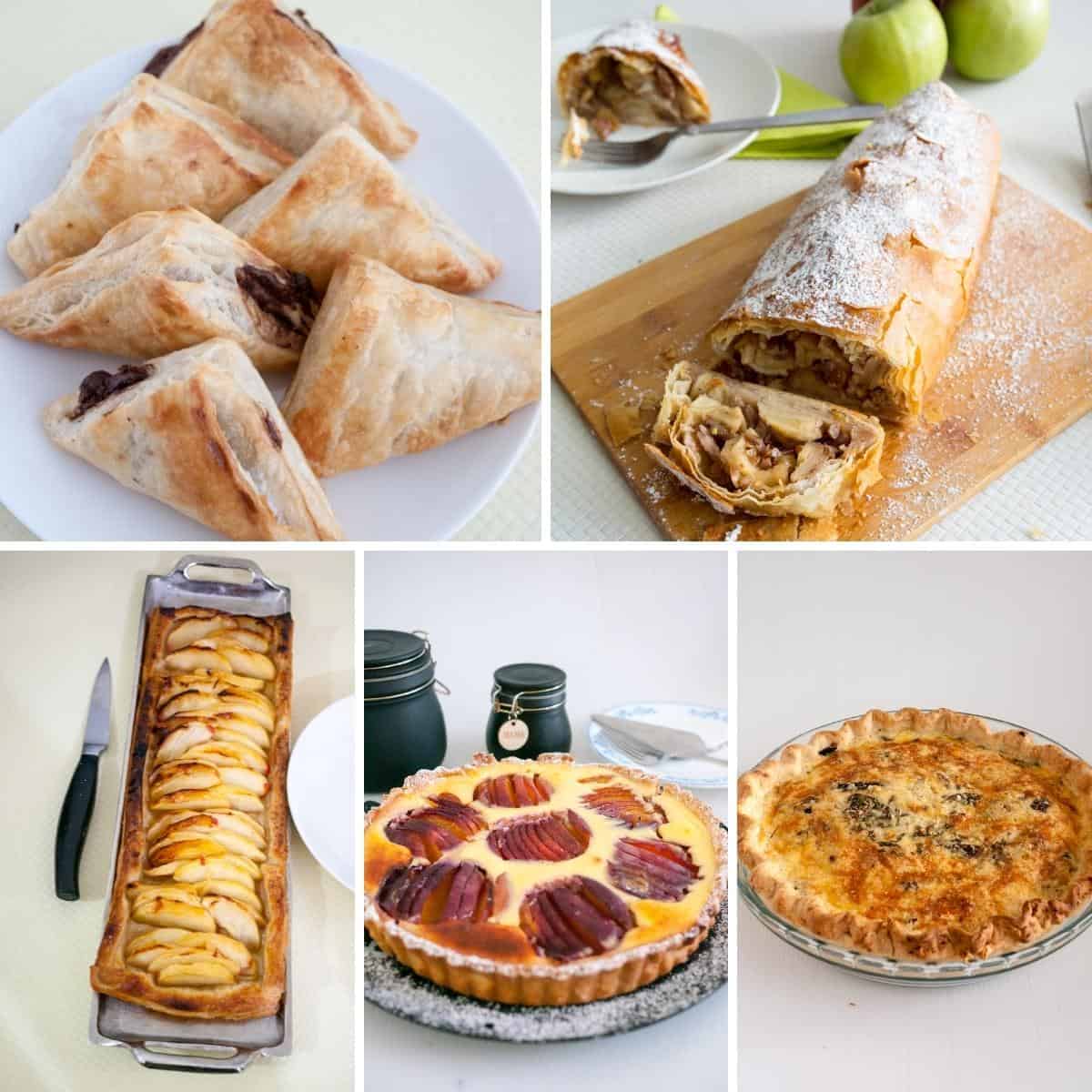
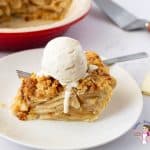
A pie crust or Pate Brisee is a basic pastry dough using flour, butter, and cold water as the main ingredients. You can use it for sweet pies, like apple pie, which uses a double pie crust, or a pecan pie using a single pie crust. You can make a pie crust by hand or using a food processor. And you can also make an all-butter crust or a 50/50 crust.
Sweet shortcrust pastry or Pâte Sucrée is the same as the above pie crust, but sweeter to make sweet tarts. Sucrée means sweet in French. It also has a crumbly texture and uses the same ingredients and method, with the addition of a little sugar. I have shown you how to make shortcrust by hand as well as using a food processor.
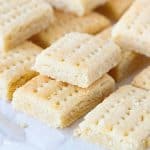
Rich short-crust pastry or Pâte sablée is your dessert pastry with high fat content and a crumbly texture, and is very much like a cookie crust. In addition, it has a higher sugar content. Sablee means sandy or grainy. I have shown you how to make this shortcrust along with three different methods to roll it.
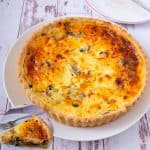
Quiche crust – On this blog, I have also shared a recipe for the quiche crust, which is essentially our basic pie crust made with a little egg yolk. We use it to make all our quiches, as well as for savory dishes like quiches.
Puff pastry, Danish pastry, croissants
Puff pastry
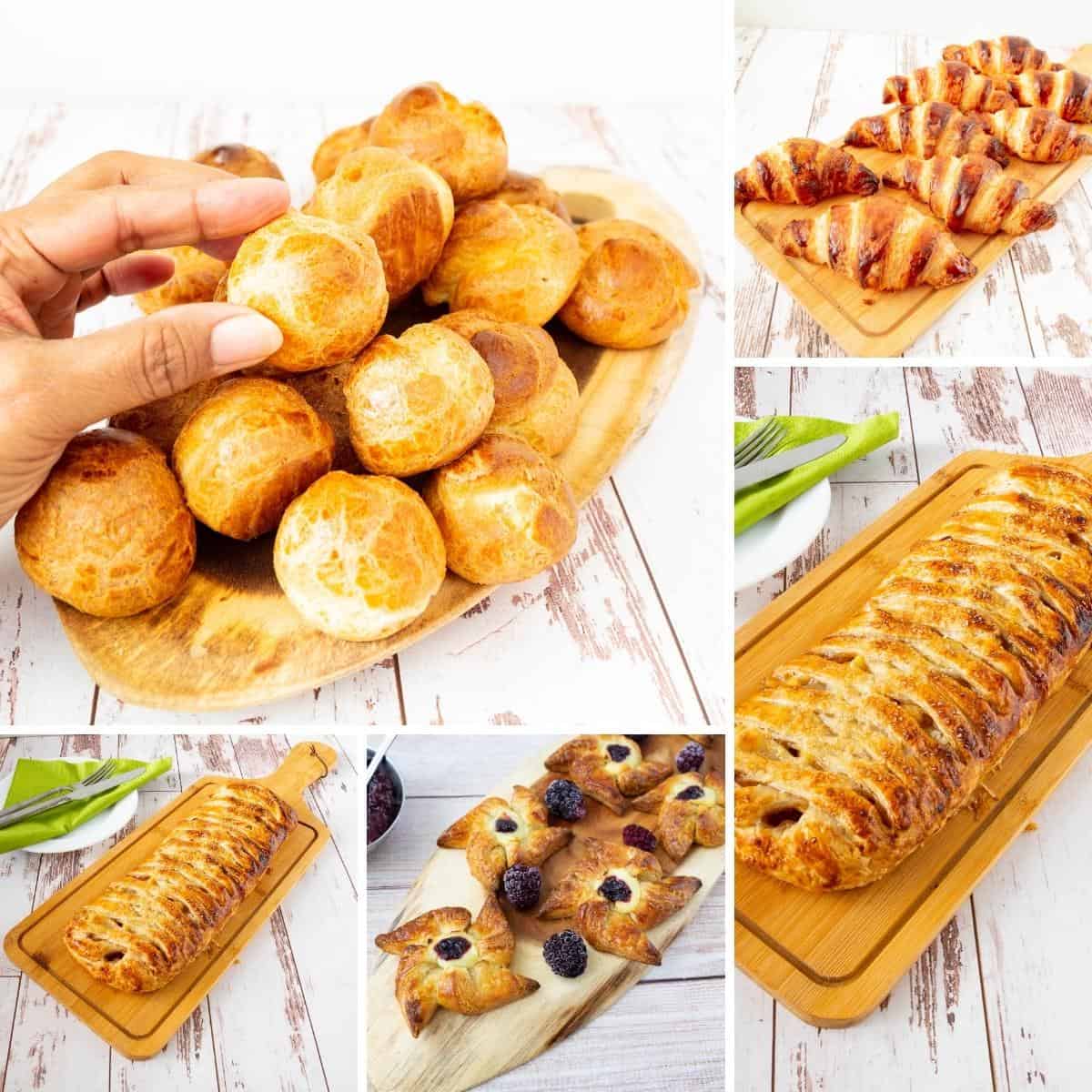
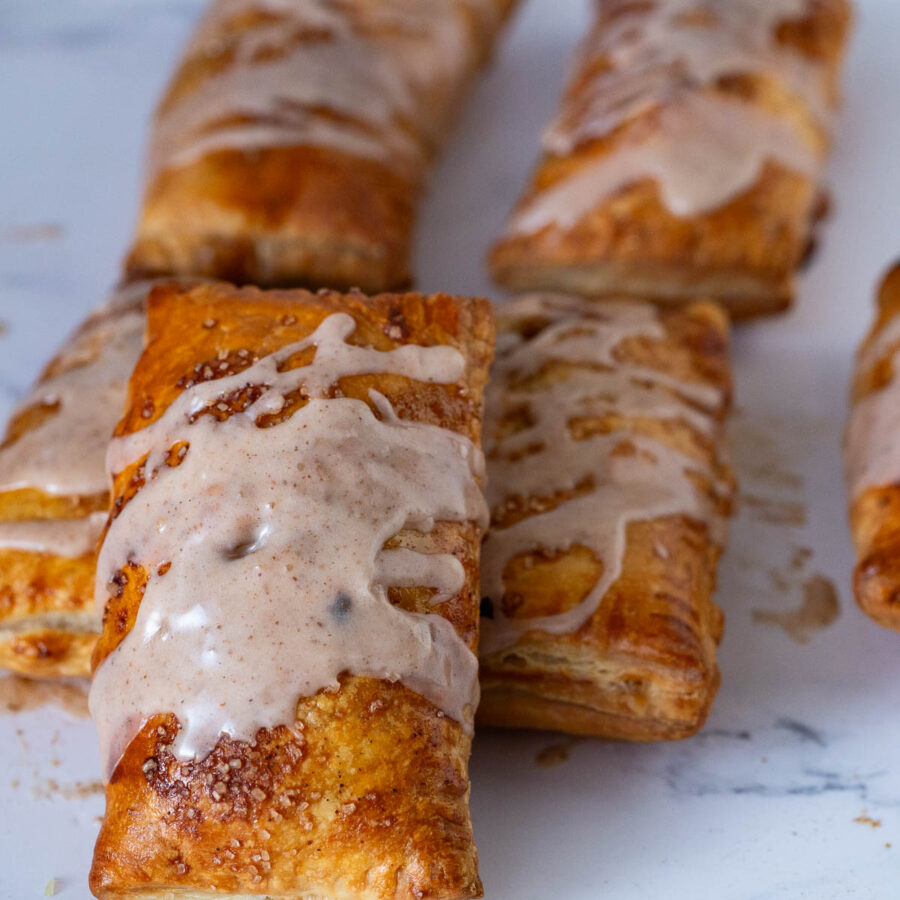
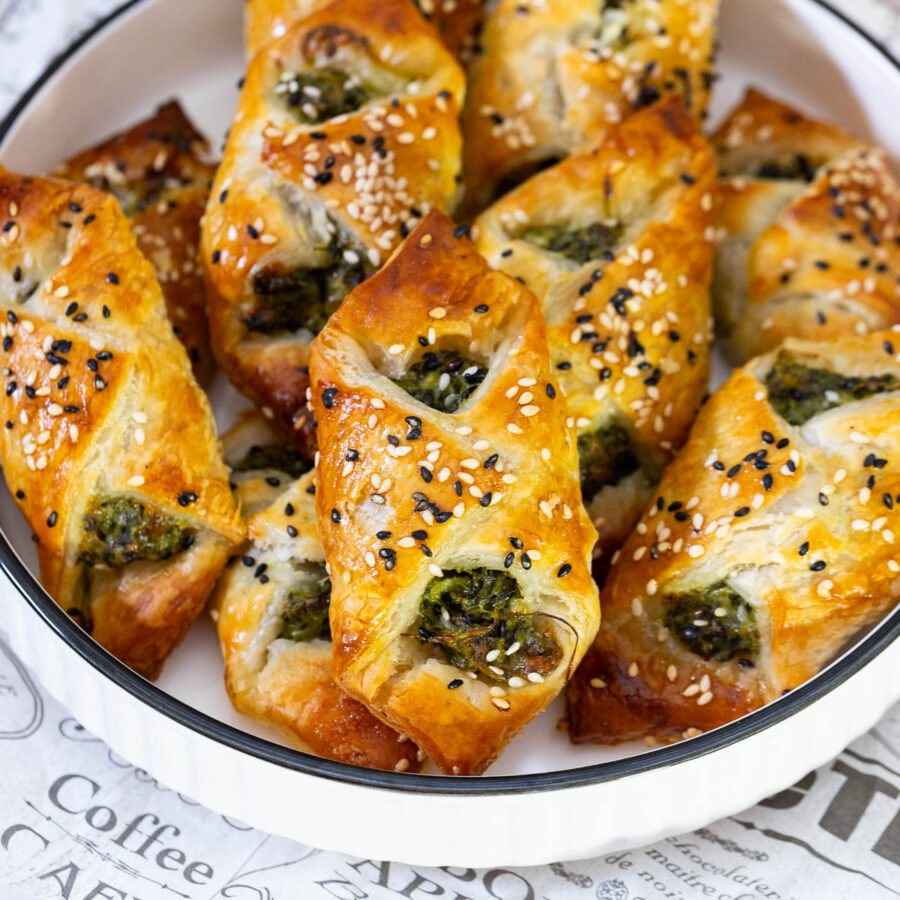
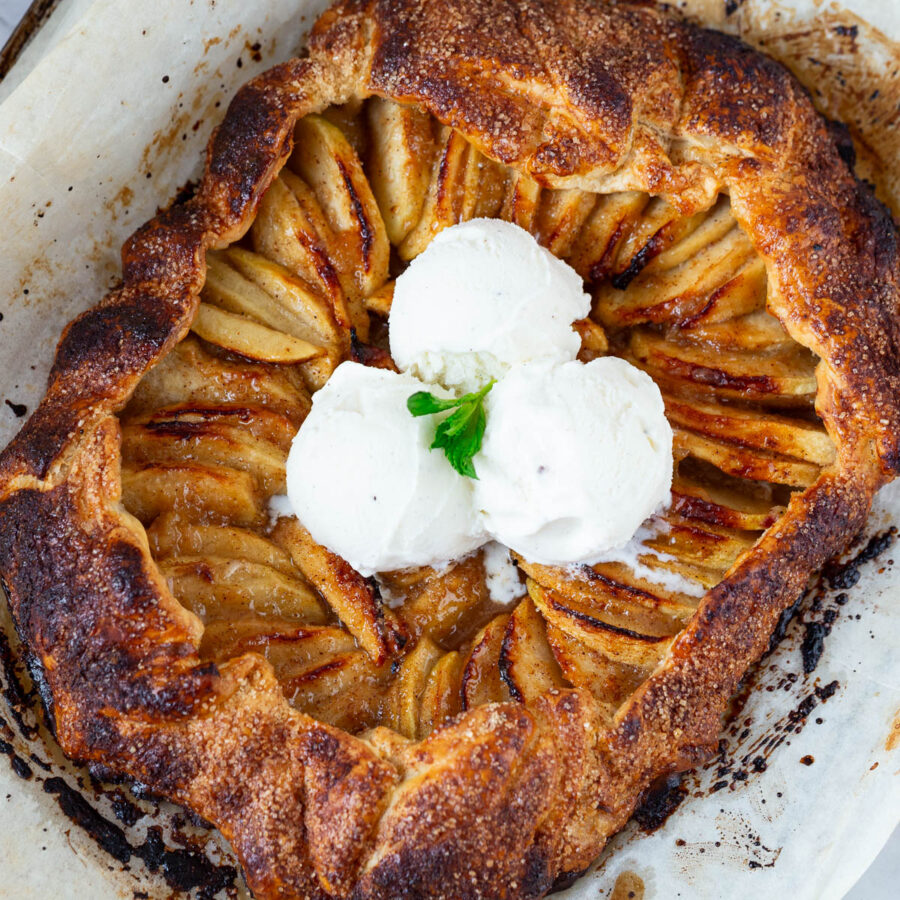
The traditional puff pastry has been around for generations and is the base of many wonderful flaky pastries. The classic puff pastry is also known as Pâte feuilletée. In French, it means layered dough (laminated dough). The layers are made with just three main ingredients: flour, water, and butter. And there is no leavening or yeast in this dough.
The puff pastry is made up of three parts: the flour, known as the détrempe in French, the butter block, which is known as the beurrage, and the Pâton, which means the package of dough by combining the two, flour and butter block into one.
We use it to make savory pies like meat pies, chicken pot pie, and rough puff pastry pizzas, as well as in sweet treats like mille feuilles or Napoleon, Nutella puffs, apple turnovers, cream horns, vol-au-vents, and sausage rolls.
Often, you will also see a recipe for quick puff pastry. This is basically a rough mixture of flour and butter combined. We do create a few layers, but it is not the same as the classic pastry. It is quicker because it does not need any lamination time. The resulting pastry does turn out buttery and flaky, but without even layers of pastry. It tastes delicious and is very close to the classic. Definitely a great substitute if you can’t make the classic.
Danish pastry
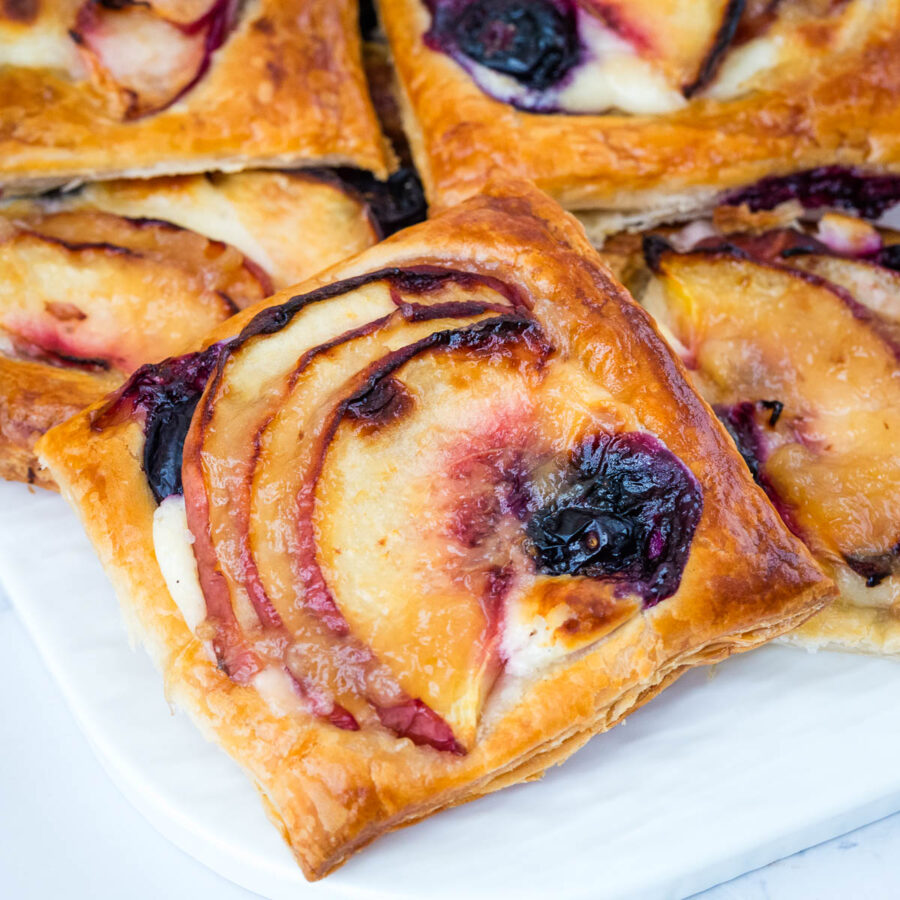
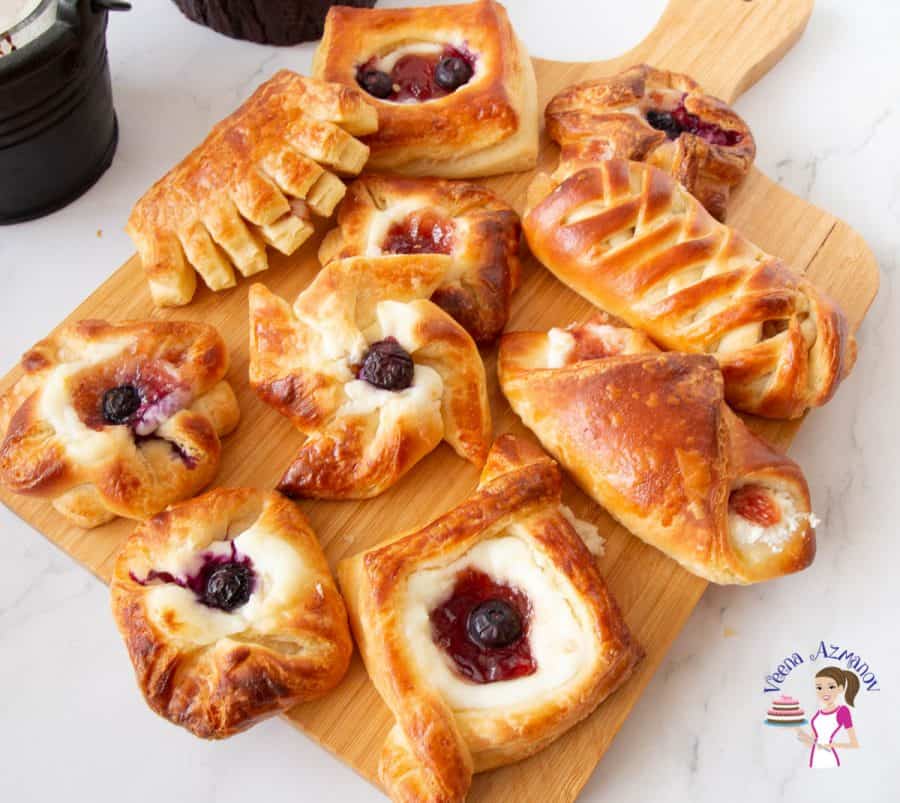
Danish pastry is a buttery, flaky pastry made with a lamination similar to croissants and puff pastry. But, they are sweeter and have more butter and eggs. The Danish dough is not necessarily difficult, but it is time-consuming because we need to chill the dough in between steps.
It’s also a very forgiving dough that’s easy to knead with a stand mixer or by hand. There are three main components to this pastry.
- The dough – this is a simple yeast-based dough with eggs, butter, and sugar. It can be soft and sticky to work with, so don’t skip the chilling times.
- Butter block – yes, it is lots of butter, which we cream with a little flour and then laminate between the dough. The purpose of the flour in the butter is to help stabilize it. Most professionals often skip the flour, but I recommend you use it.
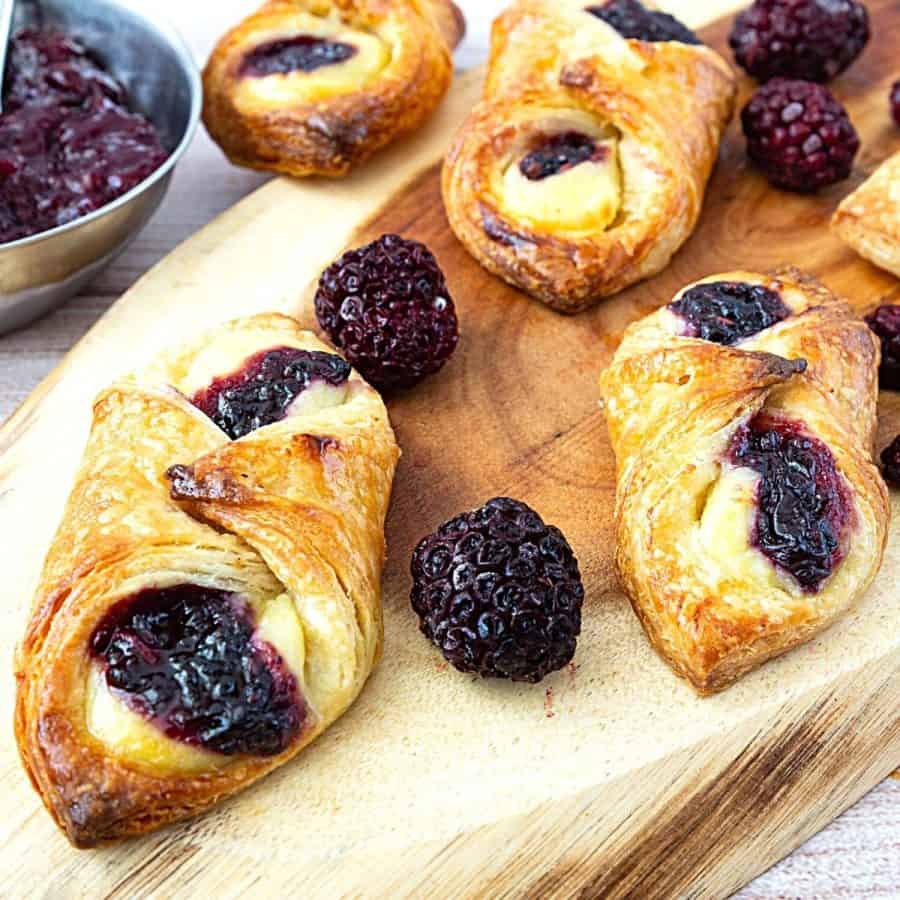
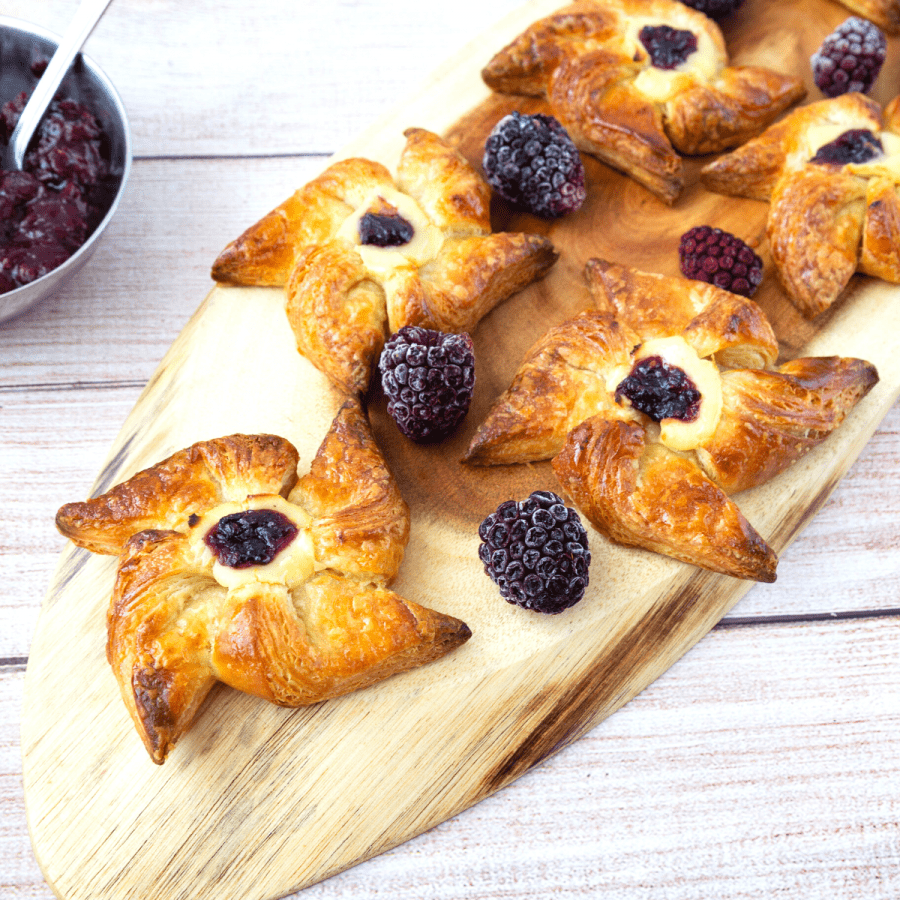
- The fillings – usually, this could often be cream cheese or pastry cream with a fruit filling or jam. It can also be just a fruit filling or jam.
Also, there are many ways to shape the Danish pastry. We have covered this dough in great detail, from the basic dough to shaping the Danish as well as individual pastries like Danish pinwheels, cream cheese cylinders, and pastry cream pain au raisin.

Croissants
‘Croissants de Boulanger’ is a flaky, buttery French pastry that is a yeast-based dough laminated with layers of butter. And then, shaped to create its distinct croissant shape. You will get lots of variations of fillings and shapes made from this basic dough. In this blog, I have made classic croissants as well as some variations, like ham and cheese croissants and chocolate.
There are two main components to this dough:
- The dough – this is a simple yeast-based dough with a small amount of butter and sugar.
- Butter block – this is lots of butter, which we cream with a little flour and then laminate between the dough.
Filo pastry
Of course, let’s not forget the flaky filo or phyllo pastry. Filo is an unleavened pastry of very thin, delicate sheets of dough. It has less moisture content, so it does not rise like puff pastry.
The filo layers are separated by melted butter or oil. They bake crispy and flaky. Often used in desserts like apple strudel, chocolate cigars, and baklava, as well as savory recipes like samosas, spring rolls, or crispy tarts.
Choux pastry – Pate a choux
Choux pastry pronounced ‘shoe pastry’ is a French dough called pate a choux, which means ‘cabbage paste. Well, apparently, the little baked puffs resemble small cabbages. Hence, the name.
The basic high-moisture-content dough is cooked twice. First, it’s cooked on the stovetop. Then, piped into small puffs and baked into the light and airy pastries. You can also fill them to make impressive desserts like cream puffs, profiteroles, éclairs, and churros.
- Cream puffs – Cream puffs are a great way to make impressive desserts that wow your guests. Using homemade choux pastry from scratch, you can fill these with whipped cream for a quick and tasty treat.
- Profiteroles – The classic French dessert profiteroles are made with choux pastry that is light as air. And, they are filled with vanilla pastry cream, whipped cream, or ice cream, and finished with a chocolate glaze.
- Eclairs – The classic eclair also uses the choux pastry dough, but we pipe it into long tubular shapes. Filled with pastry cream, whipped cream, or fruit fillings, etc. Often, with a chocolate glaze, too.
- Churros are deep-fried treats. And yet, do you know that they use choux pastry dough as a base? Yes, instead of baking the choux pastry, we put the dough in a piping bag and deep-fried it until golden and crispy. They are often dusted with cinnamon sugar and served with chocolate sauce or ice cream.
Brioche, biscuits, scones, and rolls
Yes, we often also refer to them as French pastry bread.
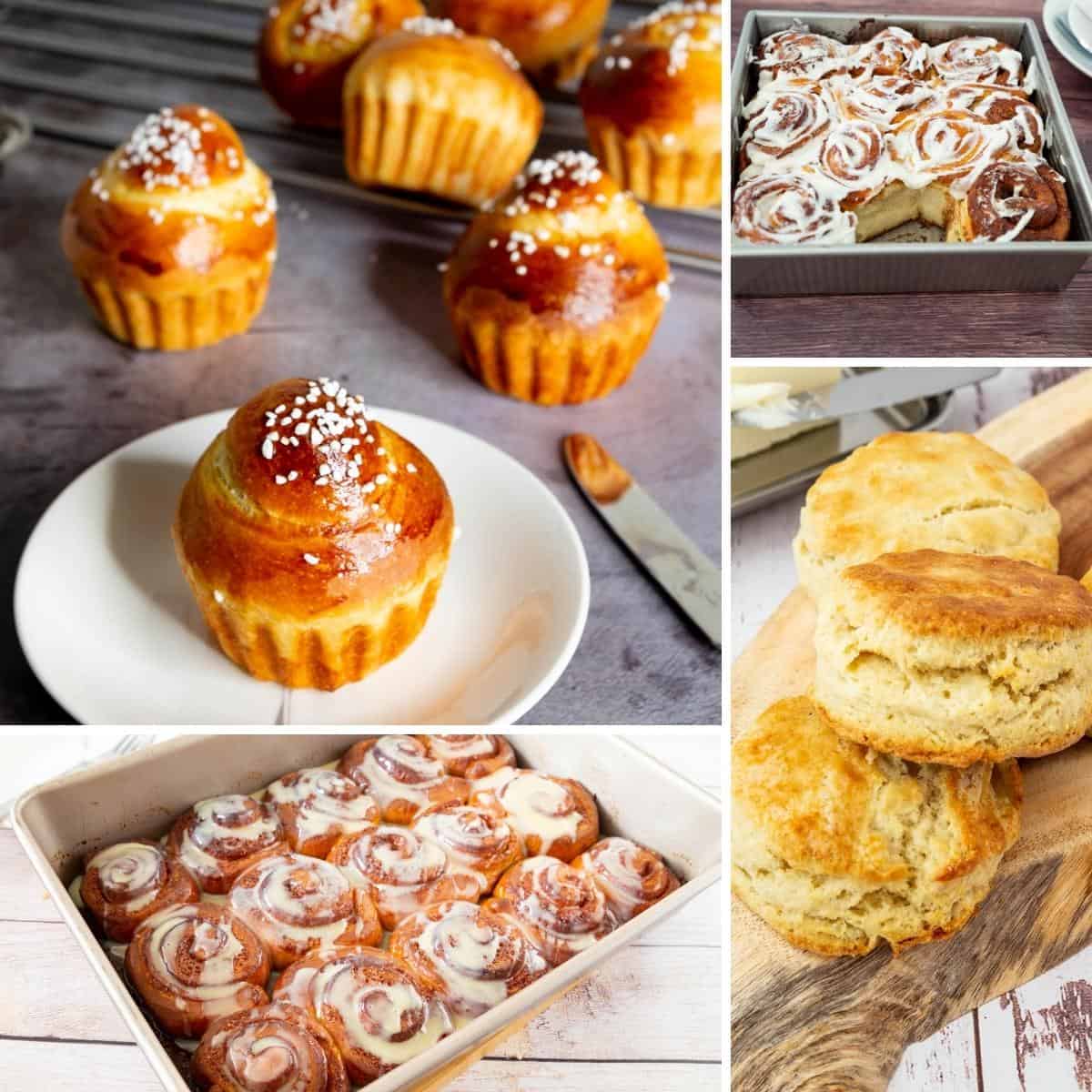
Brioche – Is a pastry that resembles bread. An enriched yeast bread with eggs and lots of butter. It has a rich, tender crumb with soft, light, and airy bread. We made the classic brioche, brioche sandwich bread, and brioche Pullman bread.
Cinnamon rolls – Are also a yeast-dough breakfast pastry bread, which I believe originated in Sweden. It is made with eggs, butter, and layered with cinnamon sugar. Then, topped with cream cheese. The dough is rich with a soft, tender crumb. We made cinnamon rolls topped with cream cheese and cinnamon rolls topped with condensed milk.
Biscuits and scones – We make these very similar to pie crust, but the ratio of butter, flour, and water is different. We often use them as quick-bread pastries served for breakfast, with soups and stews. In fact, you don’t need to chill this dough. You cut the fat into the flour, gather it all into a shaggy dough, roll and cut small discs. Then, you brush it with milk and bake it until golden. We made the classic biscuits, buttermilk biscuits, and cheddar cheese biscuits.
Tips for working with pastry
- First, read the recipe correctly. And, use ingredients at the right temperature. For example, chilled butter has to be firm-chilled, not just cold. This can have a huge impact on the outcome.
- Measure the ingredients using a weight measure, not volume. Also, use liquid measuring cups for liquid ingredients.
- Invest in an oven thermometer to ensure your oven is at the right temperature.
- In addition, a candy thermometer is important when you need to measure sauce, caramels, and chocolate for your pastry.
- When laminating the dough, ensure the butter is cold but not hard. Seal the butter properly so it does not come out.
- Always preheat the oven to the appropriate temperature and make sure the oven is hot before you bake any pastry. A cold oven can melt all the butter out of the pastry, and you will end up with a pool of butter on the bottom.
- Most pastries require to be baked and then chilled. This is the best way to ensure that the butter between the dough layers steams and does not melt.
- You must give yeast doughs enough time to rise, but also never over-proof them.
- Always use the middle rack for baking. And, if you must bake top and bottom, switch the trays halfway through baking. Top to bottom and front to back.
- Use glazes at the right temperature and at the appropriate time.
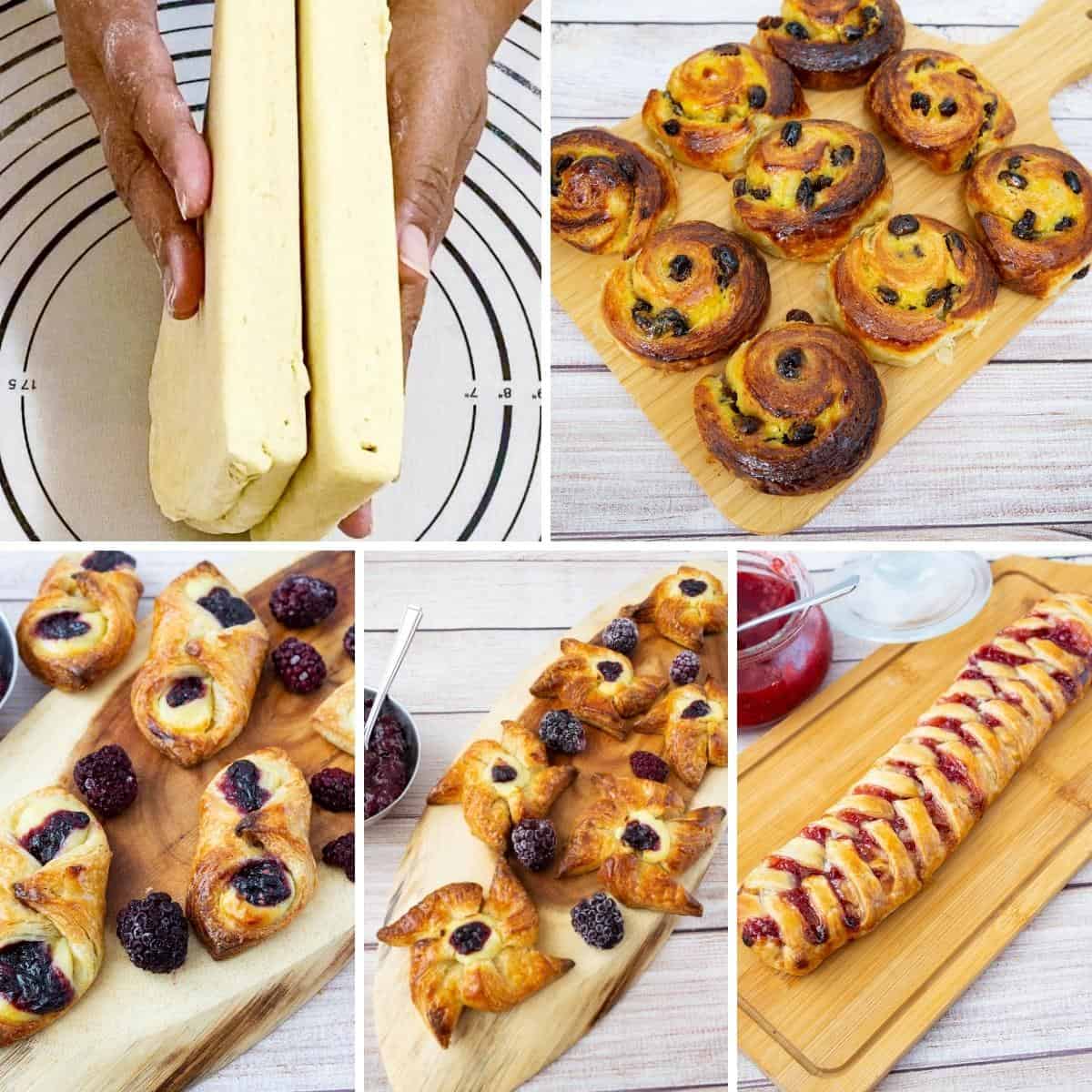
- Choux Pastry Recipe
- Danish Pastry – Dough, filling, and shaping
- Danish pinwheels, cylinders, pain au raisins
- Blackberry Braided Puff Pastry
- Strawberry Braided Pastry
- See all pastry recipes


Frequently asked questions
The word ‘viennoiserie’ means ‘things from Vienna’ in French. It usually refers to pastries such as brioche, croissants, and pain au raisin. These are baked pastries made with yeast-based dough similar to bread. Unlike bread, these are enriched with eggs, butter, cream, etc.
A boulangerie is a French bakery that sells pastries and viennoiseries as well as bread such as baguettes.
‘Patissier’ means baker, and ‘Patisseries’ means pastries in French. A Patissier bakes Patisseries.
Similar. All three are made with choux pastry dough. Profiteroles and cream puffs are little bulbs, while eclairs are long, tubular in shape. Eclairs are best filled with pastry cream, but they can also be filled with whipped cream or ice cream.
No, they are all laminated dough, meaning they are all layers of flour and butter, and yet they are all different from each other.
Puff pastry has no yeast and no eggs.
Croissant dough has the addition of yeast and is made with milk, just like bread, but with lamination.
Danish pastry has yeast as well as eggs.
While puff pastry goes through 6 folds, a croissant goes through just 3 or 4 folds, and a Danish pastry has about 3 turns as well.
Lastly, puff pastry has a flaky, crusty quality, while croissant has a more bread-like quality, and the Danish pastry has a chewier texture.
Don’t lose this recipe! Save it for Later!
📌 Save this Recipe for later on Pinterest so you can easily find it again.
⭐ Add Veena Azmanov Kitchen to your Google Preferred Sources.
It helps Google show you more of our recipes.
📧 Subscribe for new recipes delivered to your inbox.
🎥 Follow us for more recipes

- Braided Apple Puff Pastry
- Profiteroles with Vanilla Pastry Cream
- Tiramisu Cream Puffs or Cheesecake Cream Puffs
- Homemade Croissants Recipe or Chocolate Croissants


Hi, I’m Veena
I’m the recipe developer, baker, and food photographer behind Veena Azmanov Kitchen.
I’ve spent years developing and testing recipes, from everyday meals and homemade breads to cakes and desserts.
I share the practical tips and little details I’ve learned along the way so you can get great results in your own kitchen.
Thanks, Veena, for all the thorough information that does help a lot to have a professional baker’s advice.
Thanks, Adriana
Wow, this was so informative! I’ve been working with pastry for a long time, but I didn’t realize how much I didn’t know about different kinds of pastry until I read all your points on what sets them apart. Very interesting! 😀
Thanks, Shelley. Happy you found it interesting
This post is so informative – I love it! Puff pastry is definitely my fave 🙂
Thanks, Chris
Wow! This is such a helpful guide to all things pastry!! I’ll be coming back to this multiple times as I get more experienced with baking different pastries in my kitchen!
Thanks Anjali
These look so delicious and the tips are very helpful! I can’t wait to make some of these! So excited!
Thanks Beth
What an informative post! Saving this to use as a reference.
Thanks, Pam
I really appreciate all the information in your post. Very educational. I think I love puff pastries the most!
Thanks Jess. Yes, I do love puff pastry too.
This is such a great article, very informative. And I’m just drooling over all these gorgeous pastries!
Thanks Michelle
You have me craving a big pile of pastries and coffee now. This is a really detailed post.
I hear you. Dannii.
I may be drooling over here a little, we love pastries in this house. I am for sure going to give the Croissant ones a try first!
Thanks Jessie.