

Vanilla pastry cream is also known as Crème pâtissière in French. It is a perfect base for many desserts such as fruit tarts, mousses, Bavarian creams, ice cream, and more. Made by tempering egg yolks with hot milk, then cooking them gently to achieve a smooth, creamy, velvety cream.

What is pastry cream?
- Often referred to as custard, pastry cream is a milk-based cream used in a variety of desserts. It is made with milk, sugar, vanilla, and thickened with cornstarch and egg.
- Creme Patissiere is a thicker version of the cream made with exactly the same ingredients!
- Professionals often make this custard as an ingredient to fill in their desserts, but truthfully, it is a delicious treat on its own. So, ff you ever need to make a fruit dessert and find yourself short on time, this is one of the simplest, easiest, and not to mention, quickest desserts you can make.
- In fact, if you like making desserts, this is one recipe you will need to master so you can use it to fill pastries such as croissants, Danishes, choux pastry, and entremets.
- The best part is that the list of ingredients is very short (5 ingredients), and most of them are easy to find or pantry staples.
- And this recipe takes no more than 15 minutes to make.
- This is the classic recipe often used by professionals that involves tempering the egg yolk mixture. The process of tempering can be intimidating to homebakers, so there is also an easier one-pot method to make pastry cream without tempering the eggs.
- And of course, those of you who can eat eggs, there is also an eggless pastry cream that’s made with just cornstarch or custard powder.

Ingredients and substitutes
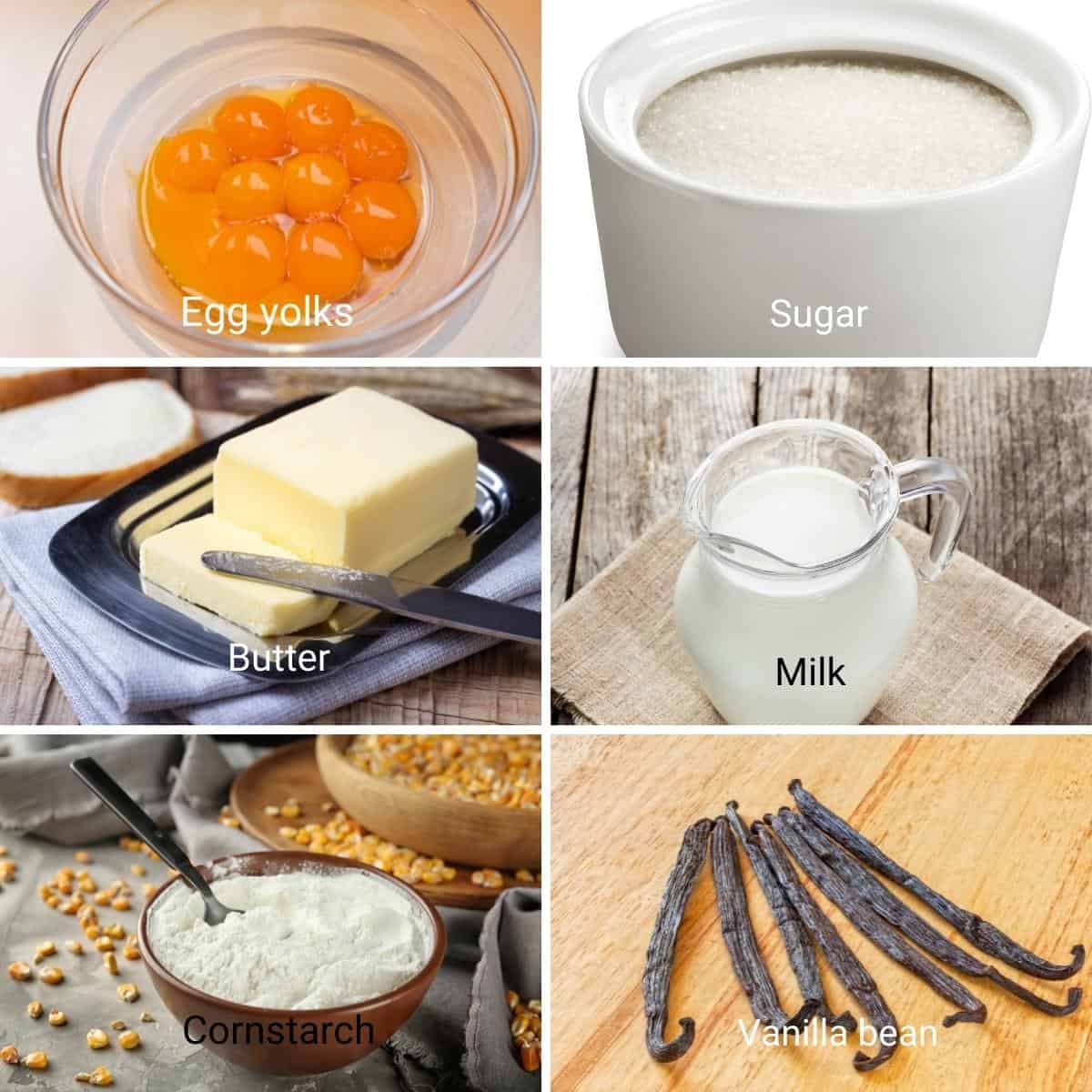
- Milk – Use regular full-fat milk, not low-fat milk. Milk is one of the main ingredients here, so make sure you use at least 3% fat. Low-fat will just not thicken enough.
- Egg yolks – We do need good-quality, large egg yolks here. It’s what gives the pastry cream its richness. The egg yolks also contribute to the color of the final product. So, I prefer to use organic eggs with a light orange color. Again, this is optional; the regular egg yolks work just fine.
- Vanilla – You also must use good-quality vanilla for this pastry cream. It does make a huge difference. I use a vanilla bean, but you can also use 2 tbsp vanilla bean paste or 2 tbsp vanilla extract.
- Cornstarch – In addition to the egg, this cornstarch will help thicken the custard even more. The consistency of your custard can be changed by using less or more cornstarch. If you can’t use cornstarch, tapioca flour, all-purpose flour, or potato starch can also be used. However, you may need to use less or more because every starch will give you a different consistency. You may need to play with the amounts.
- Butter – just a little bit of butter adds richness and a lovely shine to the pastry cream. But you can omit it as well.
How to make pastry cream
- Heat milk – Pour milk into a heavy-bottomed saucepan over medium heat. Cut the vanilla pod in half lengthwise, open the pod, and scrape the seeds. Add the pod and the scrapings, and bring the milk to a boil.
- In a separate mixing bowl, mix the egg yolks, sugar, salt, and cornstarch. Whisk until light and almost foamy. You want to get the sugar to almost dissolve. Once the milk is ready. Reduce heat. Remove the pot of milk from the heat.
Pro tip – Use a mixing bowl large enough to hold the milk.

- Tempering the milk – Carefully and gently – pour some of the hot milk mixture into the egg mixture while still continuously stirring or whisking to prevent the eggs from curdling.
- Once more than half the milk has been poured into the egg mixture, the eggs have been tempered. Now, transfer all the milk and egg mixture back into the saucepan.
- Then, place the pan back over medium-low heat and continue cooking the pastry cream, stirring constantly. When the pastry cream is thick and coats the back of a wooden spoon or spatula, add the butter and take it off the heat.
Pro tip – The liquid will transform from a foamy liquid to a thick custard with no foam at all.

- Strain through a mesh or sieve; discard the vanilla pod and any curdled eggs. Cover the surface of the pastry cream with plastic wrap.
Pro tip – Straining will also give the cream a smooth texture and take away any curdled or thickened milk solids. - Let it cool completely before you store it in the fridge or use it as stated in the desired recipe.

Storage
- Crème pâtissière has to be stored in the refrigerator because it contains eggs and milk. Never leave creme patisserie at room temperature.
- Always place the plastic wrap over the surface of the pastry cream; this will prevent skin from forming.
- This can be stored in the fridge for 3 to 4 days only.
- You cannot freeze creme patisserie because when thawed, it tends to break down. The starch and egg protein separate.

Tips for success
- Always use good-quality ingredients – fresh eggs are very important for this recipe.
- Heat the milk with the vanilla bean for a few minutes before you temper the egg yolks. This lets the milk infuse with vanilla, resulting in a wonderful, rich vanilla flavor.
- Whip the egg yolks, sugar, and starch with a whisk until light and fluffy to prevent lumps.
- There is no need to rush the tempering process. Take your time and pour the hot milk mixture a little at a time. What is important is that you continue to move the egg mixture while pouring the milk to prevent curdling.
- A whisk or wooden spoon works great when stirring to prevent lumps
- You must stir all the time – this will prevent the milk and egg from curdling, and you will have a silky smooth custard.
- Stirring can be very boring, but it is important to keep the heat medium-low and stir constantly. Medium-high heat can easily burn the milk solids. You want the mixture to cook and thicken at the same time. If you thicken it too quickly, it may curdle or remain undercooked. The slow process helps cook the eggs and the cornstarch. The mixture will look reduced in quantity when thickened.
- This mixture will continue to thicken as it cools and chills in the fridge.
- Straining is necessary to remove any lumps, giving you a smooth, velvety, creamy pastry.
- Always cover the top surface of the custard to prevent any skin from forming. If you don’t, that skin will later result in lumpy pastry cream, which can block the piping bags.

Variations
- Creme Anglaise – this is a custard sauce or a pouring version of this recipe. It is often used as a sauce to serve with cakes, brownies, and pastries. The simplest way to make it is to use less cornstarch and thicken it for less time. Reduce cornstarch by 1 tbsp and remove while still pouring consistency.
- Creme Patissiere – A thicker version made with additional cornstarch. The purpose of this is to use it as a filling in cakes, desserts, and pastries so it won’t flow out. In order to thicken the custard longer, additional cornstarch is used, which also prevents the eggs from curdling. Add 1 additional tablespoon of cornstarch and cook until the cream is thicker.
- Crème chantilly – a combination of pastry cream with sweetened whipped cream. I like an equal quantity of pastry cream and whipped cream.
- Creme legere – is a thick creme patissiere with sweetened whipped cream. (Same amount as chantilly).
- Diplomat cream – a combination of pastry cream or creme patissiere with stabilized whipped cream. The gelatin in the whipped cream helps keep the cream longer. (Same amount as chantilly)
- Creme bavarios is a dessert made with custard or pastry cream, whipped cream, and gelatin, which helps set like a pudding. Try my
- Custard cake filling – I like to add some all-purpose flour along with cornstarch to make a cake filling. This helps thicken the pastry cream, making it stable for filling between layers of a cake.

How to use pastry cream (creme patisserie)
- Very commonly used with choux pastry, such as in classic profiteroles, mille-feuille, and chocolate eclairs.
- You can also use pastry cream as a cake filling between layers for a layered cake.
- Add some strawberry puree and whipped cream to creme patisserie to make a quick strawberry mousse.
- And, add some melted chocolate and whipped cream to the pastry cream to make a quick chocolate mousse.
- Spread creme patisserie evenly in a pre-baked tart shell, topped with your favorite fruits, and you have a fruit tart.
- Also, you find it often used in most bakeries and restaurants as a filling for cakes and pastries.
- In addition, one of the easiest desserts you can create is a fruit tart with vanilla pastry cream as a base, topped with fresh fruits, as I did in my Blueberry Tart or Fresh Strawberry Tart.
Troubleshooting
- Why is my pastry cream curdled?
Pastry cream needs to be cooked slowly on medium to low heat. Too high heat can cause the eggs to scramble and curdle, which results in lumpy pastry cream. - Lumpy cream
I prefer to use a whisk and cook pastry cream on medium-low heat to keep things moving and homogenous. If the heat is high and the mixing is not even, the custard can get lumpy. Remove it from the heat, whisk it well, and return it to low heat to continue cooking. Adjust the heat accordingly. - Too thin
Crème pâtissière needs to be cooked until it is thick enough to coat the back of a spoon. If you take it off too quickly, it will be thin and often undercooked. - Too thick
Too much starch can cause the custard to be too thick or sometimes doughy. So, always measure the ingredients well and use only the amount stated in the recipe. You can thin down a thick creme patisserie by adding a little whipped cream.
More custard-based recipes
- Creme Brulee, Apricot Creme Brûlée, Pumpkin Creme Brûlée
- Creme Caramel – flan, Creme Caramel Apricot Flan
- Panna Cotta – Strawberry, Mango, Blackberry, Blueberry,
- Chocolate Soufflé Tart, Pumpkin Soufflé
- See all custard desserts or see all dessert recipes
- See all custard-based desserts


Frequently asked questions
You can make a dairy-free custard by simply substituting the milk in the recipe with almond milk, coconut milk, or soy milk. Coconut milk is my favorite, and I often use it when I make coconut mousse.
Yes, this Crème pâtissière is made with cornstarch instead of flour. In the past, all-purpose flour was often used to thicken custard. And yet, these days, almost everybody uses cornstarch. But, if you are allergic to gluten, it would be best to check with the kitchen first just to make sure.
Yes, I do make an eggless Crème pâtissière, and you won’t even guess it’s eggless.
You cannot freeze creme patisserie because when thawed, it tends to break down. The starch and egg protein separate. As it thaws, you will find the liquid separates from the solids, which does not smooth even with a whisk.

Vanilla Pastry Cream or Creme Patisserie
Ingredients
- 6 Egg yolks large
- ¾ cup (150 g) Granulated sugar
- 6 tbsp (85 g) Cornstarch
- 3 cups (700 ml) Whole milk
- 1 Vanilla bean OR 1 tsp vanilla bean paste
- ½ tsp Salt
- 2 tbsp Butter (optional)
Instructions
- Heat milk – Pour milk in a heavy bottom saucepan over medium heat. Cut the vanilla bean in half length-ways, open the pod and scrape the seed. Add the pod as well as the scrapings and let the milk come to a boil.
- In a separate mixing bowl, mix the egg yolks, sugar, salt, and cornstarch/cornflour. Whisk until light and almost foamy. You want to get the sugar to almost dissolve. Once the milk is ready. Reduce heat. Remove the pot of milk from the heat. Pro tip – Use a mixing bowl large enough to accommodate the milk.
- Tempering the milk – Carefully and gently – pour some of the hot milk mixture into the egg mixture while still continuously stirring or whisking to prevent the eggs from curdling.
- Once more than half the milk has been poured into the eggs mixture the eggs have been tempered. Now, transfer all the milk and egg mixture back into the saucepan.
- Then, place the pan back on medium-low heat and continue to cook the pastry cream stirring all the time. When the pastry cream is thick and coats the back of a wooden spoon or spatula add the butter and take it off the heat.Pro tip – The liquid will transform from a foamy liquid to a thick custard with no foam at all.
- Strain through a mesh or sieve – discard the vanilla pod as well as any curdled eggs. Cover the surface of the pastry cream with plastic wrap.Pro tip – straining will ensure a smooth texture and remove any curdled or thickened milk solids.
- Let cool completely before you store in the fridge or use as stated in the desired recipe.
Video
Notes
- Always use good quality ingredients – fresh eggs are very important for this recipe.
- Heat the milk with the vanilla bean for a few minutes before you temper the egg yolks. This lets the milk infuse with the vanilla and results in a wonderful rich vanilla flavor.
- Whip the egg yolks, sugar, and starch with a whisk until light and fluffy to prevent lumps.
- There is no need to rush the tempering process. Take your time and pour the hot milk mixture a little at a time. What is important, is that you continue to move the egg mixture while pouring the milk to prevent curdling.
- A whisk or wooden spoon works great when stirring to prevent lumps
- You must stir all the time – this will prevent the milk and egg from curdling and you will have a silky smooth custard.
- Stirring can be very boring but it is important to keep the heat med-low and stir constantly. Medium-high heat can cause the milk solids to burn easily.
You want the mixture to cook and thicken at the same time. If you thicken it too fast, it may curdle but it may also be undercooked. The slow process helps cook the eggs as well as the cornstarch. The mixture will look reduced in quantity when thickened. - This mixture will continue to thicken as it cools and chills in the fridge.
- Straining is necessary to remove any lumps – giving you a smooth velvety creamy pastry.
- Always cover the top surface of the custard to prevent any skin from forming. If you don’t that skin will later result in lumpy pastry cream which can block the piping bags.
Storage
- Vanilla pastry cream has to be stored in the fridge because it contains eggs and milk. Never leave creme patisserie at room temperature.
- Always place the plastic wrap over the surface of the pastry cream, this will prevent a skin from forming.
- This can be stored in the fridge for 3 to 4 days only.
- You cannot freeze creme patisserie because when thawed it tends to break down. The starch and egg protein separate.


Made this recipe?
I’d love to see how yours turned out! Share a photo on Instagram and tag @veenaazmanov_kitchen or use #veenaazmanovkitchen. And don’t forget to leave a rating and review!
Don’t lose this recipe! Save it for Later!
📌 Save this Recipe for later on Pinterest so you can easily find it again.
⭐ Add Veena Azmanov Kitchen to your Google Preferred Sources.
It helps Google show you more of our recipes.
📧 Subscribe for new recipes delivered to your inbox.
🎥 Follow us for more recipes

Hi, I’m Veena
I’m the recipe developer, baker, and food photographer behind Veena Azmanov Kitchen.
I’ve spent years developing and testing recipes, from everyday meals and homemade breads to cakes and desserts.
I share the practical tips and little details I’ve learned along the way so you can get great results in your own kitchen.




Pastry Day 11 Done
Pastry Day 11 Done
Pastry cream done
I’ve tried to make crème pâtissière maybe 3 times over the past 8 years, and each time, the result was… disappointing, to say the least! I made one that was lumpy and curdled, and I made one that was practically soup, but I could never seem to land happily in the middle! Despite past failures, I decided to try and make a berry tart this week. I hadn’t used this recipe before, and I went into it prepared for the possibility that I’d be wasting 6 eggs and 3 cups of milk on yet another culinary disaster. But guess what? As I sit here typing this, I have a plastic-wrapped bowl of thick, creamy, gorgeously vanilla-scented crème pâtissière chilling in my fridge! I followed the recipe almost exactly, except that I used 7 egg yolks (my eggs were on the smaller side) and I used a stand mixer instead of trying to whisk by hand. I don’t think I could have pulled it off without a stand mixer (or a second person with strong arms!) because you really do have to whisk vigorously and constantly. Also, I learned a good lesson doing this recipe for the first time: trust that the foam WILL turn into custard… and don’t rush the process! After adding the milk and pouring everything back into the pot, my mixture was SO foamy that I couldn’t quite believe it was going to thicken up. I turned the heat to medium-low per the instructions, but after a few minutes, there was very little change, so I got impatient, and I turned up the heat. Mistake! The foam turned into thick custard SO quickly that I had to scramble to turn off the heat and get the custard into a bowl before accidentally cooking it into a curdled mess. Thankfully, I was able to do that, but next time I use this recipe, I will remind myself to be patient so I don’t have to panic at the last minute!
Thank you, Adira. So happy to hear you enjoyed this recipe. Thanks for the feedback
Thank you very much for sharing your recipes, I really appreciate
You are very welcome Tabitha. So happy you find my blog useful.
Made this last week – perfect.
Thank you, Wiley. So happy you had success with this recipe and enjoyed it too. Thanks for coming back to write this comment. Appreciate feedback. Have a great day.
Tried this recipe a few times. Works perfectly. I usually have the problem that I cook too long and then it curdles. With the video, I was able to stop just at the right time. So then I made it again a few times. Thanks for the detailed video
Thank you, Sam. So happy to hear you had success with this recipe and that you enjoyed it. So glad the video was helpful. Thank you for coming back to write this feedback. Have a wonderful weekend.
Question, in the video it shows you adding salt. No mention in the recipe instructions. Are we supposed to add salt? If so how much? Excited to try this out.
Thank you Kat, yes you add salt in the yolks as well.
Thanks for this recipe Veena. I had a beautiful mandarin tart in a restaurant recently and decided to recreate it. I knew that it contained a Yuzu flavoured Base and creme patisserie with Mandarin oranges on top but had to adapt it from an orange tart recipe I found. The pastry was good and my homemade Yuzu curd Base was great but the creme patisserie was awful! I have substituted your recipe for the original one adapted it is so very much better. I also used tinned mandarins this time as the fresh ones were too sour. Many thanks for rescuing my tart.
Thank you, Sonia. So happy to hear my recipe saved your favorite dessert. I love this French Pastry Cream very much too and I know how important it is in desserts. Thank you so coming back to write this feedback. Appreciate it very much.
How to make without egg ? What i will use substitute of egg
You can use my eggless vanilla pastry cream recipe
How long do you stir after you put the mixture back in the pot?
I might have missed that bit…but I’m new to baking and wanted to make sure. 🙂
Daphne. You stir until the mixture becomes thick and coats the back of a wooden spoon. Thanks