
Whether you’re a seasoned baker or just starting, mastering the art of stacking cakes is essential for creating beautiful and structurally sound multi-tiered cakes. In this tutorial, we’ll walk you through the process of leveling, filling, frosting, doweling and stacking cakes, providing tips and tricks along the way to ensure your cakes are stable and stunning. Whether you’re preparing for a special occasion or just want to elevate your baking skills, this guide is for you.

Stacking a cake refers to the process of placing multiple cake layers on top of each other to create a tiered cake. This is commonly done for cakes with two or more layers, such as wedding cakes or celebration cakes. Stacking typically involves placing a layer of frosting or filling between each cake layer to create a cohesive, layered cake. Dowels or other supports are often used to ensure the stability of the stacked layers, especially for taller or more elaborate cakes.
Step-by-step: Level, Torte, fill, and frost the cakes
Torting, filling, and frosting a cake is a process that involves layering multiple cake rounds with filling and then covering the entire cake with frosting. Here’s a step-by-step guide:
Torting and Filling
- Level the Cakes: Use a long serrated knife to trim the domed tops of the cakes, making them level.
- Cut the Cakes: Carefully cut each cake horizontally into even layers. You can use a cake leveler or the serrated knife for this.
- Prepare the Filling: Make your desired filling, such as buttercream, ganache, fruit preserves, or pudding. Ensure the filling is spreadable but not too runny.
- Layer the Cake: Place one cake layer on a cake board or plate. Spread a thin layer of filling evenly over the cake.
- Add More Layers: Continue layering cake and filling, making sure each layer is level and evenly distributed.
- Stack the Cake: Place the final cake layer on top, cut side down, to create a flat top surface.

Frosting the Cake
- Crumb Coat: Apply a thin layer of frosting, known as a crumb coat, to the entire cake. This helps seal in crumbs and provides a smooth base for the final coat of frosting. Chill the cake for about 30 minutes to set the crumb coat.
- Final Coat: Apply a thicker layer of frosting to the entire cake, starting with the top and then the sides. Use a spatula to spread the frosting evenly, working quickly to prevent crumbs from mixing into the frosting.
- Smooth the Frosting: Use a bench scraper or offset spatula to smooth the frosting, starting with the top and then the sides. Hold the scraper or spatula at a slight angle and rotate the turntable to create a smooth finish.
- Decorate (Optional): Once the cake is frosted, you can decorate it as desired with piping, fondant, sprinkles, or other decorations.
- Do the same for all cakes: If you have more cakes, follow the same process as above to fill, frost, and decorate the cakes.
- Chill the Cake: Refrigerate the cakes for at least an hour or overnight to allow the frosting to set before stacking.
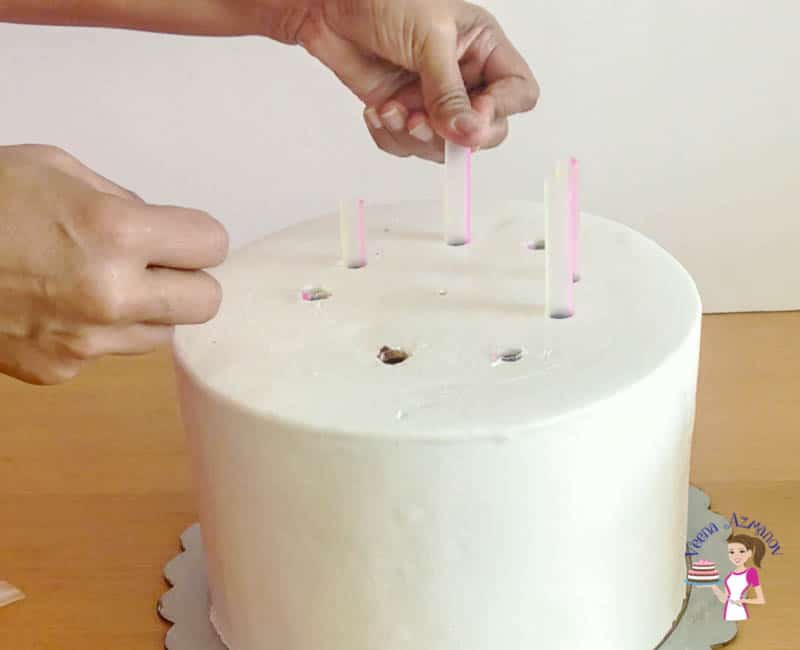
What does doweling a cake mean?
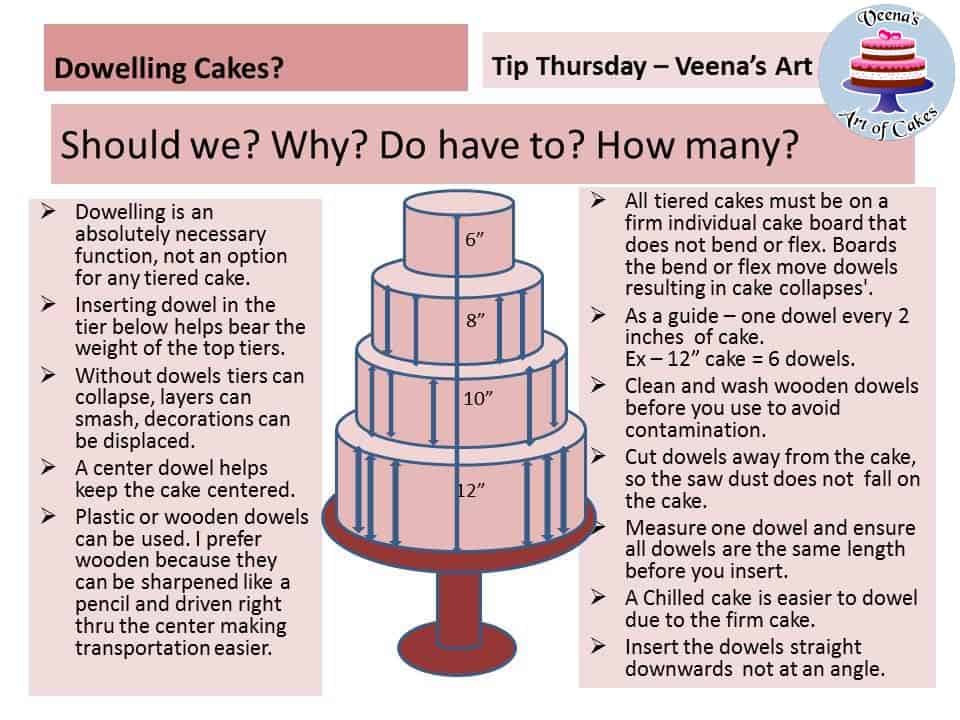
Doweling a cake refers to the process of inserting dowels or other supports into the cake tiers to provide stability when stacking multiple layers. Dowels are usually inserted into the lower tiers to support the weight of the tiers above them. This is especially important for tiered cakes to prevent the layers from collapsing or shifting during transport or display. Doweling helps distribute the weight evenly and ensures that the cake remains stable and secure.
Doweling a cake before stacking is necessary for several reasons:
- Support: Dowels provide support for the upper tiers of the cake, distributing the weight evenly and preventing them from collapsing into the lower tiers.
- Stability: Dowels help stabilize the cake layers, especially during transportation or if the cake is on display for an extended period.
- Prevent shifting: Dowels help prevent the cake layers from shifting or sliding, which can happen if the cake is not properly supported.
- Structural integrity: Doweling ensures that the cake maintains its shape and structure, especially for tall or multi-tiered cakes.
- Safety: Doweling reduces the risk of the cake collapsing, which could be dangerous, especially for large or heavy cakes.
Overall, doweling is essential for ensuring that stacked cakes are structurally sound, stable, and safe to serve.
How do I know if I must dowel a cake?
Deciding whether to dowel a cake depends on several factors, including the size, weight, and design of the cake. Here are some guidelines to help you decide:
- Number of tiers: Generally, cakes with two or more tiers should be doweled to provide support for the upper tiers. Single-tier cakes may not require doweling unless they are exceptionally large or heavy.
- Height of tiers: Taller tiers are more likely to need doweling to prevent them from collapsing under their weight. Shorter tiers may be stable enough without doweling, especially if the cake is not too heavy.
- Weight of decorations: If the cake is heavily decorated with fondant, gum paste flowers, or other heavy decorations, doweling may be necessary to support the weight of these decorations.
- Transportation: If the cake needs to be transported, doweling is essential to ensure that the tiers remain stable and intact during transit.
- Customer preference: Some customers may prefer to have all cakes, even single-tier cakes, doweled for added stability and peace of mind.
In general, it’s better to err on the side of caution and dowel a cake if you are unsure whether it needs it. It’s also a good idea to follow best practices for stacking and doweling cakes to ensure that they are stable and secure.

Types of dowels used to stack cakes
- Wooden dowels – Make sure you buy the firm wooden dowels as some dowels sold at craft shops are too delicate and will not hold under multiple tiers.
- Plastic Dowel – These plastic cake dowels are the most popular in the UK and can be easily found in most cake shops.
- Bubble Straws – These bubble straws are thicker than the usual straws and are usually easier and cheaper to buy. Most often, it’s best to use a few extra of these just because they are more flexible than the firm wooden straws.
- PVC plastic straws – These are the thick water PVC pipes that are usually used in cakes that have more structure. These are considered acceptable because they are used for water.
- Metal dowels: Metal dowels are strong and can support heavy cakes. However, they are not as common as wooden or plastic dowels and can be harder to cut to size.
Step-by-step: How to stack a cake with dowels?
Stacking a three-tier cake with dowels requires precision and care to ensure the tiers are properly supported. Here’s a general guide on how to do it:
- Prepare the cakes: Bake and cool your cakes. Level them if necessary to create a flat surface.
- Choose dowels: Select food-safe dowels (like wooden or plastic dowels) that are sturdy enough to support the weight of the tiers. You’ll need a central dowel that runs through all tiers, as well as additional dowels for support in each tier.
- Mark and cut the dowels: For each tier, measure the height of the cake and cut dowels slightly shorter to ensure they won’t poke through the top of the cake. You’ll need four to six dowels for each tier, spaced evenly in a circle near the center.

- Stack the bottom two tiers: Place the largest tier on your serving plate or board. Push the central dowel through the center of the cake, stopping just above the top surface. Insert the shorter dowels in a circle within the area where the next tier will sit.
- Add the next tier: Carefully place the next tier on top, ensuring it’s centered. The dowels in the lower tier should support the weight of the upper tier.
- Repeat for the top tier: If you have a third tier, repeat the process with the central dowel and dowels in the second tier.
- Finish the cake: Add any decorations or frosting to the stacked tiers.
- Transport and store carefully: If you need to move the cake, use a cake box for support and handle it gently.
Always keep the size and weight of your cakes in mind when stacking tiers, and adjust the number and placement of dowels as needed.

My easy method for stacking chilled cakes
I reside in the Middle East, where summers are hot and humid, making it challenging to handle cakes. To mitigate this, I only stack cakes when they are thoroughly chilled. However, this can present its own set of difficulties, particularly with chilled ganache cakes, which become heavy and firm. Inserting bubble straws into such cakes can be quite demanding.
This tutorial demonstrates a clever technique for stacking chilled cakes using bubble straws. By first inserting a wooden dowel into the cake and then replacing it with a bubble straw, the process of supporting the tiers becomes much easier. This method is especially useful in hot and humid climates where cakes can be challenging to handle. Here’s the method I employ for stacking chilled cakes using bubble straws:
- Begin by marking the center and top cake as usual.
- Utilize the first dowel or skewer as a guide to cut all the dowels to the appropriate length.
- Instead of struggling to insert the straws directly into the cake, I opt to use a wooden dowel of similar size.
- Insert the wooden dowel into the cake, then remove it.
- Following this, insert the bubble straw into the same location from which the wooden dowel was extracted.
For a visual demonstration of this technique, I recommend watching the accompanying video, which illustrates both the process and its effectiveness.

Do I have to use a center dowel in tiered cakes?
The central dowel in a tiered cake serves several important purposes:
- Support: The central dowel provides vertical support for the entire cake structure, ensuring that the upper tiers do not collapse or shift during transport or display.
- Stability: By running through the center of all the cake tiers, the central dowel helps stabilize the entire cake, especially important for tall or multi-tiered cakes.
- Prevention of Leaning: The central dowel helps prevent the cake from leaning or tilting to one side, ensuring that the tiers remain stacked evenly.
- Structural Integrity: The central dowel contributes to the overall structural integrity of the cake, helping to keep it upright and intact.
- Ease of Serving: The central dowel makes it easier to transport and serve the cake as a single unit, rather than individual tiers.
In summary, the central dowel is a crucial element in tiered cakes, providing essential support, stability, and structural integrity to the entire cake structure.
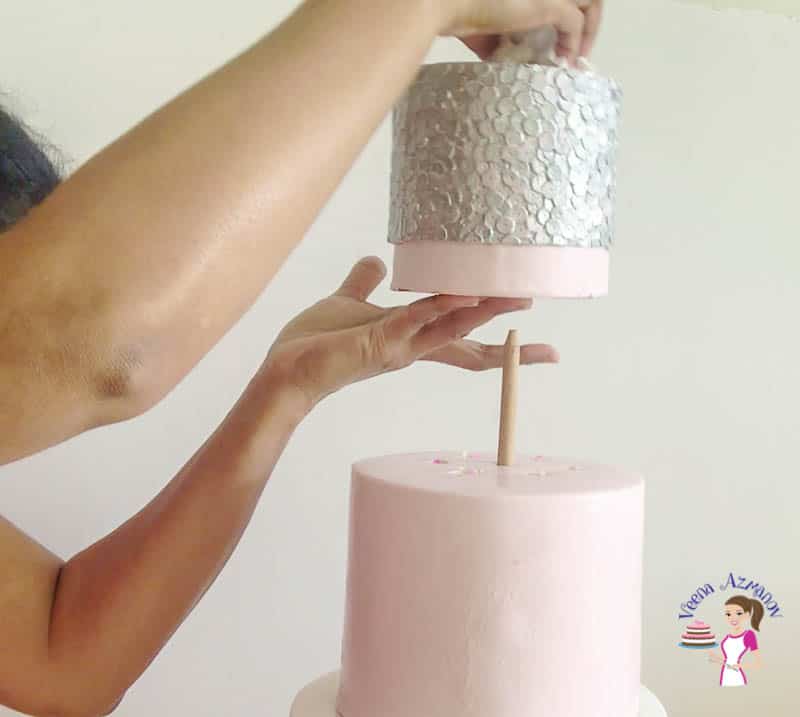
How many dowels do I need to stack my cake?
The number of dowels you need in your cake depends on the size and weight of the tiers, as well as the design of the cake. Here are some general guidelines for doweling cakes:
- Central dowel: For tiered cakes, you typically need a central dowel that runs through all the tiers to provide stability and support. This dowel should be long enough to go through the entire cake and into the baseboard or cake drum.
- Support dowels: For each tier, you’ll need support dowels to distribute the weight of the tiers above evenly. The number of support dowels depends on the size and weight of the tier. As a general rule, you can use 4 to 6 dowels for each tier, spaced evenly in a circle near the center of the tier.
- Spacing: The spacing of the dowels is crucial for even support. Space them evenly in a circle near the center of the tier, ensuring that they are not too close to the edge to prevent them from poking through the top of the cake.
- Size: Dowels should be cut to the height of the tier minus the height of the cake board or cake drum it sits on. This ensures that the dowels provide support without poking through the top of the cake.
- Type: Use food-safe dowels such as wooden or plastic dowels. Bubble tea straws can also be used as dowels and are popular for their sturdiness and ease of use.
Tips for Success
- Frosting a cake
- Prepare the Cake: Make sure your cake layers are completely cooled before filling and frosting to prevent the frosting from melting or becoming too soft.
- Level the Cake: Use a serrated knife or cake leveler to trim the tops of the cake layers to create an even surface for stacking and frosting.
- Use a Turntable: A turntable makes it easier to frost the cake evenly. Rotate the turntable as you frost to ensure smooth and even coverage.
- Apply a Crumb Coat: Before adding the final layer of frosting, apply a thin layer called a crumb coat. This helps seal in any crumbs and provides a smooth base for the final layer of frosting.
- Chill the Cake: After applying the crumb coat, chill the cake in the refrigerator for about 30 minutes to set the frosting before adding the final layer.
- Use an Offset Spatula: An offset spatula is a great tool for spreading frosting evenly and smoothly on the cake.
- Apply the Final Layer of Frosting: Once the crumb coat is set, apply the final layer of frosting using smooth, even strokes. Start with the top of the cake and work your way down the sides.
- Smooth the Frosting: Use a bench scraper or the edge of an offset spatula to smooth the frosting on the sides and top of the cake.
- Decorate as Desired: Once the cake is frosted, you can decorate it with piping, sprinkles, or other decorations to suit the occasion.
- Chill the Cake: After decorating, chill the cake again for about 30 minutes to set the frosting before serving.
- Dowel & Stack a cake
- Use sturdy dowels: Choose sturdy, food-safe dowels such as wooden or plastic dowels that can support the weight of your cake tiers.
- Measure accurately: Measure the height of your cake tiers and cut the dowels slightly shorter to ensure they don’t poke through the top of the cake.
- Space dowels evenly: Place the dowels in a circle near the center of each tier, spaced evenly apart, to distribute the weight of the tiers above evenly.
- Use a central dowel: For stacked cakes, use a central dowel that runs through all the tiers to provide additional support and stability.
- Chill your cakes: Stack your cakes when they are thoroughly chilled to make them easier to handle and less likely to shift during stacking.
- Practice patience: Take your time when stacking and doweling cakes to ensure each step is done carefully and accurately.
- Watch tutorials: Watch video tutorials or seek guidance from experienced bakers to learn new techniques and tips for successful cake stacking.
- Practice makes perfect: Like any skill, practice is key. Don’t be discouraged if your first attempts aren’t perfect – with practice, you’ll improve your technique and achieve beautiful, stable cake stacks.

Troubleshooting
- Level, Fill, & Frost a cake
- Uneven Layers: If your cake layers are uneven after cutting, use a cake leveler or a long, serrated knife to carefully trim them to create an even surface.
- Filling Leaking Out: If your filling is leaking out between the layers, you may have used too much filling or applied too much pressure when stacking the layers. Use a thin layer of filling and spread it evenly to prevent leakage.
- Cracks in the Cake: Cracks can occur if the cake is overbaked or if it is handled too roughly. To prevent cracks, ensure your cake is baked just until done and handle it gently when leveling and stacking.
- Bulging Layers: If you notice bulging between the layers after filling, it could be due to too much filling or uneven stacking. Use a thin layer of filling and ensure the layers are stacked evenly.
- Difficulty Spreading Frosting: If your frosting is too stiff and difficult to spread, try warming it slightly in the microwave or adding a small amount of milk or cream to loosen it up.
- Crumbly Frosting: If your frosting is too crumbly and not spreading smoothly, it may be too dry. Add a small amount of liquid (such as milk or cream) and mix until smooth.
- Frosting Too Thin: If your frosting is too thin and not holding its shape, it may need to be chilled for a short time to firm up before spreading.
- Air Bubbles in Frosting: To remove air bubbles from frosting, gently tap the cake stand or plate on a flat surface after applying the frosting. You can also use a toothpick to carefully pop any large bubbles.
- Dowel & Stack a cake
- Cake tiers are uneven: Ensure that each cake layer is level before stacking. If the tiers are uneven, carefully trim them with a serrated knife to create a flat surface.
- Cake is leaning or unstable: This could be due to uneven doweling or an unstable base. Double-check that your dowels are evenly spaced and that your base is sturdy and level.
- Dowels are visible or poking through the cake: Cut the dowels to the correct height, ensuring they are slightly shorter than the tier they are supporting. You can also cover the exposed dowels with frosting or decorations.
- Cake layers are sliding: If your cake layers are sliding, ensure that each layer is properly adhered with frosting or ganache. You can also use a thin layer of frosting between each layer to help them stick together.
- Cake is cracking or breaking: This could be due to a dry cake or rough handling. Ensure your cake is moist by using simple syrup or a moistening agent. Handle the cake with care during stacking to prevent cracking.
- Stacked cake is leaning to one side: This could be due to an uneven base or doweling. Double-check that your base is level and that your dowels are evenly spaced and cut to the correct height.
- Gaps between cake layers: If you notice gaps between your cake layers, you may not have used enough frosting or filling. Add more filling between the layers and gently press the layers together to close the gaps.
- Cake tiers are slipping: If your cake tiers are slipping during stacking, use a small amount of frosting or ganache between each tier to help them stick together. You can also use a central dowel for added stability.
more cake decorating tips
- Cake Pricing – How to Price your cakes
- How to Transport Cupcakes (DIY Cupcake Carrier)
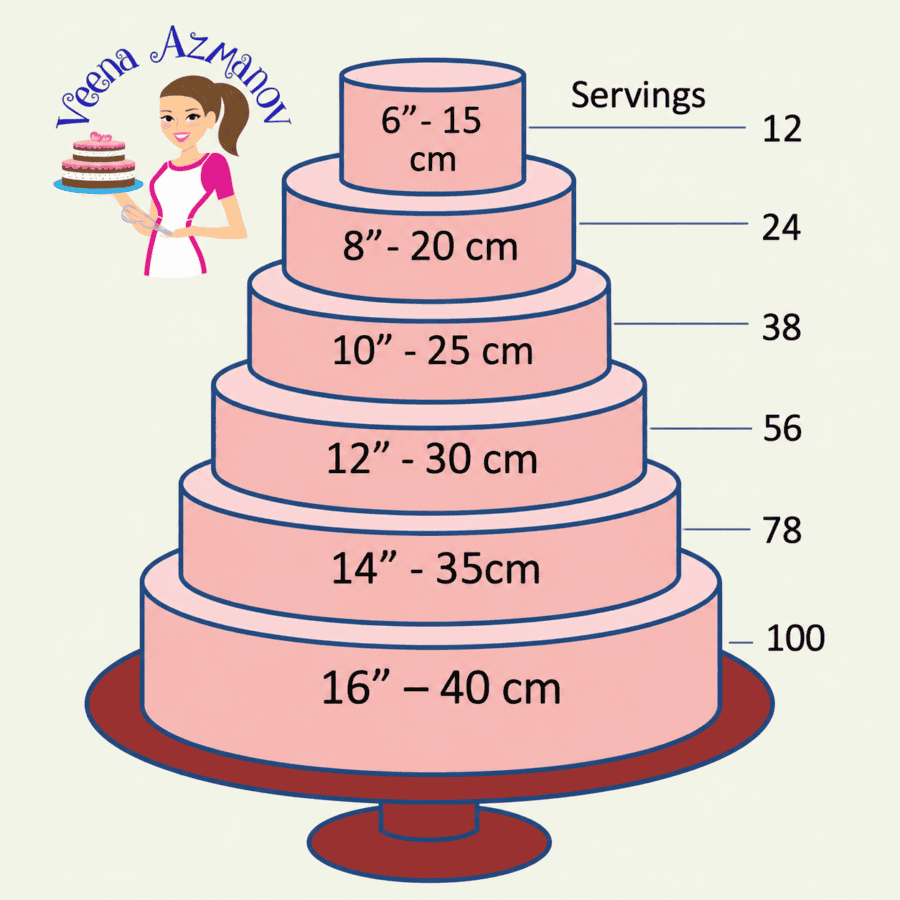
- Cake Serving Chart Guide – Popular Tier Combinations
- Working with Fondant – Tips, Tricks, Troubleshooting
- Sharp Edges Buttercream Cakes


Frequently asked questions
Use a long, serrated knife or a cake leveler to carefully trim the domed top of the cake until it is level with the edges of the pan.
Filling a cake adds flavor and moisture to the layers and helps hold them together. It also provides a contrast in texture and flavor to the cake itself.
Use a thin layer of filling and spread it evenly over the cake layer. Leave a small border around the edge to prevent the filling from spilling out when the layers are stacked.
You can level, fill, and frost a cake a day or two in advance of serving. Store the frosted cake in the refrigerator, but allow it to come to room temperature before serving for the best texture and flavor.
Yes, you can freeze a cake that has been leveled, filled, and frosted. Wrap it tightly in plastic wrap and then aluminum foil before freezing. Allow it to thaw in the refrigerator before serving.
Generally, single-tier cakes do not require doweling unless they are exceptionally large or heavy. However, some decorators choose to dowel all cakes for added stability.
It’s possible to stack a cake without dowels, especially if it’s a small, lightweight cake. However, dowels provide additional support and stability, especially for tiered cakes or cakes with heavy decorations.
yes, as long as you have cake on cake, you need to dowel. So the bottom cake will not have to bear the weight of the top cake.
If you can’t get dowels, you can use regular drinking straws. It’s something better than nothing. Right?
To cut a stacked cake, use a sharp knife or cake slicer. Start by removing any decorations on the top of the cake, then slice straight down through all the tiers to create individual servings.
No. The center dowel is usually anchored to the cake board which ensures that the two cakes don’t move. This is added security for your cake. But, you decide how critical it is. For example, if the cake isn’t going to travel skip the center dowel.
Yes, it is generally necessary for each tier of a stacked cake to have a cake board underneath it. Cake boards provide support and stability to each tier, making it easier to stack the tiers and transport the cake. They also help distribute the weight of the tiers evenly, which is especially important for tall or multi-tiered cakes. Using cake boards also makes it easier to separate and serve the tiers individually.
Exactly the same way you stack a fondant or ganache cake. You will follow the exact same process. The only difference is that you need to be extra careful with buttercream cakes not to ruin the smooth cake while stacking.
The ganache, buttercream or piping gel used between cake tiers works as a glue to hold the tiers in place once chilled.
To transport a stacked cake, use a sturdy cake box or container that is larger than the cake to prevent damage to the decorations. Place non-slip matting or a damp towel on the bottom of the box to prevent the cake from sliding.
It’s best to stack and dowel a cake shortly before serving or displaying to ensure that it remains stable. However, you can stack and dowel a cake a few hours in advance if necessary, as long as it is stored in a cool, dry place.
Yes, bubble tea straws are a popular alternative to dowels for supporting cakes. They are sturdy, easy to cut, and food-safe.
It depends on the type of frosting and filling used. Cakes with perishable fillings or frostings should be refrigerated, while cakes with stable fillings and frostings can be stored at room temperature.
more cake tutorials
- Perfect Sphere Cake
- Gum Paste Poinsettia Tutorial
- Working with Fondant – Tips, Tricks, Troubleshooting
- Gum Paste Easter Bunnies
- How to Transport Cupcakes (DIY Cupcake Carrier)
Don’t lose this recipe! Save it for Later!
📌 Save this Recipe for later on Pinterest so you can easily find it again.
⭐ Add Veena Azmanov Kitchen to your Google Preferred Sources.
It helps Google show you more of our recipes.
📧 Subscribe for new recipes delivered to your inbox.
🎥 Follow us for more recipes


Hi, I’m Veena
I’m the recipe developer, baker, and food photographer behind Veena Azmanov Kitchen.
I’ve spent years developing and testing recipes, from everyday meals and homemade breads to cakes and desserts.
I share the practical tips and little details I’ve learned along the way so you can get great results in your own kitchen.





Hi I’m making 9” size cakes bottom layer is three high with buttercream frosting in between so total bottom cake will be 9”3. Then will be doing the same on top with cake board in between so they can be cut as two cakes but will ice it as one cake. Hope that makes sense. Will I need to dowel it and if so how many? Thank you, it’s my first time making this size cake and don’t want it to lean as it’s for my sister in laws wedding. I have plastic and wooden dowels but just unsure. Thank you.
Hey Crystal. I see the bottom layer is nice inch – I presume the top layers are narrower than the bottom. As long as you have cake one on top of the other you need to dowel. Yes, each cake had to be on its own board. And the bottom board will be one that can handle the weight of all three cakes
Please check the slide – it says for every two inches you need one dowel. So if you have a 9 inch cake with a 7 inch on top. I would put 4 dowels on the nice inch cake with a center dowel thru all three cakes. Hope this helps.
Thank you Venea. THis is really helpful.
Thank you, Cookie. So happy to hear you found this post useful. Thanks for coming back to write this feedback. Have a lovely day.
Thank you so much for all your tutorials Veena. You are a real cake angel. Your website is my go to when I need help.
Thank you so much Padun. So happy to hear you love my blog and that you find my tutorials helpful. Thanks for coming back to write this feedback. Have a wonderful day.
You always have the best cake decorating tutorials. Thank you so much
Thank you so much Guig. SO happy you hear you like my tutorials. Thanks for writing such a wonderful comment
Hello
My first attempt at a naked cake is coming up very soon.
I will be making three x 8 inch round cakes. These will then be cut in half and then layered with butercream in between layers.
As this cake will be quite high i hope, will i need to insert dowells to keep straight. Also would i need to put boards in between two layers for easy cutting?
Thank you
Hey Lynda, By three 8 inch round cakes you mean three layers of a single cake.
SO if these will be cut in half and make 6 layers?
It depends on how tall the cake is – if the six layers come up to more than 4 inches tall
I would recommend using dowels and a smaller cake circle in between the three layers.
You could go up to 6 inches tall without any support inside.
Very helpful. Thanks alot
You are very welcome
Thanks for sharing. This is very helpful…
Thanks you..always very helpful.
God bless
thanksvery helpful
Puede ser en Español