




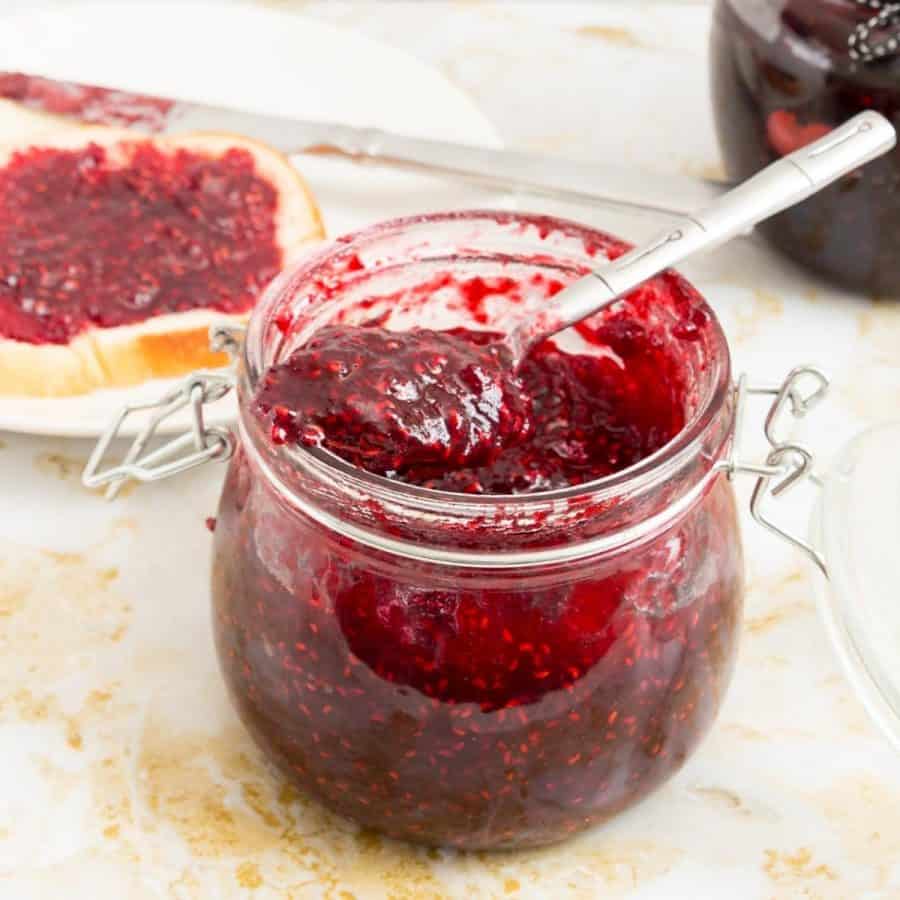
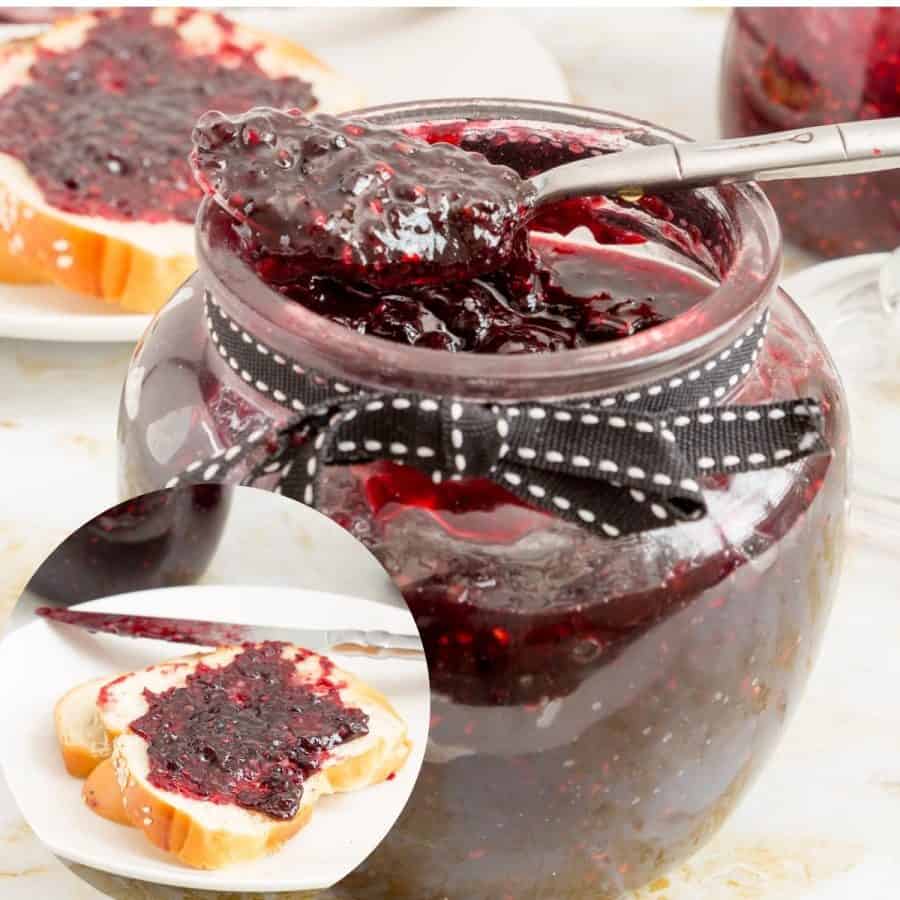
Making jam at home is an absolute treat and worth the time. You don’t have to make big batches, nor do you have to can every jam. Here, I make a small batch of good, wholesome, homemade, all-natural cherry jam without pectin or preservatives. And this recipe is as simple and easy as can be.
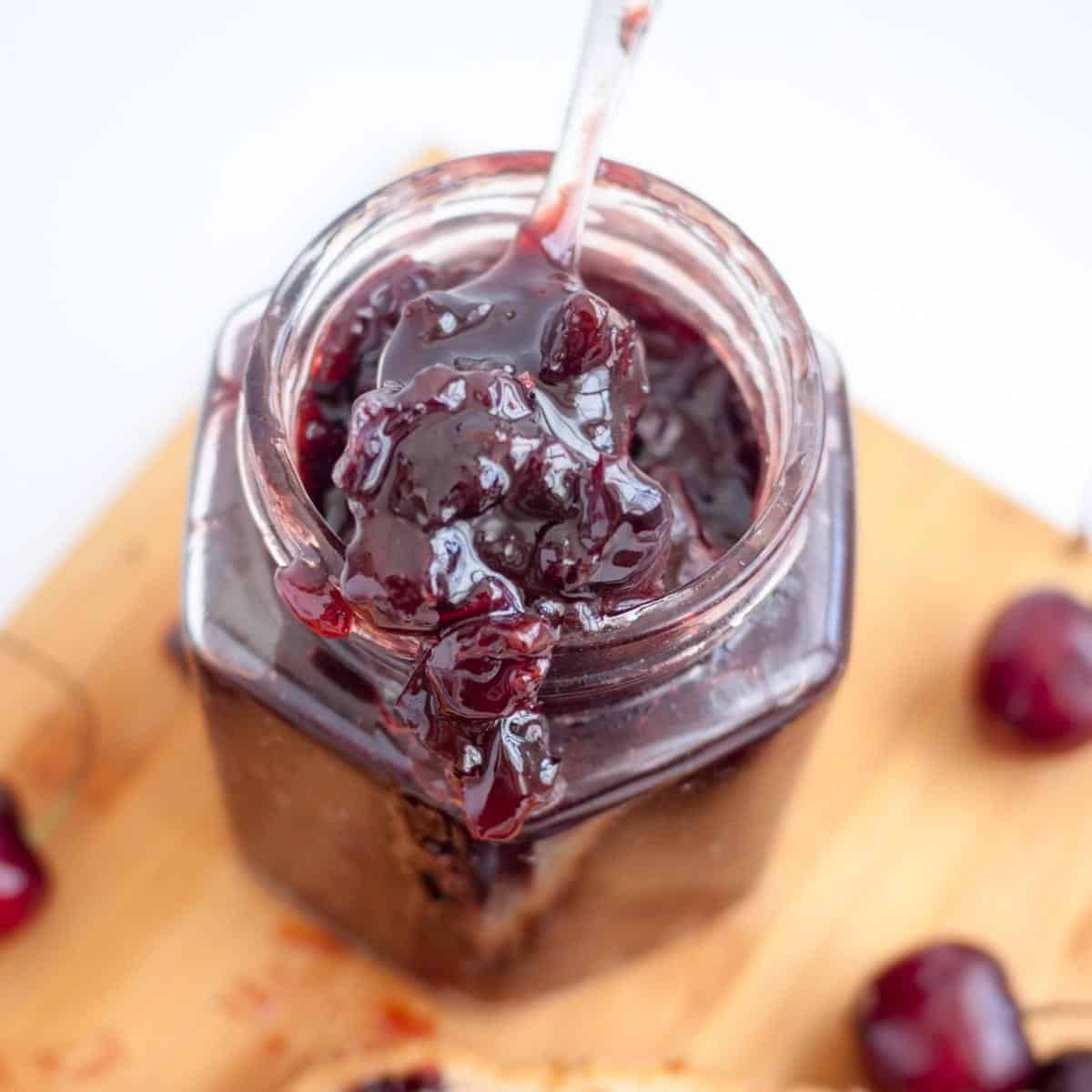
You know, I first fell in love with cherry jam while traveling. I was at a breakfast buffet when I tasted that jam, and I was hooked. Growing up, my mom made tons of homemade jams, but we never had fresh cherries because they were so rare where I lived. Now, cherries come in buckets, and my kids can’t get enough of them!
So I decided to make my own cherry jam—low in sugar, packed with extra fruit, and no pectin at all. The home smells of this sweet aroma. Everyone in the house is looking towards the kitchen, and my kids ask, “Mama, what are you making?” I like the smell. Oooh, jam!! I want some.
Honestly, it makes me feel like my mom, which is fantastic because I loved watching Mom busy in the kitchen with her pretty apron and a big smile that said, “I’m cooking for my family.”
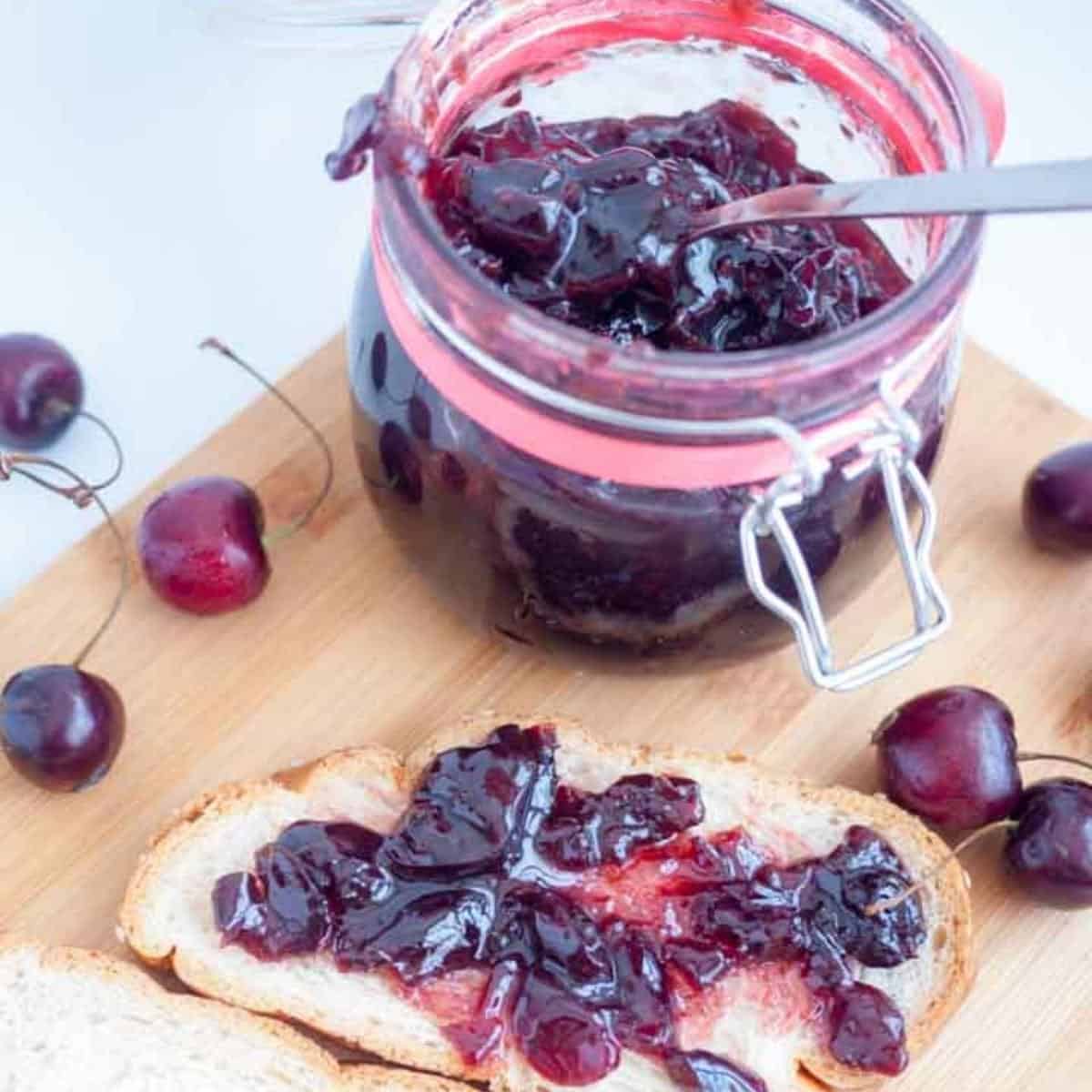
Trust me, this cherry jam is a game-changer. Try it on toast, swirl it into your yogurt, or even use it as a topping for ice cream. Enjoy every spoonful!
Why make this jam?
- The flavor is amazing, the taste is less sweet than commercial jams, and the color is oh-so-gorgeous!!
- No-fail method – This recipe is simple and easy. And if you’ve never made homemade jam, you will definitely start now.
- No canning – This homemade recipe does not involve canning. You can just pour the jam into sterilized jars and store them in the fridge or freezer. However, I have also provided the detailed canning process.
- No pectin – Ideally, you can make cherry jam with just two ingredients: cherries and sugar. The thick skin of cherries has natural acidity and pectin in abundance. And yet, adding lemon juice helps break down the skin.
- Low-sugar – Fresh cherries are naturally soft and sweet, so you don’t need to add a lot of sugar to this jam.
Ingredients and substitutes
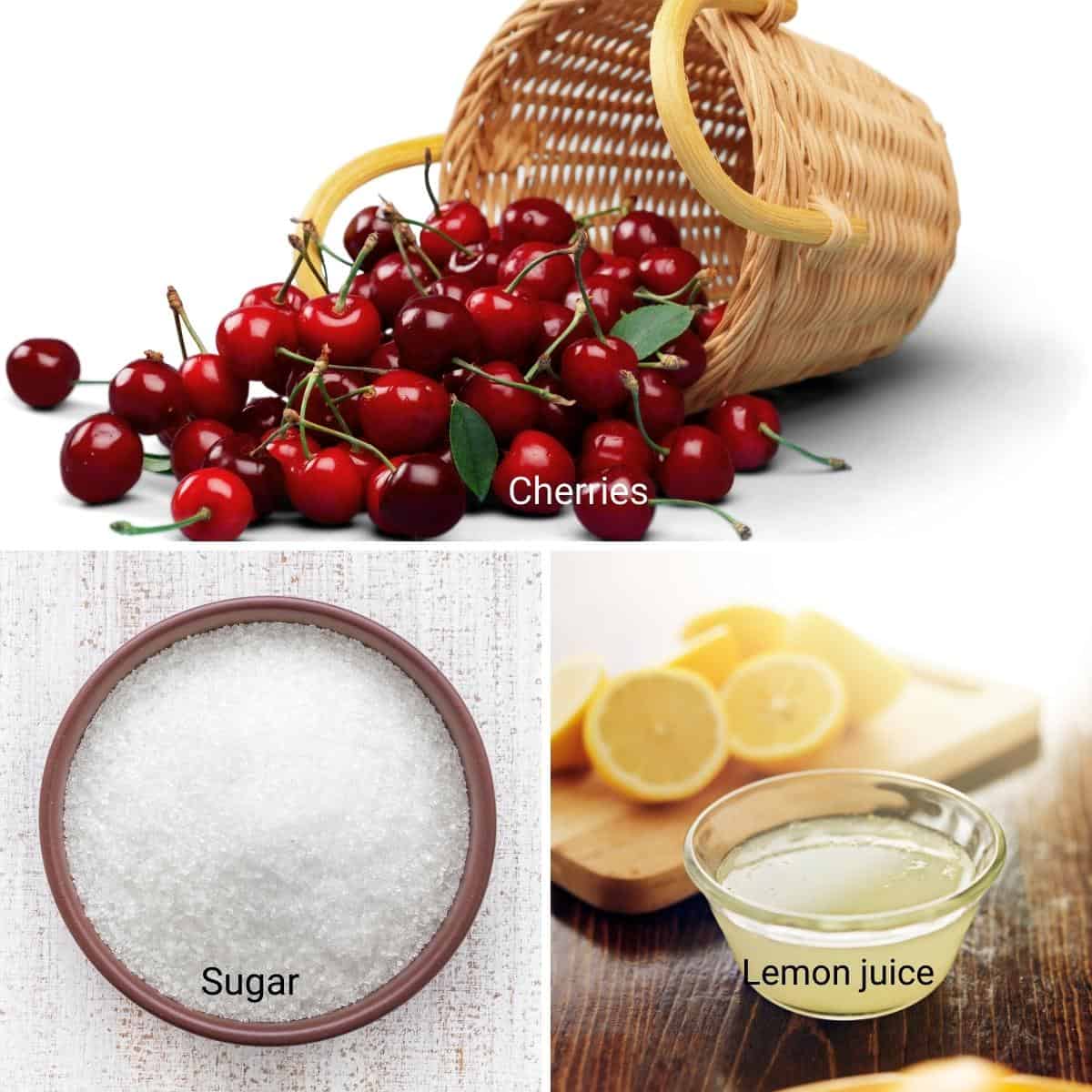
- Cherries – I used these bright red cherries, but the dark purple-black ones work just as well. Of course, I prefer to chop them, but you can leave them in big chunks, cut them really small, or even pulse them in the blender. If you pulse them in the blender, the resulting jam will be very syrupy and take a bit longer than the time mentioned here. Sometimes, I make cherry jam that has been blended thin, which I use for my cake decorating projects.
- Sugar – Unlike commercial jams, I like to use less sugar, usually half the quantity of fruit. If I have 1 kg of fruit, I usually add 500 grams of sugar. So, my jam is more fruity rather than just sugary sweet. But if you like it sweet, you can add more. Most commercial jams are made with 3/4 of sugar, in this case 750 grams.
- Lemon Juice – Cherries are sweet, so the lemon really helps bring out and enhance its sweetness.
Step-by-step: How to make the best cherry jam
Makes 4 x 8 oz or 250 g jars
- Place two small ceramic plates or saucers in the freezer so we can use them to test the jam later. Alternatively, you can use a candy thermometer to check the jam’s doneness.
- Rinse, drain, and pit the cherries. Discard bruised or discolored cherries. Depending on the texture you need, chop the pitted cherries into small chunks.
- In a heavy-bottom pan or large saucepan, combine the cherries, sugar, salt, and lemon juice.
Pro tip – If you are using frozen cherries, let them macerate in sugar and lemon juice for a few hours before cooking. This softens the blueberry skin considerably. - Cook on medium heat until the sugar dissolves. Then, turn the heat up and let the mixture come to a full rolling boil. Let it boil for two minutes on medium-high heat.
Pro tip – Boiling the jam is essential as it releases pectin from the skin and seeds in fruits.

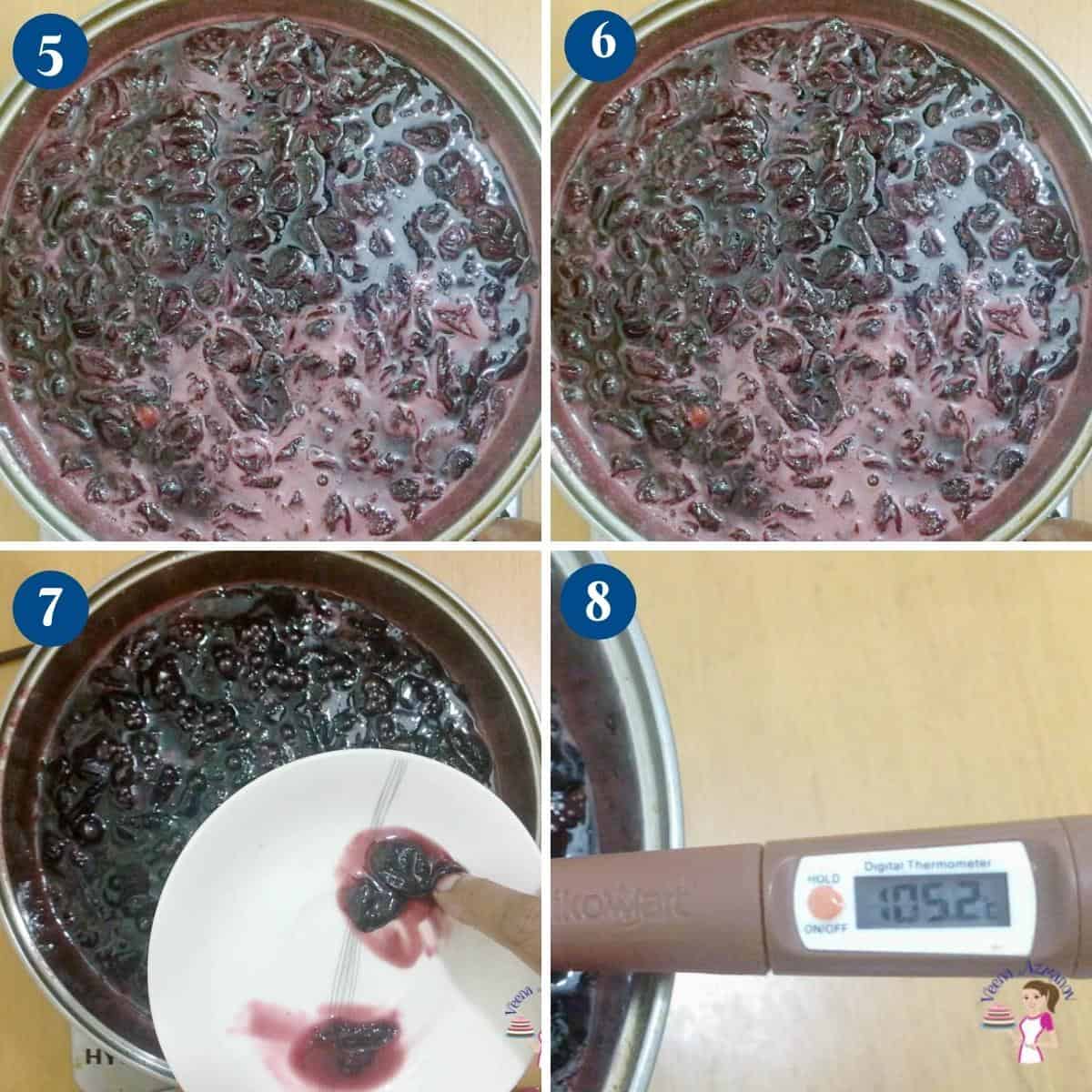
- Then, turn the heat to medium-low. The jam should still be simmering but at a low heat, not bubbling. Mash the fruit with a potato masher for a smoother, jam-like consistency.
- Continue to simmer for about 20 to 30 minutes more, stirring often to prevent it from sticking to the bottom of the pan. The jam will continue to thicken and deepen in color as it cools. Skim the top with a ladle as you go.
Testing the Jam
- Remove one of the ceramic plates from the freezer. Place a teaspoon of jam on the cold plate.
- Set aside 2 to 3 minutes, and then test with your finger. Move/push the jam with your finger. If it wrinkles/crinkles, the jam is ready. If not, let the jam cook a few more minutes and test again.
- Alternatively, you can use a candy thermometer – the jam should reach 105 °C / 221°F.
Pro tip – I find the thermometer the easiest and most foolproof method to check for doneness. - Optional – When you are ready to remove the jam from the heat, add a teaspoon of butter and stir well. Butter helps dissolve the foam that accumulates on top of the jam.
Pro tip – You don’t need more than one teaspoon of butter to help with the foam. It will also give you that glossy shine. - Pour the jam into warm, sterilized jars, leaving 1/4-inch headspace from the top. Use a clean, sterilized knife or spatula to move the jam a bit—this will remove any air pockets.
- Place a piece of wax paper on the top before you place the lid on tightly. Clean the rim of the jar with a clean paper towel. Top the lid.
Alternatively, use the lid with screw-on rings that come with the canning jars.

The canning process (if you plan to can the jam)
Sterilize the jars
- Sterilize 4 x 8 oz (250 g) jars by washing them in hot, soapy water or cleaning them in the dishwasher with a gentle cycle. Then, place them in the oven for 20 minutes at a low 284°F / 140 °C.
- Note – Leave them on the tray in the oven until you are ready to use them (you can turn the oven off). Don’t forget to wash and sterilize the bottle lids as well.
Canning process
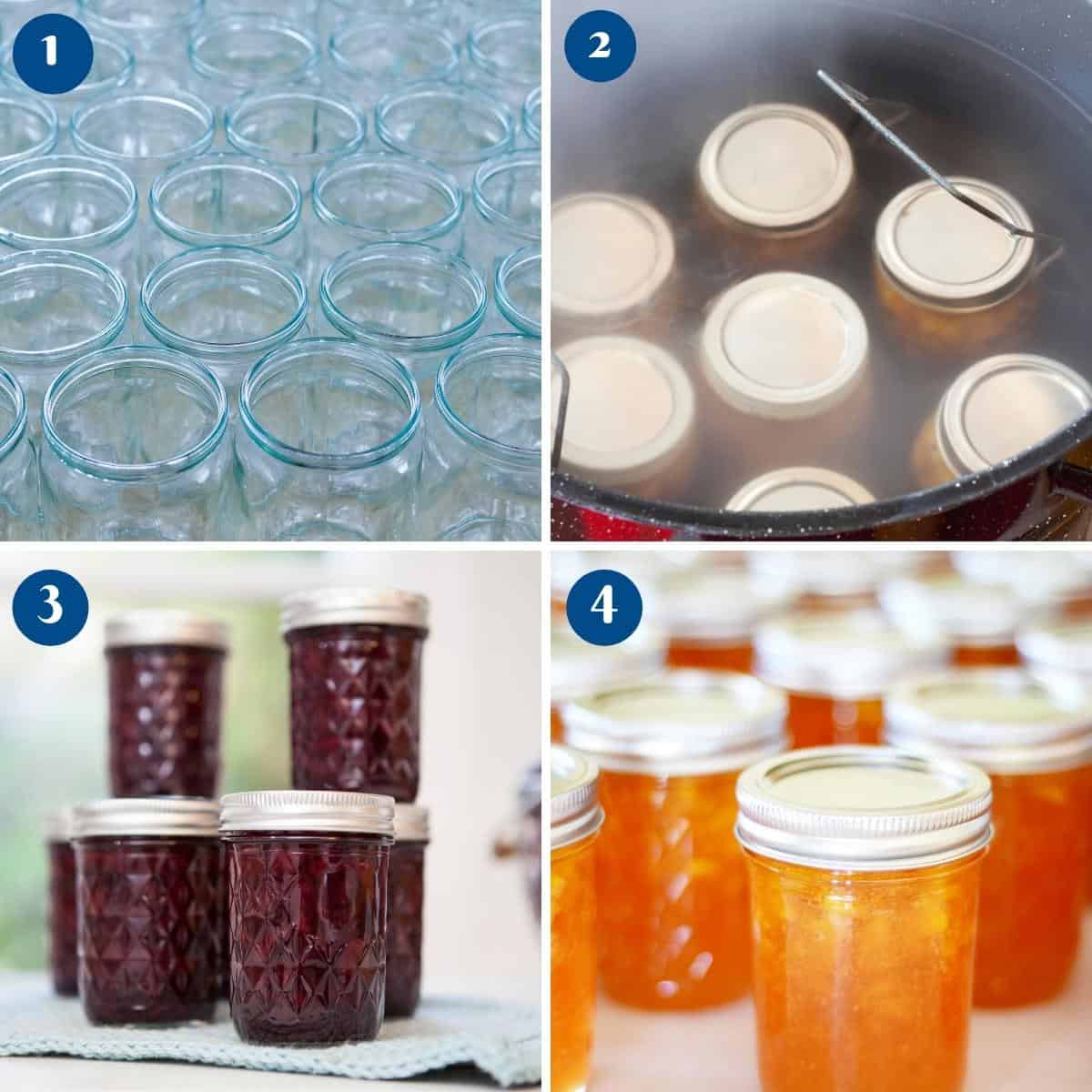
- Place a rack in the bottom of a large stockpot or canner. Fill half the pot with water. Bring the water in the pot to a boil on high heat.
- Place jars over the rack, leaving enough space between them.
- Bring the water to a boil again. Cover the pot and process/simmer for 15 minutes.
- Then, carefully remove the jars from the stockpot and place them on a kitchen towel to absorb any excess moisture. Cool completely.
- Press the top of the lid to ensure the seal is tight – the lid should not move at all. Store in a cool, dry place.
Storage
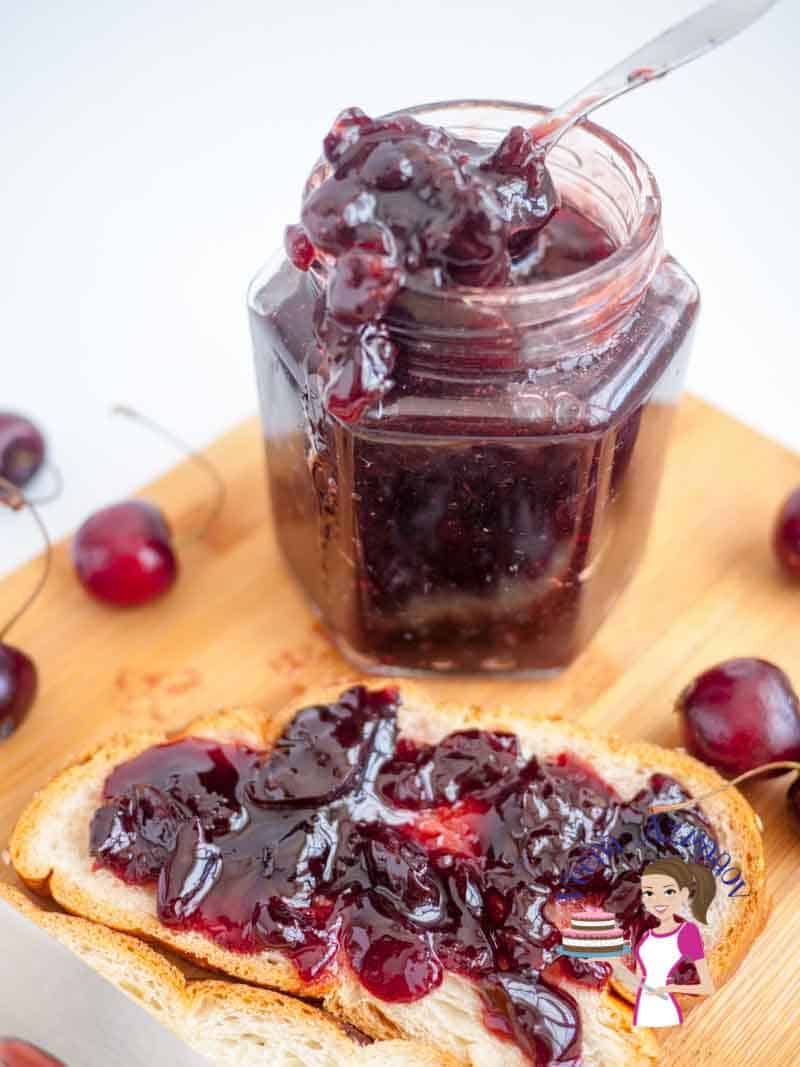
- If canning, the canned jam will stay in a cool, dry place in the pantry for up to a year or even longer.
- When not canned, the jam will stay at room temperature for a month or more in good weather.
- You can also keep the jam in the fridge for 3 to 6 months.
- Label the jar with the name and date so you know what is in it and when you made it.

Troubleshooting
- How long do you cook jam? We often say low-heat, slow cooking is what makes a good jam. This does not mean it takes a long time. Usually, a good 20 minutes is all it needs for about 1 kg / 2 lbs of fruit jam to reach a set point. You can start checking the jam after it has been cooking for 18 to 20 minutes.
- Jam no setting – Often, jam does not set, even when reduced to half, because it has not been boiled long enough. Low-heat slow cooking is what makes jam reach its setting point. If cooked too quickly, the liquid is reduced without going through the natural process of setting. So, low-heat, slow cooking is the key to a perfect jam.
- Overcooked jam—It is possible to overcook jam. It is better to undercook than to overcook jam. Undercooked jam can be cooked again, but once overcooked, you have to add water to thin the jam. Note that once you add water, you also reduce the jam’s shelf life. It is best to get it right the first time.

Frequently asked questions
There are many cherry-pitting hacks in a glass bottle method, where you place the cherry upside down on the opening of a glass bottle and push the pit down through the cherry into the glass bottle. It’s an easy tactic if you don’t have a cherry pitter. However, I use my cherry pitter, which isn’t expensive and can be easily found these days. There are also some fancy multiple cherry pitters in the market these days.
Before I had my cherry pitter, I made cherry jam using the old-school method: a knife, a chopping board, and my favorite program on TV. Simply cut the cherry in half and remove the pit. No matter what method you use, your cherry jam will be delicious.
Yes, you can pit the cherries ahead of time, and they will last in the fridge for a week. And if you plan to make this cherry jam without pectin, place the cherries, sugar, and lemon juice in a glass or stainless steel bowl (never use aluminum for marinades or soaks). Then, let it rest in the fridge until you are ready to cook the jam. The advantage of the added time in the fridge is that it softens the fruit skins, resulting in a tender jam.
Whether you use bright red cherries or deep black cherries, the recipe and technique for making a good cherry jam are the same. And here’s a little tip: Taste the cherries. See how tart they are? See how firm they are? Sometimes, even when the fruit is not frozen, you can use the overnight macerating method to break down these complex flavors.
Sugar helps create pectin, which makes our jam. But if you can’t have sugar, or you don’t want to eat sugar, you can still make jam. Here’s how.
First, pick the naturally sweetest cherries you can find. Forget everything you read about pectin and buy a box of natural pectin. These are available in most supermarkets. If you don’t want to use pectin, you can use chia seeds. The difference is that jam with pectin has a longer shelf life than jam with chia seeds. Also, grab some fresh lemon juice because it has some natural pectin in it, too. The formula is pretty simple, and it belongs to my mom.
4 cups fruits (one or a combination)
3 tbsp pectin
2 tbsp lemon juice
3/4 cup water
1/4 cup honey, maple syrup, or 2 tbsp Splenda
Bring everything to a boil and cook on low until thickened to a jam consistency. You can also add 2 tbsp of chia seeds to the jam at the end of cooking.
Homemade Cherry jam No Pectin – Low Sugar
Video
Method
- Prep: Place two small ceramic plates in the freezer so we can test the jam later. Alternatively, a candy thermometer can check the jam's doneness.
- Prep Cherries – Rinse drain and pit the cherries. Discard bruised or discolored ones. Chop the pitted cherries into little chunks depending on the texture you need.
- Combine – In a heavy-bottom pan or large saucepan, combine the cherries, sugar, salt, and lemon juice. Cook on medium heat until the sugar dissolves. Then, turn the heat up and let the mixture come to a full rolling boil. Let it boil for two minutes on medium-high heat.2 lbs Cherries , 1 lb Sugar, 1 tbsp Lemon Juice, ½ tsp Salt
- Mash – Then, turn the heat to medium-low. The jam should still be simmering but at low heat, not bubbling. Mash the fruit with a potato masher to achieve a smoother jam-like consistency.
- Simmer – Continue to simmer for about 20 to 30 minutes more, stirring often so it does not stick to the bottom of the pan. The jam will continue to thicken and deepen in color as it cools.
- Test the jam – Remove one of the ceramic plates or saucers from the freezer. Place a teaspoon of jam on the cold plate. Set aside for 2 to 3 minutes, and then test with your finger. Move/push the jam with your finger. If it wrinkles/crinkles, the jam is ready. If not, let the jam cook a few more minutes and test again. Alternatively, you can use a candy thermometer—the jam should reach 105°C / 221°F.1 tsp Butter
- Store – Pour the jam into warm sterilized jars, leaving 1/4-inch headspace from the top. Use a clean, sterilized knife or spatula to move the jam a bit—this will remove any air pockets. Place a piece of wax paper on the top before you tighten the lid. Clean the rim of the jar with a clean paper towel. Top the lid.
- Sterilize jar: Sterilize 4 x 8 oz (250 g) jars by washing them in hot, soapy water or cleaning them in the dishwasher with a gentle cycle. Then, place them on a tray in the oven for 20 minutes at a low 284 F / 140 C.Pro tip– I find the dishwasher does a good job of cleaning, and the oven dries any excess moisture from the bottles.
- Simmer – Place a rack in the bottom of a large stockpot or canner. Fill half the pot with water. Bring the water to a boil on high heat. Place jars over the rack, leaving enough space between them. Bring the water to a boil again. Cover the pot and process/simmer for 15 minutes.
- Store – Then, carefully remove the jars from the stockpot and place them on a kitchen towel to absorb any excess moisture. Cool completely.
- Press the top of the lid to ensure the seal is tight – the lid should not move at all. Store in a cool, dry place.
Notes
- Shelf life – Homemade jams made with sugar and fresh fruit can have a long shelf life. If processed with the canning method, and stored properly in a cool dark place, a blueberry jam can last for up to 2 years. Once opened it can be kept in the refrigerator for up to 3 months
- Do you need lemon juice? Almost all jams use lemon juice. Lemon is a great way to cut down on that sweetness with a citrus edge. It also prevents the sugar from crystallizing. Most importantly the lemon helps prevent any growth of bacteria when canning the jam.
- How long do you cook jam? We often say low-heat slow cooking is what makes a good jam. This does not mean it takes a long time. Usually, a good 20 minutes is all it needs for about 1 kg / 2 lbs of fruit jam to reach a set point. You can start checking the jam after it has been cooking for 18 to 20 minutes.
- Jam no setting – Often the reason jam does not set though reduced to half is that it has not been boiled enough. The low-heat slow cooking is what makes jam reach its setting point. If cooked too fast the liquid is reduced but without going thru the natural process of setting. So, low-heat slow cooking is the key to a perfect jam.
- Over-cooked jam – It is possible to overcook jam. It is better to undercook rather than overcook a jam. Because undercooked can be cooked again, but once overcooked you have to add water to thin the jam. Note, once you add water you reduce the shelf life of the jam as well. Best to get it right the first time.
- Jam done test – getting the jam off the heat is critical and often we take it off too soon or too late resulting in a runny or too thick jam. So here is an old mom’s method that works great to test any fruit jam.
- Place two ceramic plates in the freezer or fridge. These cool while the jam is cooking. When you are ready to test – bring the cold plate out. Put a spoonful of jam on the plate. The cold plate will instantly cool the jam giving you an indication of how much it has set. Simply put the jam on the plate from the corner towards the center. If it wrinkles it is set. Time to take the jam off the heat. If not, continue with a few more tests – every 3 to 5 minutes.
- If you do have a candy thermometer on hand you can use it and take the guesswork out. I used mine for instructional videos to show the process for those who would like to use a candy thermometer.
Storage
- If canning, the canned jam will stay in a cool dry place in the pantry for up to a year or even longer.
- When not canned, the jam will stay at room temperature for a month or more in good weather.
- You can also keep the jam in the fridge for 3 to 6 months.
- Label the jar with the name and date so you know what is in and when you made it.
Equipment you will need


Nutrition
Tried this recipe?
Mention @veenaazmanov_kitchen or tag #veenaazmanovkitchen!- Fresh Fig Jam – No Pectin (just 3 ingredients)
- Microwave Strawberry Jam – No Pectin
- Blueberry Jam – No Pectin (3 ingredients)
- See all jam recipes


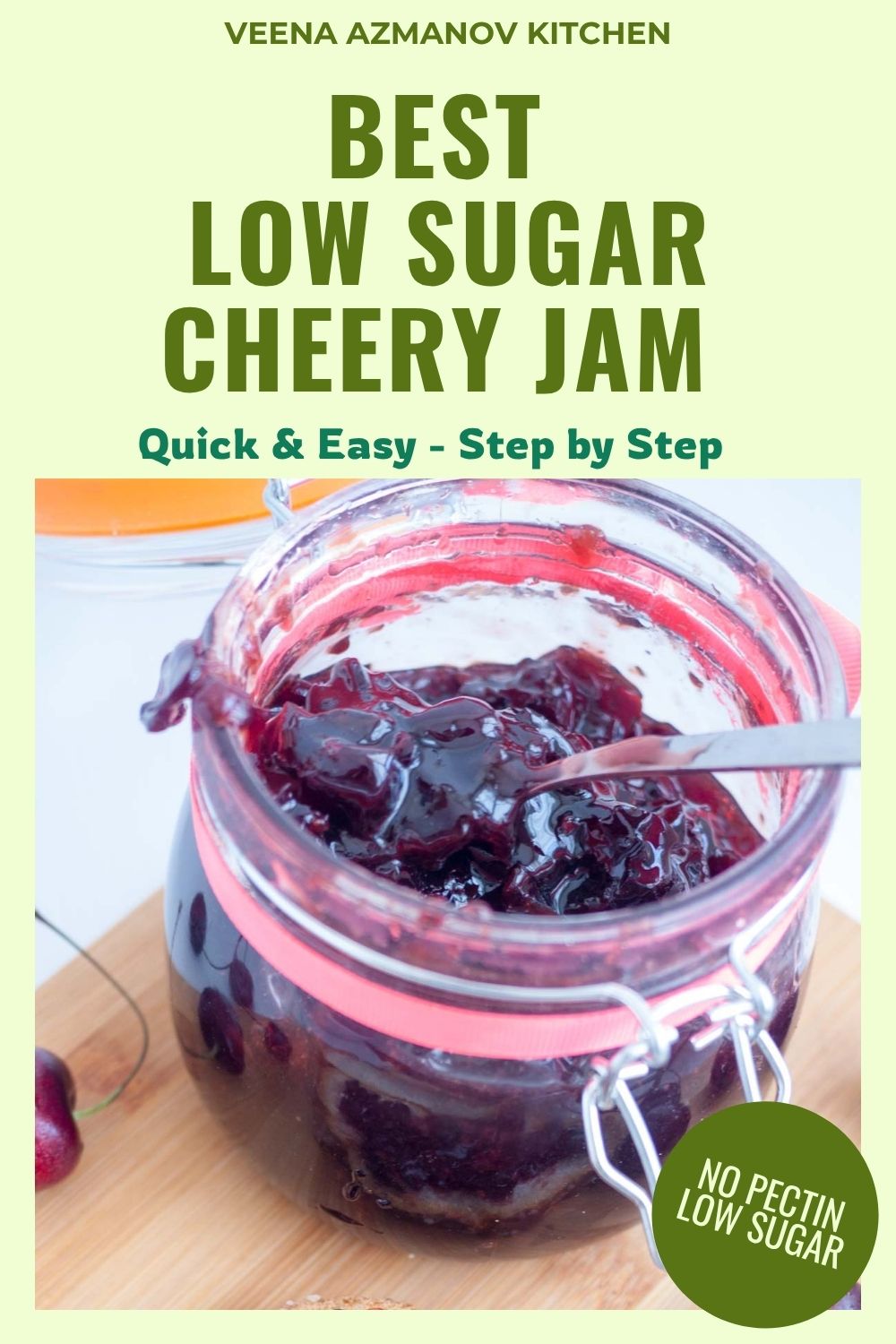
Don’t lose this recipe! Save it for Later!
📌 Save this Recipe for later on Pinterest so you can easily find it again.
⭐ Add Veena Azmanov Kitchen to your Google Preferred Sources.
It helps Google show you more of our recipes.
📧 Subscribe for new recipes delivered to your inbox.
🎥 Follow us for more recipes

Hi, I’m Veena
I’m the recipe developer, baker, and food photographer behind Veena Azmanov Kitchen.
I’ve spent years developing and testing recipes, from everyday meals and homemade breads to cakes and desserts.
I share the practical tips and little details I’ve learned along the way so you can get great results in your own kitchen.




This looks awesome! I love cherry jam, but have never actually made my own. I might try it though as this method looks pretty straight forward.
So easy to make at home Romina. You must try.
Yum, this looks great! I made kumquat jam once, but I think I should have picked a better fruit- like cherries- that everyone likes to eat! I’m sure this would go well in my house.
Yes, the kumquat is also a lovely jam. You must try the cherry Estelle.
I loooove making my own jams and I’m like you, I prefer to make them without pectin or added preservatives. I’ve never tried to make cherry jam but I cannot wait to give it a go now!
Thanks, Sylvie. Yes, love making it the old fashion way. You must try this one.
Homemade jam is the absolute best, I just made some yesterday! I’ve never made a cherry jam before though, yours looks wonderful! I have a cherry pitter tool now, so I actually but cherries again, need to make this!
Yes, Cherry jam is an addiction. Never last long in our home. Kids eat it on pancakes too.
Cherries are great this time of year! This jam looks so yummy, perfect amount of sweetness!
Absolutely, Tisha. Cherries are in abundance this time of the year.
I live in Florida and do not have access to fresh or frozen sour cherries. I did, however, find morello canned (in glass jar) cherries at TraderJoes. Can I use these to make cherry jam? They are in a light syrup. How do I adjust the recipe as I do not want to add any sugar. Thanks!
Hey Lisa. Morello cherries are not the same. I have not tried this jam with Morello. Sorry, can’t give you a definite answer.
Information and explanation great but you do not indicate how long this jam will keep for and whether it needs to be refrigerated at all times.
Also how much does it actually make? small jars size??
Thanks Susan
Hey Susan. Actually, it’s all there but now I have also moved them around and you can find them in the recipe card below. I hope that will help find it easier.
I love this cherry jam. Not too sweet and so perfect with anything. I used them in my cherry tartlets too.
Thank you, Britnay. Cherry tartlets sound delicious. Thanks for coming back to write this feedback.
Thank you so much for this recipe. It was perfect. Just the right sweetness.
Thank you, winfred. Thanks for coming back to write this feedback. So happy you enjoyed it
Could I use Rainer cherries with this recipe??
Yes, Taylor. You can use Rainer cherries. Those are quite expensive so you don’t get them used often in jams. Here they cost almost three times the price of the other.
Made cherry jam for the first time, was so good. I love the chunky jam. It’s so good we are eating it with a spoon.
Thank you, Josh. So happy to hear you had success with this recipe and that you enjoyed it. Thank you for coming back to write this feedback. Have a wonderful weekend.