
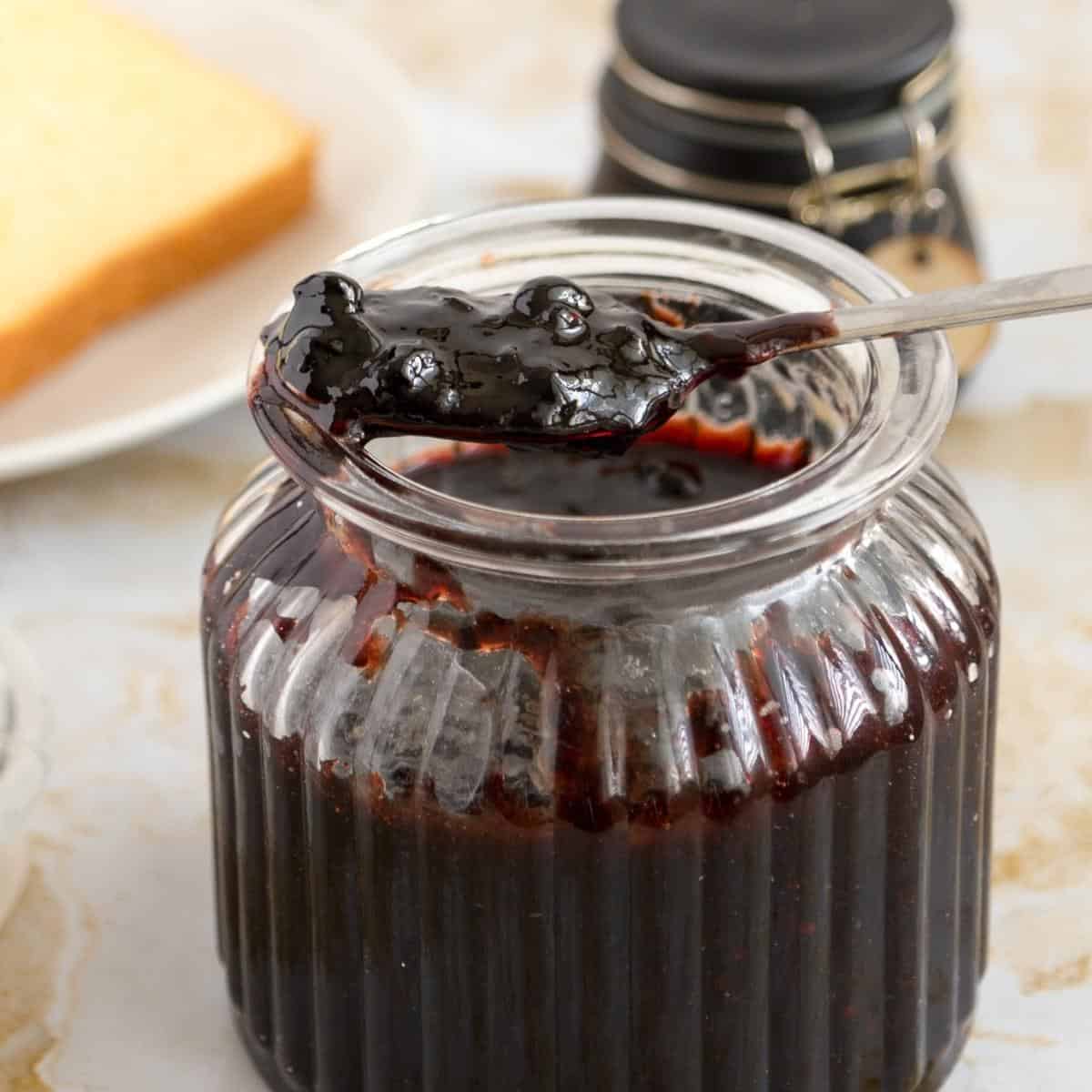

This homemade blueberry jam is simple and easy to make. It uses less sugar and no added pectin or artificial flavoring. It takes less than 30 minutes. Save it in the fridge, or can these jams for the whole year.
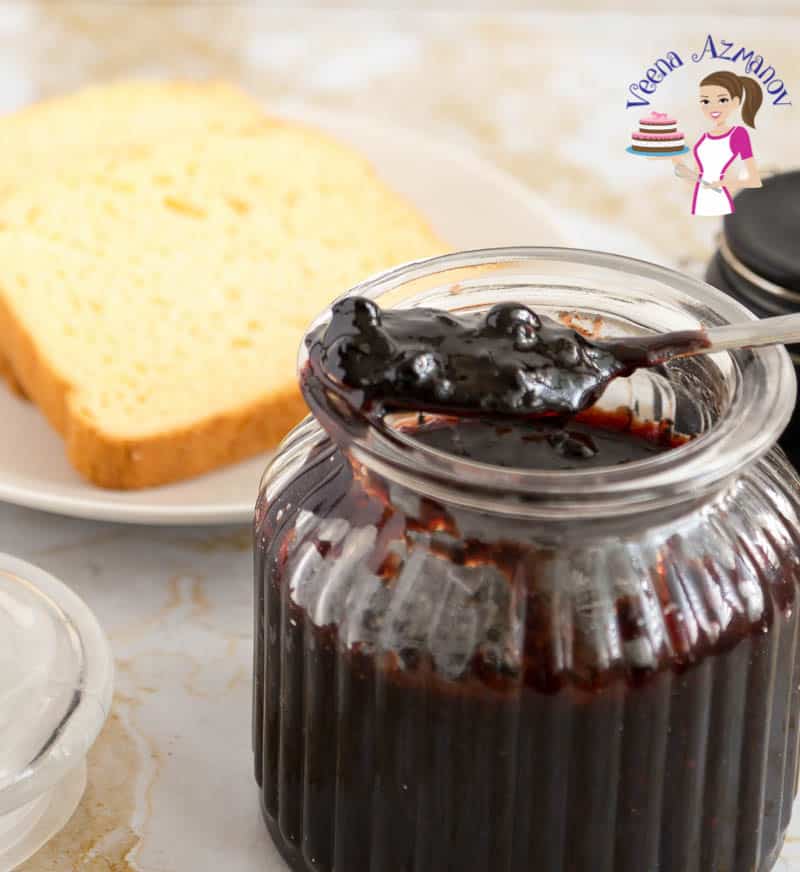
Blueberries have always held a special place in my heart. Growing up, they weren’t something you could easily find in the markets, so whenever we had them, it felt like a real treat. I remember the first time I got my hands on fresh blueberries during my travels—it was like discovering a hidden gem.
Now, I’m fortunate enough to get fresh blueberries year-round, and of course, I’ve turned them into my own blueberry jam. This jam isn’t your ordinary stuff—it’s made with extra fruit, very little sugar, and no pectin. Trust me, once you taste it, you’ll see why it’s a game-changer. Slather it on your toast or pancakes in the morning, use it as a topping for yogurt or oatmeal, or even scoop it up with a spoon when you need that little sweet moment! You’re going to love it.
Why make this jam?
- No-fail method – This recipe is simple and easy. And if you’ve never made homemade jam, you will definitely start now.
- No canning—This homemade recipe does not involve canning. You can just pour the jam into sterilized jars and store them in the fridge or freezer. However, I have also provided the detailed process for canning.
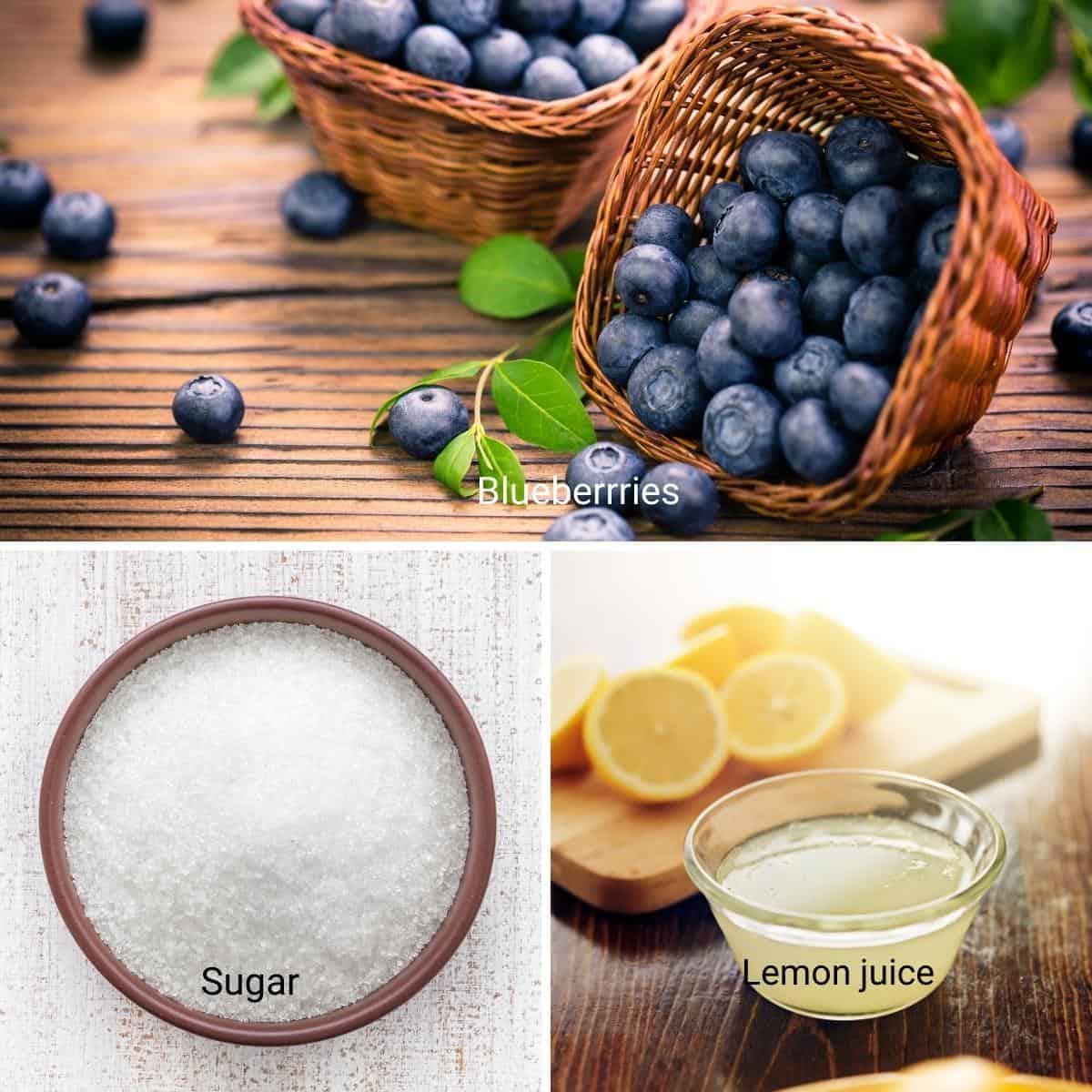
- And no added pectin – Ideally, you can make blueberry jam with just two ingredients: blueberries and sugar. Blueberries have natural acidity and pectin in abundance. And yet, adding lemon juice helps break down the skin.
- Low-sugar – Fresh blueberries are naturally soft and sweet, so you don’t need to add a lot of sugar to this jam.

Ingredients and substitutes
- Blueberries –The best candidates for jam are blueberries with a deep, rich color. Ripe but firm, discard blueberries that are too soft or bruised.
Pro tip – Never let the blueberries soak in water, as the skin absorbs water and becomes tough. If you find the blueberry skins tough (some suppliers prewash them), combine the sugar, lemon juice, and blueberries in a glass or plastic container and let it stay in the fridge overnight. Letting the fruit macerate in sugar and lemon juice helps soften the skin. - Sugar – Unlike commercial jams, I like to use less sugar, usually half the quantity of fruit. If I have 1 kg of fruit, I typically add 500 grams of sugar. So my jam is more fruity rather than just sugary sweet. But if you like it sweet, you can add more. Most commercial jams are made with ¾ % sugar, in this case, 750 grams.
- Lemon juice – It’s best to use fresh lemon juice. You can also add zest, but I’m not a big fan of zest in my blueberry jam.
- Butter – Now you don’t really need butter, and yet, if you notice, often there is foam in the jam when cooking. Adding butter helps clarify the jam – foam comes to the surface so that you can skim it off easily.
Step-by-step: Blueberry jam recipe (no pectin)
- Place two small ceramic plates in the freezer so we can test the jam later. Alternatively, you can use a candy thermometer to check the jam’s doneness.
- Check the blueberries and remove any bad, discolored, or bruised ones. Give them a quick wash and drain in a colander.
Pro tip – Soft blueberries can be used, but discolored and bruised ones will ruin the jam. Also, don’t soak blueberries in water for too long, as they do soak up moisture. - In a large, heavy-bottomed pot or Dutch oven pan, combine the blueberries, sugar, salt, and lemon juice.
Pro tip – If you use frozen berries, let them macerate in sugar and lemon juice for a few hours before cooking. This softens the blueberry skin considerably. - Cook over medium heat until the sugar dissolves. Then, turn the heat up and let the mixture come to a boil. Let it come to a full rolling boil for two minutes on medium-high.
Pro tip – Boiling the jam is essential as it releases pectin from the skin and seeds in fruits. - Then, turn the heat to medium-low. The jam should still be simmering, but at a low simmer, not bubbling. Use a potato masher to mash the fruit for a smoother, jam-like consistency.
Pro tip – Mashing the fruit is optional. As it cooks, the fruit will break down into smaller chunks, similar to preserving. However, mashing will give it a smoother, jam-like consistency. - Continue to simmer for about 20 to 30 minutes more, stirring often to prevent it from sticking to the bottom of the pan. As it cools, the jam will continue to thicken and deepen in color.
Pro tip – The cooking time will depend on the quantity of the jam and the heat applied to it. It’s okay to cook a little longer, but there must be a simmer for the fruit to release pectin.

Testing the jam
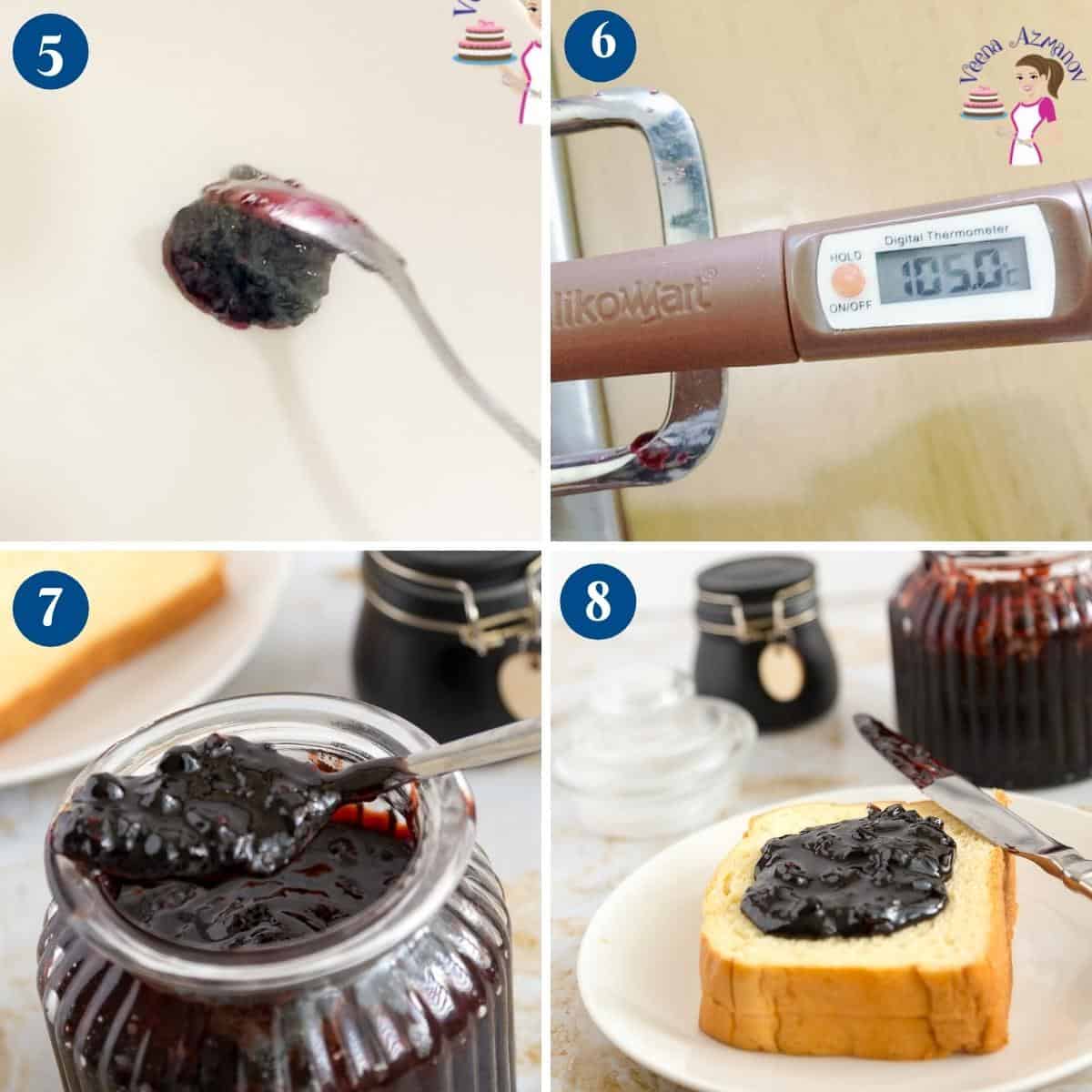
- Remove one of the ceramic plates from the freezer. Place a teaspoon of jam on the cold plate.
Pro tip – The cold plate will help cool the jam almost instantly and give you a good indication if the jam is ready. - Set aside for 2 to 3 minutes, then test with your finger. Simply move/push the jam with your finger. If it wrinkles/crinkles, it means the jam is ready. If not, let the jam cook a couple more minutes and test again.
Pro tip – You may need to test the jam on a ceramic plate more than once or a couple of times, depending on how early you start checking. - Alternatively, you can use a candy thermometer – the jam should reach 105 °C / 221°F.
Pro tip – I find the thermometer to be the easiest and fail-proof method to check for doneness. - Optional – Just when you are ready to take the jam off the heat, add a teaspoon of butter and stir well. Butter helps dissolve the foam that accumulates on top of the jam.
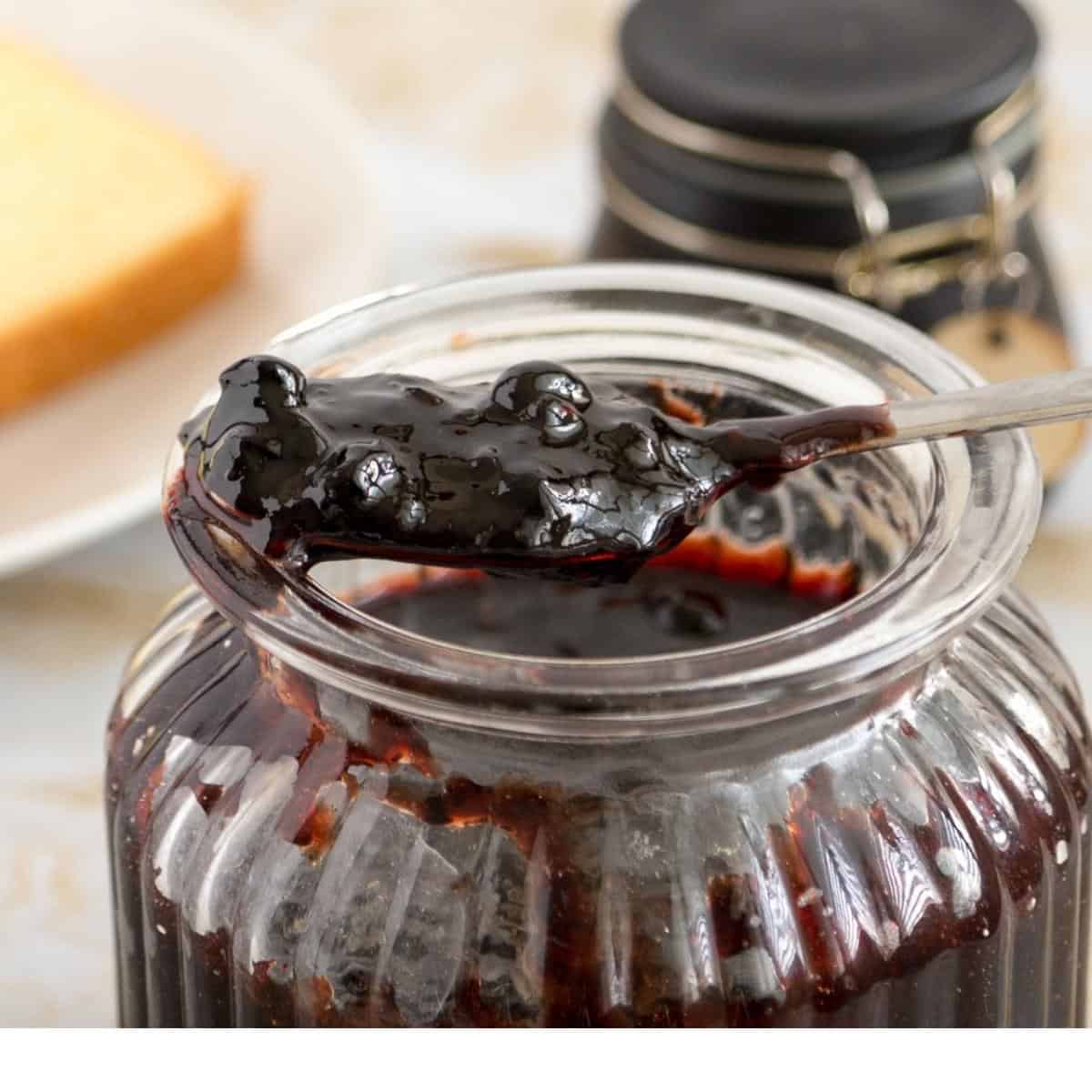
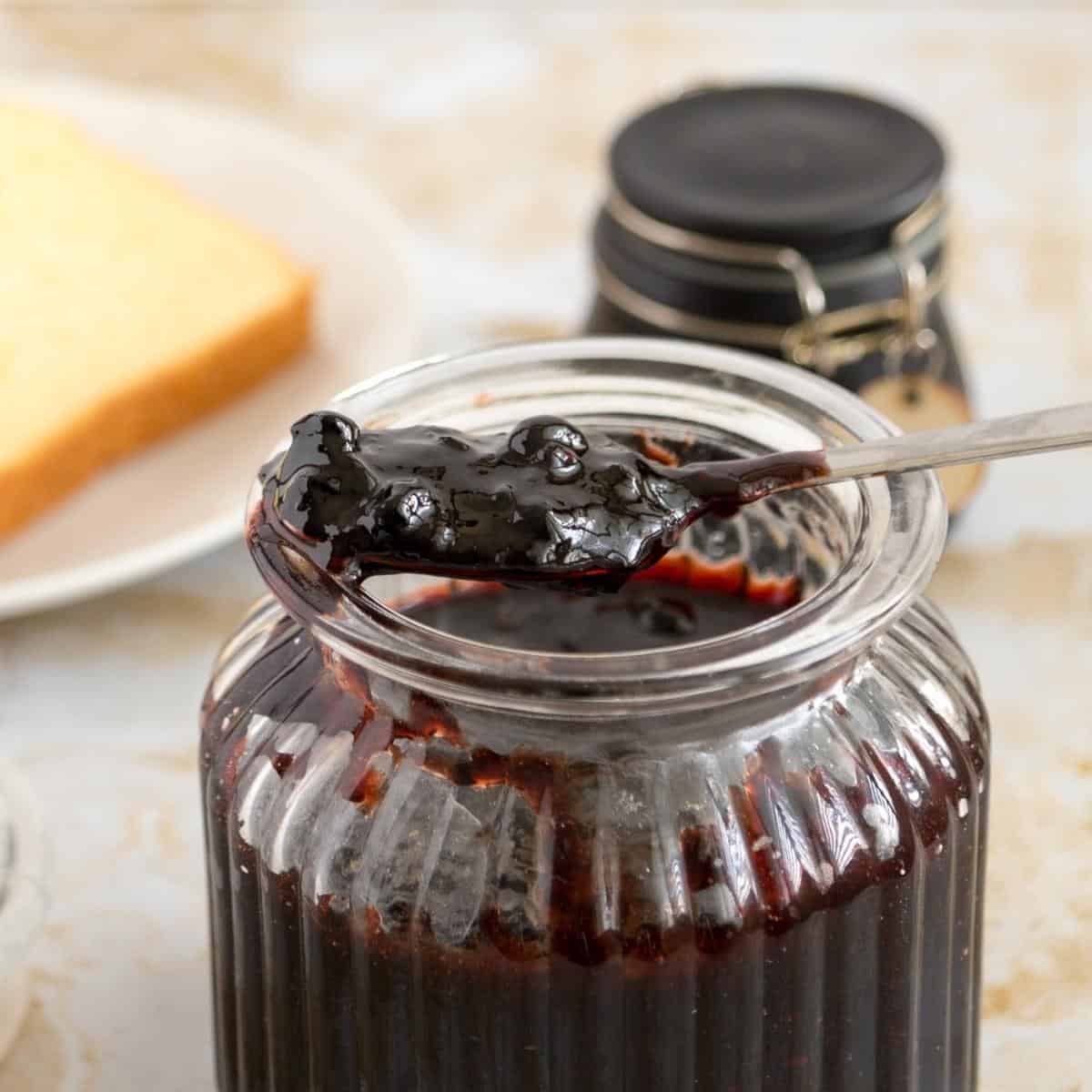
Pro tip – You don’t need more than one teaspoon of butter to help with the foam. It will also give you that glossy shine. - Ladle the almost-hot jam into sterilized jars, leaving 1/4 inch space from the top. Use a clean, sterilized knife or spatula to move the jam a bit – this will remove any air pockets, small air bubbles, or a large bubble. Wipe the rim with a clean cloth.
- Place a piece of wax paper on the top before you place the lid on tightly. Wipe the jar rim with a clean paper towel. Then, top the lid.
Alternatively, use the lid with screw-on rings that come with the canning jars.
The canning process (if you plan to can the jam)
Sterilize the jars
- Sterilize 4 x 8 oz (250 g) jars by washing them in hot, soapy water or cleaning them in the dishwasher with a gentle cycle. Then, place them in the oven for 20 minutes at a low temperature of 284°F / 140 °C.
Pro tip – I find the dishwasher does a good job of cleaning, and the oven dries any excess moisture in the bottles. - Note – Leave them in the oven until you are ready to use them (you can turn the oven off). Don’t forget to wash and sterilize the bottle lids as well.
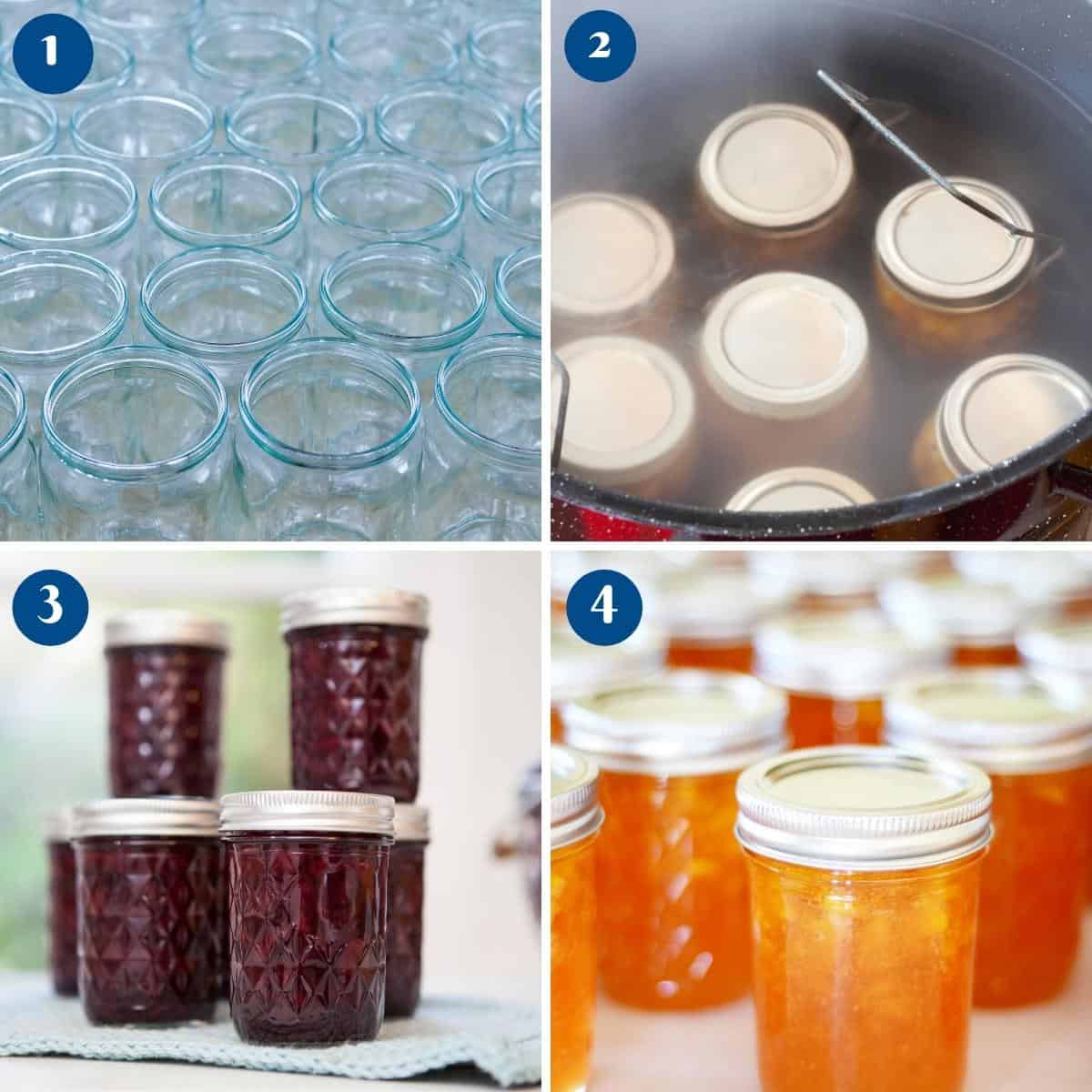
Canning process
- Place a rack in the bottom of a large stockpot or canner. Fill half the pot with water for a hot water bath. Bring the water in the pot to a boil on high heat.
- Lower the prepared jars over the rack, leaving enough space between them.
Pro tip – The water level should be at least an inch above the top of the jars. So, if necessary, pour more boiling water. - Bring the water bath to a boil again. Cover the pot and process/simmer for 15 minutes.
- Then, carefully remove the jars from the stockpot and place them on a kitchen towel to absorb any excess moisture. Cool completely.
Pro tip – The hot jars are very delicate, so make sure to use tongs when taking them out and place them on soft towels to prevent them from breaking. - Press the top of the lid to ensure the seal is tight – the lid should not move at all. Store in a cool, dry place.
Storage
- If canned, the jam will stay in a cool, dry place in the pantry for up to a year or longer.
- When not canned, the jam will stay at room temperature in an airtight container for a month or more in good weather.
- In about 24 hours, you will notice that the jam will thicken considerably.
- You can also keep the jam in the fridge for 3 to 6 months.
- Label the jar with the name and date so you know what is in it and when you made it.
Blueberry jam without sugar
Sugar helps create pectin, which makes our jam. But what if you can’t have sugar, or you don’t want to eat sugar? You can still make jam. Here’s how.
First, pick the naturally sweetest raspberries you can find at the market. Forget everything you read about pectin and buy a box of natural pectin. These are available in most supermarkets. If you don’t want to use pectin, you can use chia seeds. The difference is that jam with pectin has a longer shelf life than jam with chia seeds. Also, grab some fresh lemon juice because it also has some natural pectin in it. The formula is pretty simple, and it belongs to my mom.
- With Pectin
- 4 cups of fruits (one or a combination)
- 3 tbsp pectin
- 2 tbsp lemon juice
- 3/4 cup water
- 1/4 cup honey, maple syrup, or 2 tbsp Splenda
Bring everything to a boil and cook on low until thickened to a jam consistency.
- With chia seeds
- 4 cups fruit
- 2 tbsp lemon juice
- 1/4 cup water
- 1/4 cup honey, maple syrup, or 2 tbsp Splenda
Bring all to a boil and cook until thick, then add 2 tbsp of chia seeds.
If you ever need to add more sweetness, add a little agave syrup or honey to the jam just before you take it off the heat. This will sweeten it a bit. I used to make no-sugar jams for a friend of my mom long ago because she was diabetic. She loved the jam, so she enjoyed it for breakfast every day.

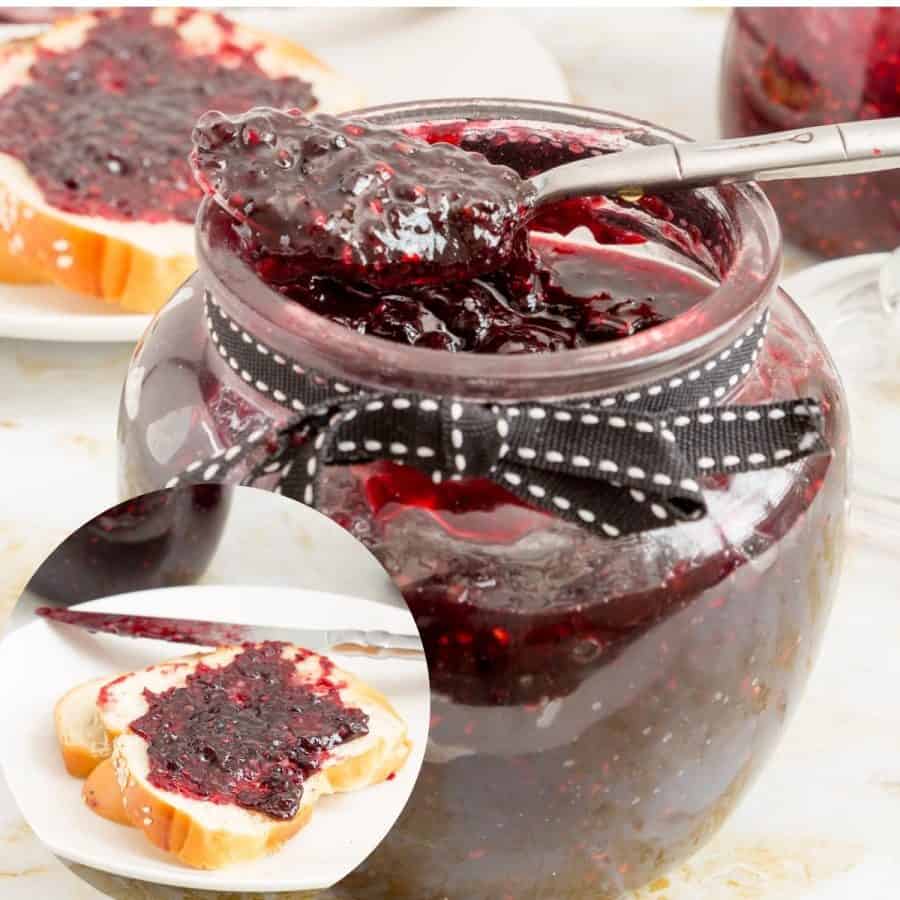

Frequently asked questions
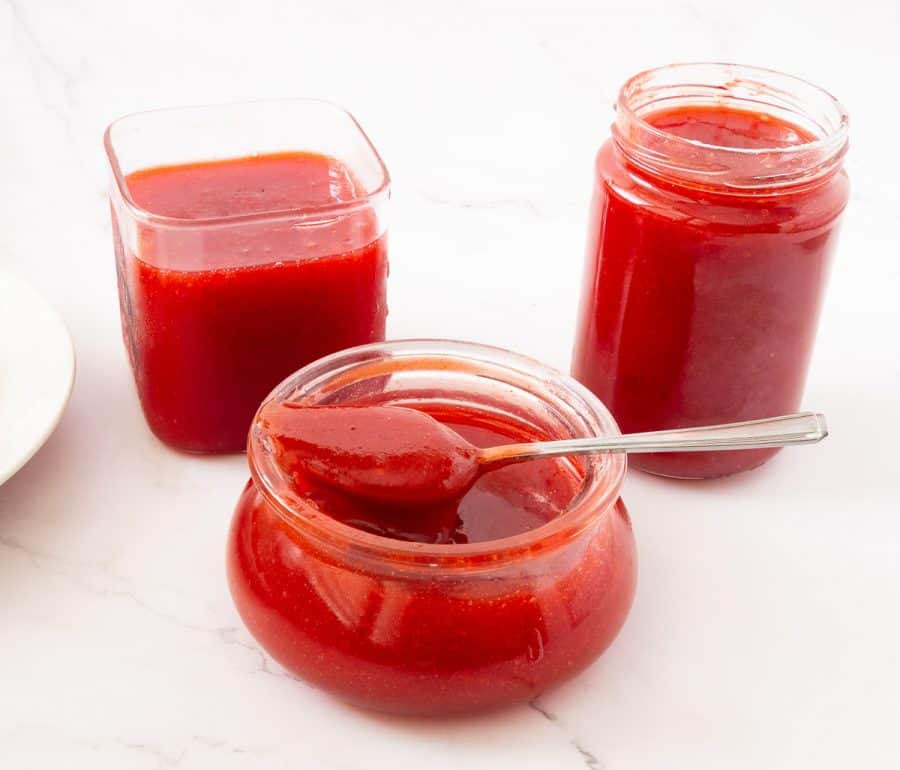
Pectin is an essential ingredient for jams, jellies, and preserves. Without pectin, our jams and jellies will not set. Pectin is naturally found in many fruit seeds and skins, but can also be produced artificially.
Commercial pectin is usually made from the fruit rind. Using artificial pectin can reduce jam cooking time and increase yield. However, it lacks that intense flavor produced through longer, slower cooking by the natural production of pectin in jam.
Yes, of course, you can use frozen blueberries. If you use frozen berries, let the blueberries macerate in sugar and lemon juice for a few hours before cooking. This softens the blueberry skin considerably.
All fruits have pectin. Some fruits have more pectin than others, such as blueberries and apples. In fact, in a blueberry jam, you don’t really need any more pectin.
Our grandmothers did not use any artificial pectin either. And yet, they’ve made us some amazing jams. Low-heat, slow cooking is the key to making a good jam because that’s when the pectin is naturally released.
An acid, like lemon juice, is necessary to keep the sugar from crystallizing, which is why all jam recipes have lemon juice. So, to fix crystallization, simply heat the jam in a microwave or a clean saucepan over medium heat. Then, add lemon juice and cook until the sugar has melted again. This should fix it.
NO! You don’t. But if you do have a candy thermometer on hand, you can use it and take the guesswork out. In fact, I have always used the old-school jam-testing method. But trust me, the thermometer makes life so much easier.
Blueberry Jam – No-Pectin (3 ingredients)
Ingredients
INGREDIENTS
- 2 lbs (1 kg) Blueberries fresh or frozen, stalks removed
- 2½ cups (500 g) Sugar
- 2 tbsp Lemon juice
- ½ tsp Salt optional
- ½ tsp Lemon zest optional
Instructions
- Prep for testing – Place two small ceramic plates in the freezer so we can use them to test the jam later. Alternatively, you can use a candy thermometer to check the doneness of the jam.
- Prep fruit – Check the blueberries and remove any bad, discolored, or bruised ones. Give them a quick wash and drain in a colander.
- Combine the blueberries, sugar, salt, and lemon juice (and lemon zest) in a heavy-bottomed large pan or Dutch oven pot.2 lbs Blueberries, 2½ cups Sugar, 2 tbsp Lemon juice, ½ tsp Salt, ½ tsp Lemon zest
- Boil – Cook on medium heat until the sugar is dissolved. Then, turn the heat up and let the mixture come to a full rolling boil. Let it boil for two minutes on medium-high.
- Simmer – Then, turn the heat to medium-low. The jam should still be simmering, but at a low simmer, not bubbling. Use a potato masher to mash the fruit, so you have a smoother, jam-like consistency.
- Thicken – Continue to simmer for about 20 to 30 minutes more, stirring often so the jam does not stick to the bottom of the pan. The jam will continue to thicken and deepen in color as it cools.
Testing the jam
- Test the jam – Remove one of the ceramic plates from the freezer. Place a teaspoon of jam on the cold plate. Set aside 2 to 3 minutes, and then test with your finger. Simply move or push the jam with your finger. If it wrinkles or crinkles, it means the jam is ready. If not, let it cook for a few more minutes and test it again. Alternatively, you can use a candy thermometer – the jam should reach 105 C / 221 F.
- Remove scum (Optional) – Just when you are ready to remove the jam from the heat, add a teaspoon of butter and stir well. Butter helps dissolve the foam that accumulates on top of the jam.
- Fill jars – Ladle the almost hot jam into warm sterilized jars, leaving 1/4 inch space from the top. Use a clean, sterilized knife or spatula to move the jam a bit – this will remove any air pockets, small air bubbles, or a large bubble.
- Close the lid – Before you tighten the lid, place a piece of wax paper on top. Wipe the jar rim with a clean paper towel. Then, top the lid. Alternatively, use the lid with screw-on rings with the canning jars.
The canning process (if you plan to can the jam)
- Sterilize the jars – Sterilize 4 x 8 oz (250 g) jars by washing them in hot, soapy water or cleaning them in the dishwasher with a gentle cycle. Then, place them in the oven for 20 minutes at a low 284°F / 140 °C.Note – Leave them in the oven until you are ready to use them (you can turn the oven off). Don’t forget to wash and sterilize the bottle lids as well.
- Canning – Place a rack in the bottom of a large stockpot. Fill half the pot with water for a hot water bath. Bring the water in the pot to a boil on high heat. Lower the jars over the rack, leaving enough space between the jars. Bring the water to a boil again. Cover the pot and process/simmer for 15 minutes.
- Cool – Then, carefully remove the jars from the stockpot, place them on a kitchen towel to absorb any excess moisture, and let them cool completely.
- Store – Press the top of the lid to ensure the seal is tight. The lid should not move. Store in a cool, dry place.
Notes
-
- Shelf life – Homemade jams made with sugar and fresh fruit can have a long shelf life. If processed with the canning method and stored properly in a cool, dark place, a blueberry jam can last up to 2 years. Once opened, it can be kept in the refrigerator for up to 3 months.
-
- Do you need lemon juice? Almost all jams use lemon juice. Lemon is a great way to cut down on that sweetness with a citrus edge. It also prevents the sugar from crystallizing. Most importantly, lemons help prevent the growth of bacteria when canning jams.
-
- How long do you cook jam? We often say low-heat, slow cooking is what makes a good jam. This does not mean it takes a long time. Usually, a good 20 minutes is all it needs for about 1 kg / 2 lbs of fruit jam to reach a set point. You can start checking the jam after it has been cooking for 18 to 20 minutes.
-
- Jam not setting – Often, the reason jam does not set, even after being reduced by half, is that it has not been boiled enough. The low-heat, slow cooking is what makes jam reach its setting point. If cooked too fast, the liquid is reduced, but without going through the natural process of setting. So, low-heat, slow cooking is the key to a perfect jam.
-
- Over-cooked jam – It is possible to overcook jam. It is better to undercook rather than overcook a jam. Because undercooked can be cooked again, but once overcooked, you have to add water to thin the jam. Note that once you add water, the jam’s shelf life is also reduced. It’s best to get it right the first time.
Storage
- If canning, the canned jam will stay in a cool, dry place in the pantry for up to a year or even longer.
- When not canned, the jam will stay at room temperature for a month or more in good weather.
- In about 24 hours, you will notice that the jam will thicken considerably.
- You can also keep the jam in the fridge for 3 to 6 months.
- Label the jar with the name and date so you know what is in and when you made it.



Made this recipe?
I’d love to see how yours turned out! Share a photo on Instagram and tag @veenaazmanov_kitchen or use #veenaazmanovkitchen. And don’t forget to leave a rating and review!

Don’t lose this recipe! Save it for Later!
📌 Save this Recipe for later on Pinterest so you can easily find it again.
⭐ Add Veena Azmanov Kitchen to your Google Preferred Sources.
It helps Google show you more of our recipes.
📧 Subscribe for new recipes delivered to your inbox.
🎥 Follow us for more recipes

- Fresh Fig Jam – No Pectin (just 3 ingredients)
- Microwave Strawberry Jam – No Pectin
- Old Fashioned Raspberry Jam – No Pectin
- See all jam recipes
Hi, I’m Veena
I’m the recipe developer, baker, and food photographer behind Veena Azmanov Kitchen.
I’ve spent years developing and testing recipes, from everyday meals and homemade breads to cakes and desserts.
I share the practical tips and little details I’ve learned along the way so you can get great results in your own kitchen.






Looking forward to making this recipe. Appreciate the pro tips. Did have a question regarding using frozen blueberries. Do you use the specified recipe amount of sugar and lemon juice when allowing the frozen blueberries to macerate? I live close to a fabulous blueberry farm and bake with my frozen summer harvest during the cold months. Looking forward to expanding the use of these gems ❤️
Thank you.
Hey Lisa. So lucky to have a farm close to you. For me, these are very expensive so I use them sparingly.
I wait anxiously for them to go on sale which usually happens towards the end of the season.
You will need the same amount of sugar for frozen berries unless you add sugar to them before freezing.
Excited to try your blueberry jam recipe. I have no luck with canning, but I can do freezer jam! Saw the video for your chocolate mug cake. That’s the next recipe I’m going to try! Thanks.
Thanks, Suzanne. Enjoy.
I am trying the recipe right now.
Best jam I’ve ever made. Super easy and so tastey. It took my jam longer to come to temp, but it thickened perfectly. Thanks for sharing this wonderful recipe!!
Thank you so much, Pam. Happy you enjoyed this recipe.
“In a heavy bottom pan, combine the blueberries, sugar, salt, and lemon juice.”
Salt? Is that a typo?
No, there is no typo? You can add salt in jams too!
I just made this, and it was perfect. I can’t have dextrose, so pectins are a no for me. I used 3.5 cups of blueberries for each pound in recipe, turned out very good. I let simmer about 35 min. Thanks for a great recipe!
Thank you for the lovely feedback, Nikki. Happy you enjoyed this jam.
Can I add jalapeños to this blueberry jam recipe? And would I need to make any adjustments?
Yes, of course, love jalapenos blueberry jam sounds yum. No need for adjustments
Never mind about my comment. Somehow I skipped right over the salt in the initial instructions. Sorry
Thanks, Kelly.
Can the blueberry jam be frozen instead of canned?
Yes, Absolutley!
Couldn’t be easier Veena. I made your strawberry jam last week and this week I made blueberry jam. I used fresh strawberries but used frozen blueberries for the other. I used your recommendation to let the blueberries macerate for 2 hours. Both jam are thick, shiny (from the butter). and delicious. I have one question: I use a Thermapen to check the temperature and I cannot get it up to 221 as you recommend. The highest I can get is 217 degrees. I let the jams cook longer that you recommend so they thicken as they cool. I have an electric glass top stove so maybe it just can’t get the temperature up high enough. But all is well–thank you for the recipes and the instructions.
Thank you for the feedback, Susan. Happy both the jams turned out good and delicious. I am sorry I’m not so familiar with the working of thermapen. I use a regular [eafl id="103691" name="Stick Thermometer" text="stick thermometer"] or my [eafl id="44554" name="Spatula Thermometer" text="spatula thermometer"].