
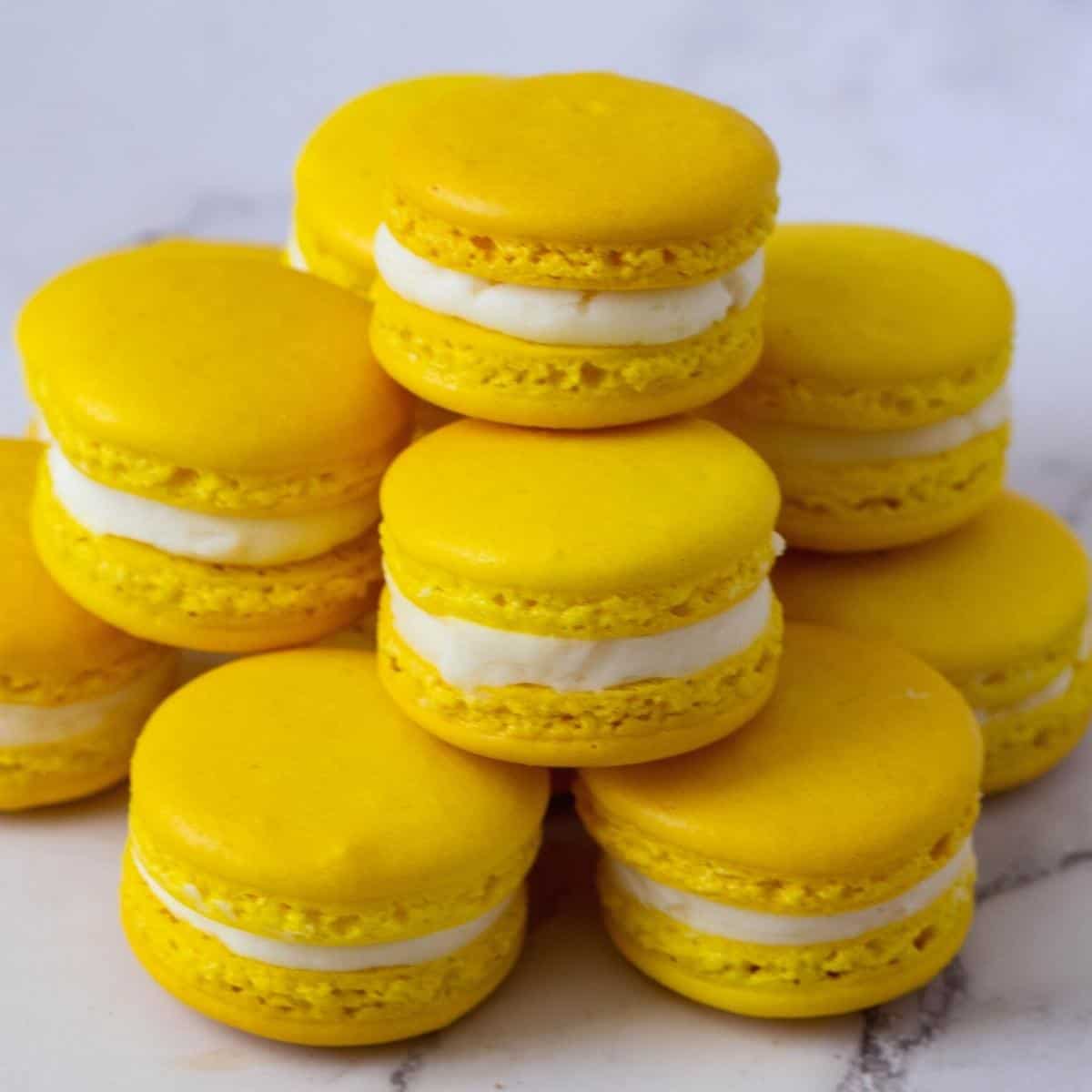




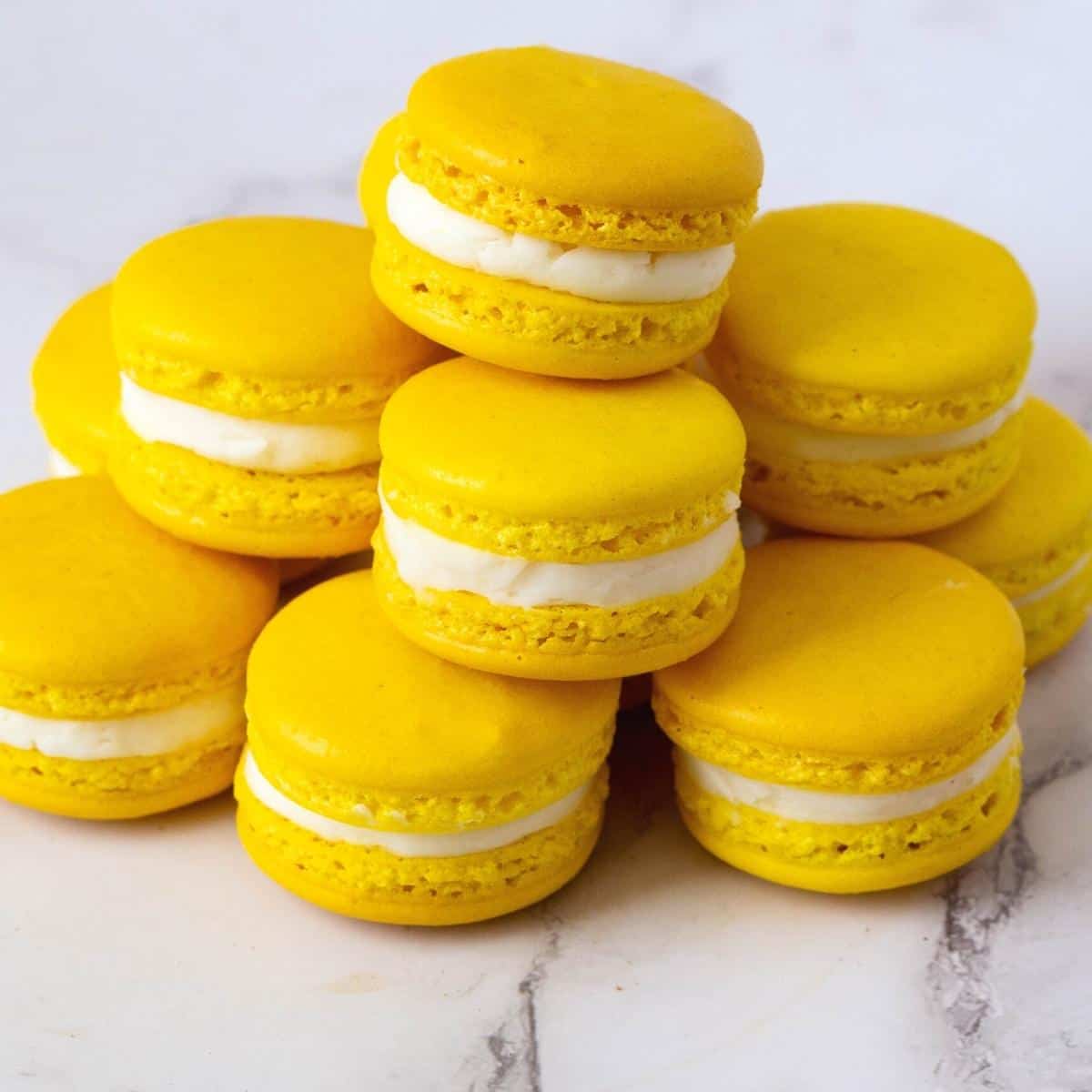
These lemon macarons filled with lemon curd and Swiss meringue buttercream are especially refreshing and light. This is of course using my foolproof macaron recipe as a base. Follow these tips below and people are going to think you are a macaron master baker!!
Lemon macarons were never the most requested flavor during my cake business days — but they were always the one I recommended. Especially for weddings or dessert tables where everything leaned sweet, the lemon ones added that perfect sharp contrast. I liked pairing them with a tart lemon curd and a light buttercream, mostly because it made them stand out without being flashy.
Of course, I always made extra shells “just in case” — you know how it is. And every single time, my kids would go for the lemon ones first. Not chocolate. Not raspberry. Lemon. My daughter once called them “the sour cookies” — and ate five before I could even fill the rest. So now, whenever I make macarons for family gatherings, the lemon ones are a must. Not because they’re trendy or fancy… just because they disappear the fastest.
Why you’ll love this recipe
- Bright and Tangy Flavor – The lemon curd adds a burst of citrus that cuts through the sweetness perfectly.
- Gorgeous Yellow Shells – A beautiful pop of color for spring, brunches, or edible gifts.
- Tried-and-Tested Texture – Crisp on the outside, soft and chewy in the center, just like a proper French macaron.
- Perfect for Make-Ahead – These actually taste better after a day or two in the fridge. Great for planning ahead!
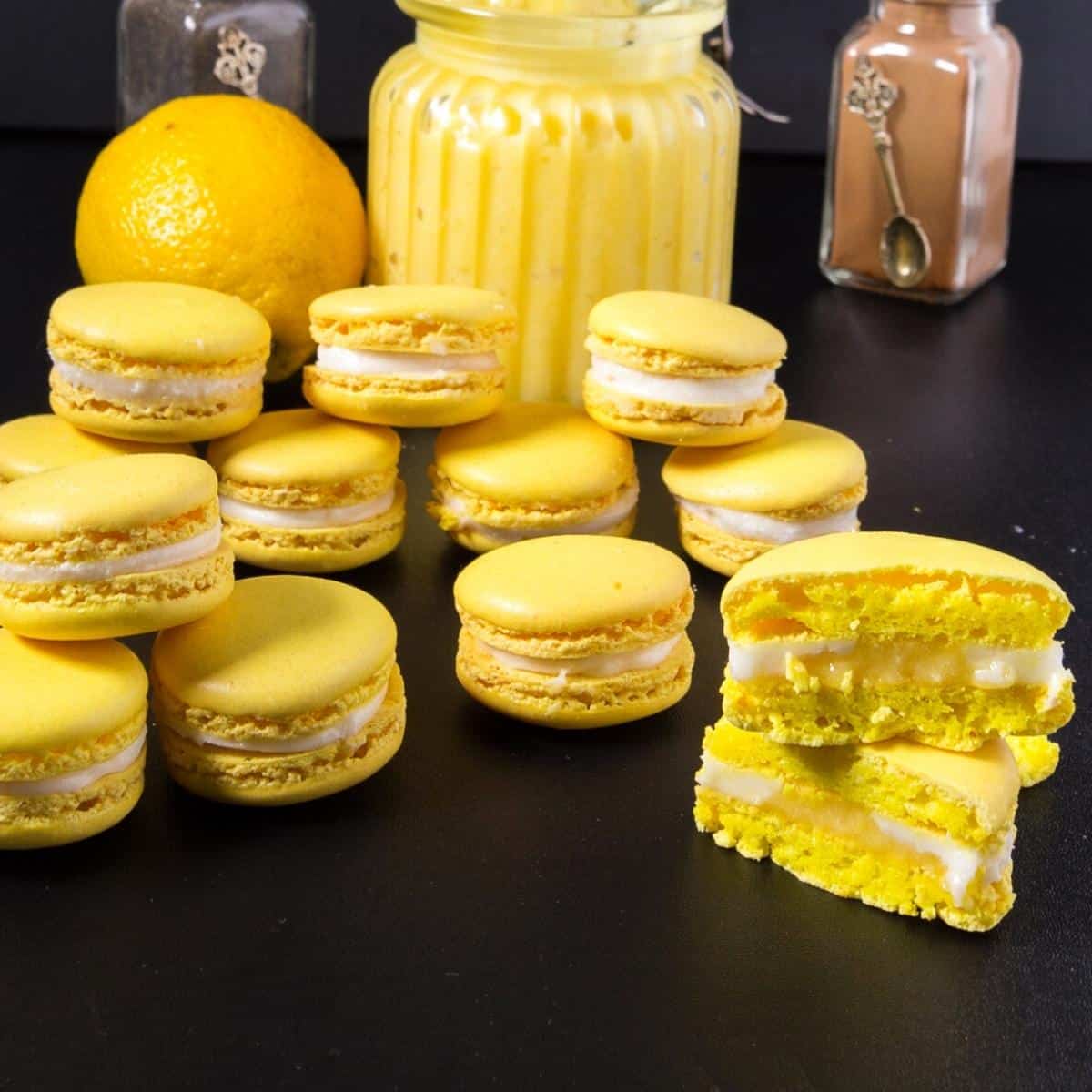
In my post – 20 tips to successful macarons we discussed ingredients in detail. I highly encourage you to read this post if you are new or have ever been frustrated with macarons
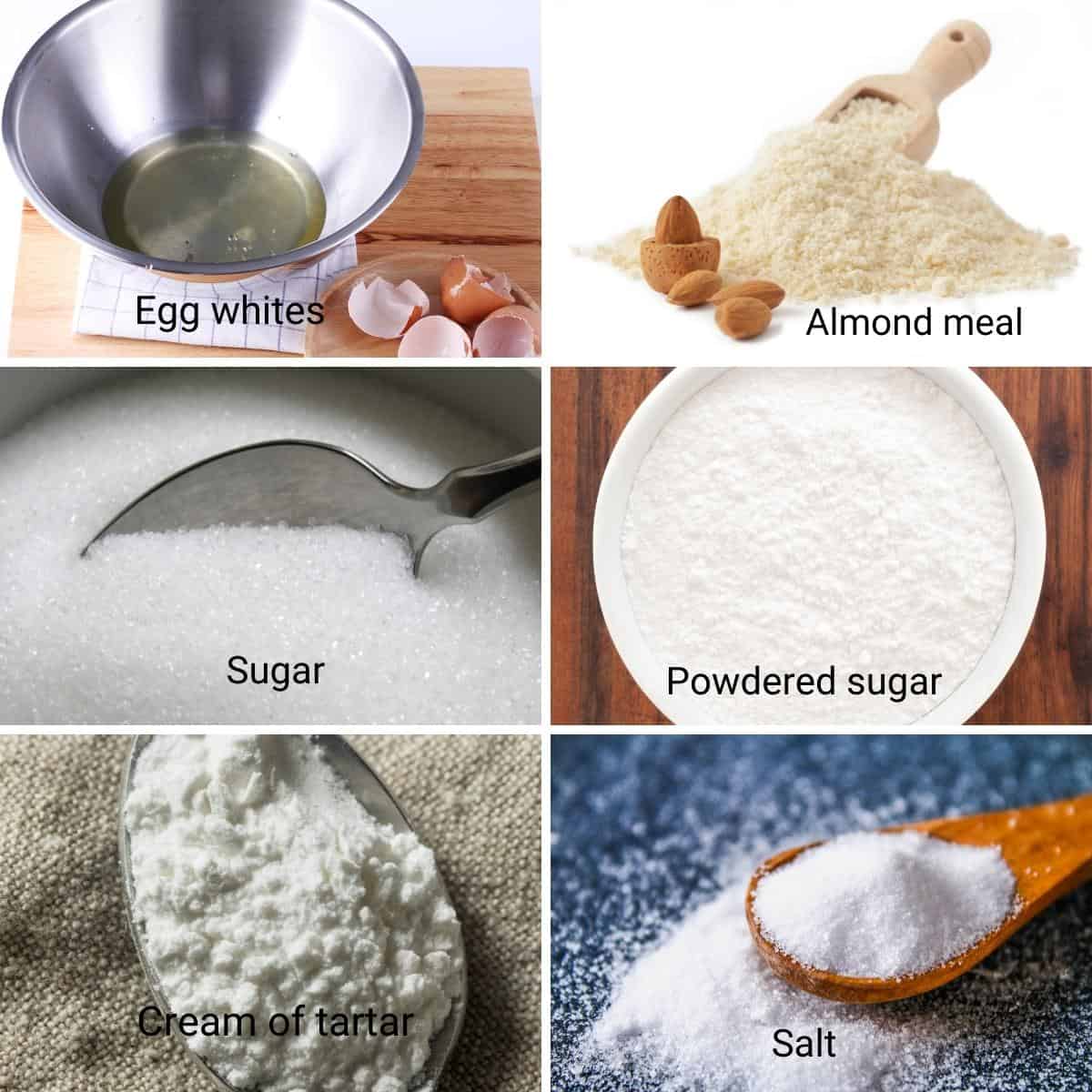
Ingredients and substitutes
- Egg whites – Always weigh them. Aged egg whites work best for stable meringue.
- Almond flour – Must be finely ground and blanched. No substitutions here.
- Powdered sugar – Use icing sugar, not granulated or caster sugar.
- Lemon curd – Homemade is best, but you can use store-bought if it’s thick and not too sweet.
- Buttercream – Swiss meringue or American buttercream both work. Add lemon zest or extract for flavor.
- Gel food coloring – Use yellow gel or powder, never liquid. Liquid color can ruin the consistency.
Step-by-step: Lemon macaron recipe
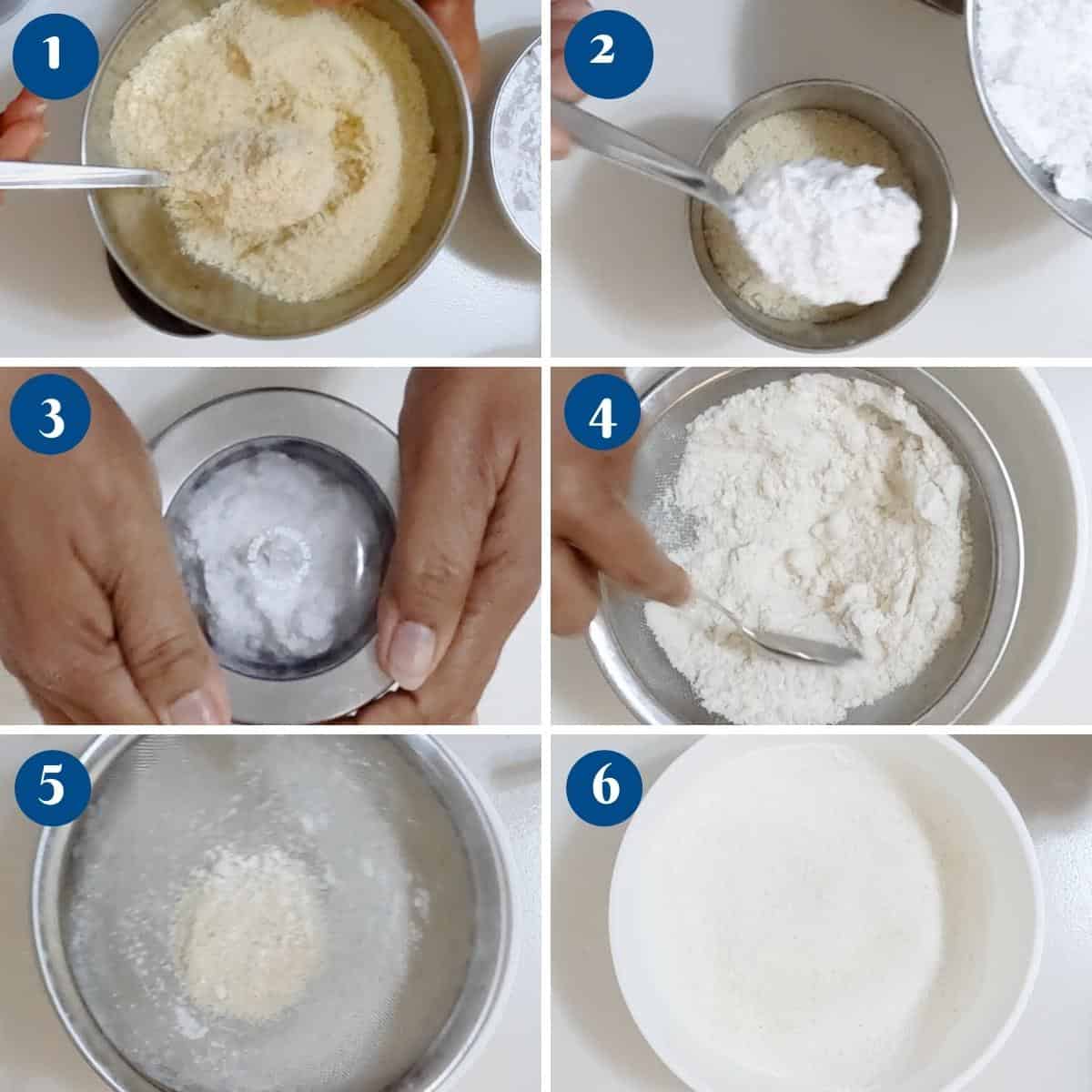
- Dry ingredients – Place almond meal and powdered sugar in a food processor. Sift it through a fine-mesh sieve and discard any remains that do not go through. However, if you have a lot in the sifter, pulse some more and strain again.
- Make the Meringue– Whip egg whites + pinch of salt until foamy. Gradually add granulated sugar and beat to stiff, glossy peaks. Add a few drops of orange gel color. (Optional: Add zest or extract here.)

- Macaronage – Fold the dry ingredients into the meringue until the batter flows like thick lava. Batter should ribbon off the spatula and settle within 10–15 seconds. Avoid overmixing.
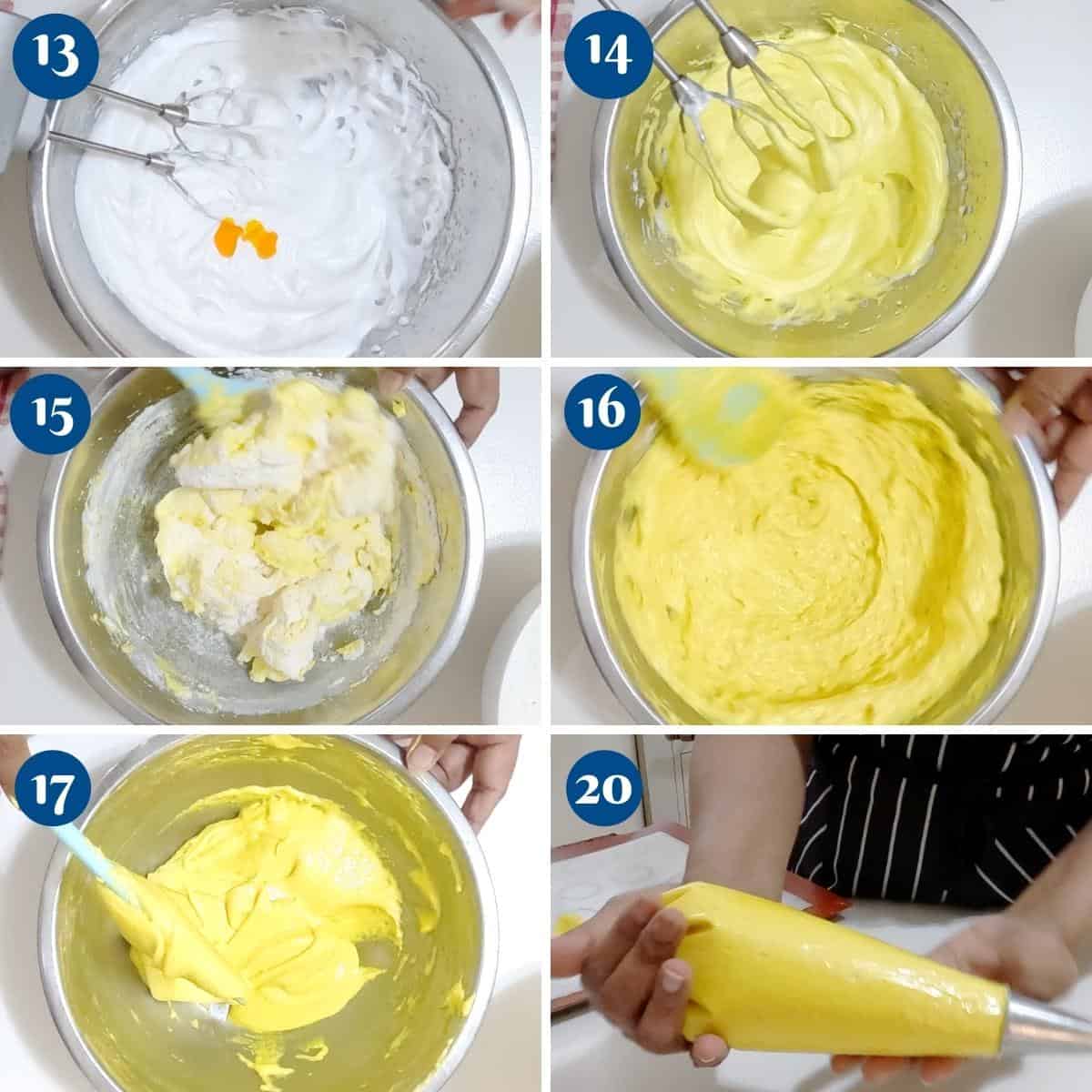
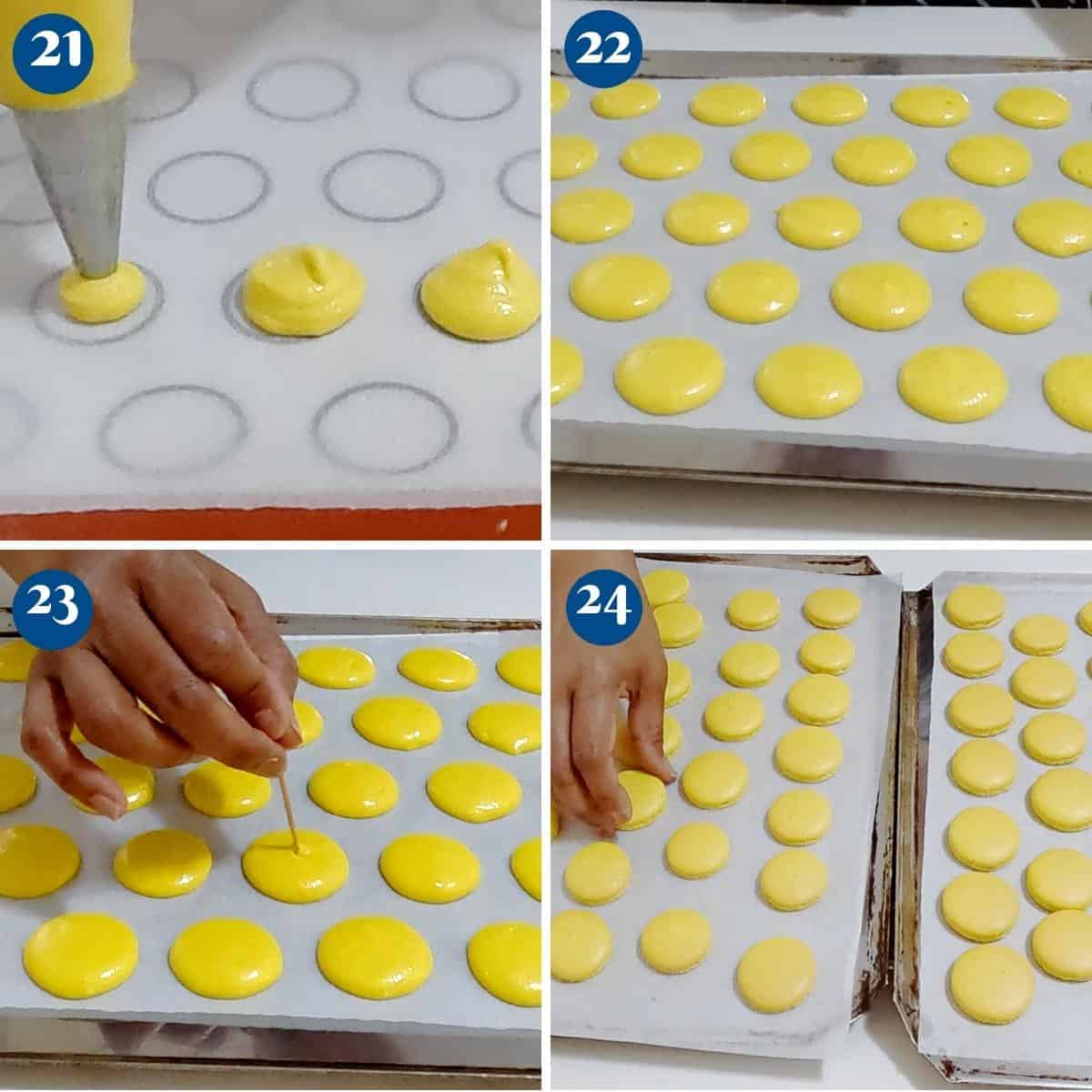
- Pipe and Rest – Pipe 1½-inch rounds on the prepared trays. Tap trays to remove air bubbles and smooth tops. Rest 30–60 mins until the surface is dry to the touch.
- Bake -Bake at 300°F / 150°C for 12–14 minutes. Cool completely before removing from trays.
- Lemon Curd – Place all lemon curd ingredients in a heavy-bottomed saucepan over medium-low heat. The mixture will first become liquid, then start to thicken. Let it cook until it coats the back of a spoon. Strain through a sieve or mesh and let cool completely before using.

- Swiss meringue buttercream: In a heatproof bowl, combine egg whites and sugar. Place over a pan of simmering water (double boiler) and whisk constantly until the sugar dissolves (about 160°F / 71°C). Remove and whip until stiff peaks and the bowl is cool. Add soft butter, a little at a time, and beat until smooth and creamy. Mix in vanilla and (optional) a spoonful of orange curd.

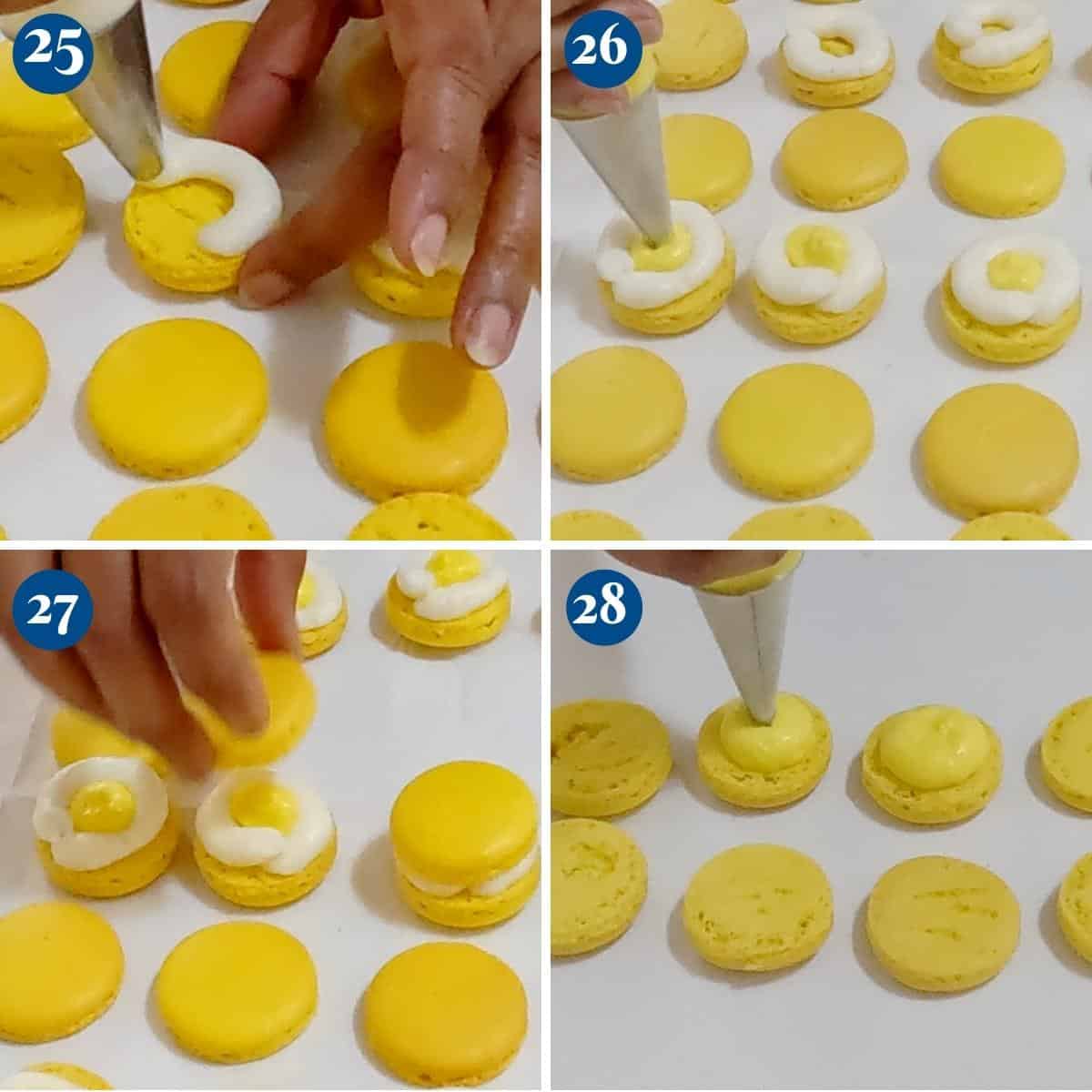
- Assemble – Pair similar-sized shells. Pipe a ring of Swiss meringue buttercream and spoon lemon curd in the center. Gently sandwich and chill for 24–48 hours to mature.
Troubleshooting
- Cracked shells? – Usually caused by under-resting or oven too hot.
- No feet? – Meringue was too soft or batter was overmixed.
- Hollow shells? – Underbaked or overwhipped meringue.
- Curd leaking out? – Curd was too runny or added while still warm.
- Shells sticking? – May be underbaked or not fully cooled before removing.

No posts
Frequently asked questions
Macarons can be made ahead of time and kept in the fridge for 2 days. Wrap them in plastic wrap to prevent them from drying out.
The shells will keep in the freezer for up to 3 months while the fill macarons will freeze for up to a month.
As you can see in most macaron recipes it is made with a stiff meringue. This meringue is made stable because of the amount of sugar in it. So while you need that amount of sugar in the recipe, you can still reduce sweetness by using a not-so-sweet filling and frosting for the shells. I love the taste of sour lemon curd with rich French buttercream.
Yes! Once filled and matured in the fridge for 24 hours, they freeze well for up to a month. Thaw in the fridge before serving.
Lemon Macarons
Ingredients
For the shells
- 100 g (3 large) Egg white
- 100 g (1 cup) Almond meal
- 100 g (¾ cup) Powdered sugar (confectioners sugar)
- 100 g (½ cup) Granulated sugar
- ½ tsp Salt
- ½ tsp Lemon extract
- ½ tsp Lemon zest (optional)
Lemon curd
Swiss meringue buttercream
- 2 large Egg whites
- 100 g (0.5½ cups) Sugar granulated
- 150 g (¾ cups) Unsalted butter room temperature, unsalted
- 1 tsp Vanilla extract
Instructions
Macaron shells
- Dry ingredients – Place almond meal and powdered sugar in a food processor. Sift it through a fine-mesh sieve and discard any remains that do not go through. However, if you have a lot in the sifter, pulse some more and strain again.100 g Almond meal, 100 g Powdered sugar
- Make the Meringue– Whip egg whites + pinch of salt until foamy. Gradually add granulated sugar and beat to stiff, glossy peaks. Add a few drops of orange gel color. (Optional: Add zest or extract here.)100 g Egg white, ½ tsp Salt
- Macaronage – Fold the dry ingredients into the meringue until the batter flows like thick lava. Batter should ribbon off the spatula and settle within 10–15 seconds. Avoid overmixing.100 g Granulated sugar
- Pipe and Rest – Pipe 1½-inch rounds on the prepared trays. Tap trays to remove air bubbles and smooth tops. Rest 30–60 mins until the surface is dry to the touch.½ tsp Lemon zest, ½ tsp Lemon extract
- Bake -Bake at 300°F / 150°C for 12–14 minutes. Cool completely before removing from trays.100 g Almond meal, 100 g Powdered sugar
- Lemon Curd – Place all lemon curd ingredients in a heavy-bottomed saucepan over medium-low heat. The mixture will first become liquid, then start to thicken. Let it cook until it coats the back of a spoon. Strain through a sieve or mesh and let cool completely before using.⅓ cup Lemon juice, ⅓ cup Sugar, 2 large Eggs, ¼ cup Butter, 1 tsp Lemon zest
- Swiss meringue buttercream: In a heatproof bowl, combine egg whites and sugar. Place over a pan of simmering water (double boiler) and whisk constantly until the sugar dissolves (about 160°F / 71°C). Remove and whip until stiff peaks and the bowl is cool. Add soft butter, a little at a time, and beat until smooth and creamy. Mix in vanilla and (optional) a spoonful of orange curd.100 g Sugar, 2 large Egg whites
- Assemble – Pair similar-sized shells. Pipe a ring of Swiss meringue buttercream and spoon lemon curd in the center. Gently sandwich and chill for 24–48 hours to mature.
Video
Notes
- Egg white – make sure the egg whites have no yolks in them otherwise they will not whip into a meringue. Start whipping at medium-low speed and add the sugar gradually this ensures stiff shiny peaks.
- Almond flour – must be ground finely. Even if you buy premade almond meal it is best to run it through the food processor one more time with the powdered sugar. This must be sifted to remove large bits otherwise the macaron batter will be lumpy
- Macronage – you need, what is called a dropping consistency or a thick ‘lava-like’ or ‘cake batter’ consistency. This means when you hold a little batter on the spatula and it should drop down like a ribbon that blends back into itself. Getting the right consistency sometimes takes time. So, watch that part of the video carefully.
- Piping tips – this is a very soft batter so don’t use a very large round tip. Find a smaller tip that helps you stay in control.
- Piping technique – The best way to pipe the macarons, hold the piping bag at 90%. Squeeze until you have a good mound then swirl the tip to one side. But don’t worry if you have a point. When you tap the pan these usually settle down.
- Oven – do not open the oven door for the first 10 minutes of baking. When you shake the pan they must look set. Remember they continue to bake with the residue heat on the baking tray.
- Have a hard time mastering macarons? read my 20 tips for making perfect macarons. Many have found it extremely useful.
- My macarons have no feet – usually, the most common reason is that the batter is too thin due to overmixing. Getting the right consistency is important and can take a few attempts for some people
- My macarons are cracked on top – Most often the reason for this is that the batter was undermixed. Pockets of dry flour or unmixed lumps can cause cracks during baking. You must first fold the batter and ensure everything is well mixed before you start the macronage stage.
- Macarons have large holes – which usually happens when there are air pockets in the batter. Most often tapping the baking sheets will help pop them but often you may need to take a toothpick and pop them yourself.
- Ripples on the macarons – usually happen when the piped batter is not tapped enough to help the batter settle before crusting.
- Faded macarons – often baked in a very hot oven are the culprit of faded macarons. Reduce heat considerably. You can also place another baking pan on the top shelf to prevent direct heat.
- No feet in macarons – Thin batter consistency. You must whip the meringue until stiff peaks form, then add the dry ingredients and bring it back to the macronage consistency.
- Burst macaron feet – also a sign that the oven is too hot or the heat is not evenly distributed. You can place another baking tray on the top shelf or bake on two (double) baking sheets to prevent direct heat to the macarons.


Made this recipe?
I’d love to see how yours turned out! Share a photo on Instagram and tag @veenaazmanov_kitchen or use #veenaazmanovkitchen. And don’t forget to leave a rating and review!
- Orange French Macarons Recipe
- French Strawberry Macarons
- Strawberry Lemon Macarons
- 20 Tips with No-fail Macaron Recipe
No posts
Don’t lose this recipe! Save it for Later!
📌 Save this Recipe for later on Pinterest so you can easily find it again.
⭐ Add Veena Azmanov Kitchen to your Google Preferred Sources.
It helps Google show you more of our recipes.
📧 Subscribe for new recipes delivered to your inbox.
🎥 Follow us for more recipes


Hi, I’m Veena
I’m the recipe developer, baker, and food photographer behind Veena Azmanov Kitchen.
I’ve spent years developing and testing recipes, from everyday meals and homemade breads to cakes and desserts.
I share the practical tips and little details I’ve learned along the way so you can get great results in your own kitchen.









Thank you for replying!
And sorry for sending the same question twice!!
Hello!
I would like to make this recipe. Would it work to cut it in half?
Thanks!
Yes, you can definitely half this recipe.
Hi there!
I want to make this recipe, but was wondering if I could halve it since I am still new to making macarons.
Would that work?
Thanks!
Yes Michelle, you can half this recipe. Just keep the measurements accurate.
Amazing!
I’m not a beginning baker, but have never made macarons. Maybe it’s just me, but I find several things you say confusing or contradictory.
There are these quotes:
“use a fine grain sugar” (this would mean granulated to me)
“place almond meal and POWDERED sugar…” (literally, Powdered sugar, which means confectioners to me?)
“start adding the granulated sugar…..”
So, granulated or powdered sugar??!!! The use of “powdered” is confusing
And, you say “also, you can use fresh eggs…….” As opposed to what?? I see no mention of meringue powder/dried egg whites, so I would assume fresh egg whites were being used.
And, lastly, “Touch the mixer bowl. If it’s still warm wait, run the mixer on low until it cools. Once the bowl feels warm to the touch….” I thought we wanted to cool it down, now it says once it’s warm??
Cathy, making macarons for the first time can be confusing which is why you need to read the recipe a few times.
1. the recipe uses both granulated sugar and powdered sugar (yes, powdered sugar is confectioners sugar)
2. We add granulated sugar to the whipping egg whites
3. we add powdered sugar – along with the almond meal in the food processor
4. Yes, in this recipe you can use fresh eggs, as compared to aged ages which are usually recommended for macarons.
– The above are all referring to the macaron batter.
5. the – touch the mixer bowl instruction is referring to the Swiss meringue buttercream.
I suggest you see the video of making the macarons and if you want to make Swiss meringue there is a video there too.
I hope I helped with some of the confusion. I try my best to write detailed recipes with Pro tips and videos. But, I’m always here to answer any questions.
Hi Veena! Just wondering, when you say granulated sugar in the recipe, are you referring to the castor sugar? Only as these are 2 separate things in the UK! Thanks x
Hey Charlie. You can certainly use castor sugar but it’s not necessary. As long as the sugar is fine grain white sugar is good enough. To me they are both different so not sure about UK. I hope this helps