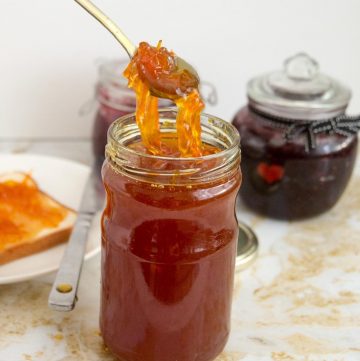
Orange Marmalade No-Pectin
Calories: 14
Adjust Servings Here: 15 servings
Description
This orange marmalade or confiture d'orange is low in sugar. It's made all-natural the old-fashion method without pectin or artificial flavoring. So, it's sweet, sticky, and less bitter than commercial condiments using my no-fail method below.
Ingredients
- 4.5 lbs (2 kg) Oranges washed & scrubbed
- 4 cups (800 g) Sugar
- 2 Lemons
- 3.5 cups (800 ml) Water
Instructions
- Place two small ceramic plates in the freezer so we can use these to test the marmalade later. Alternatively, you can use a candy thermometer to check the doneness of the jam.
Prepare Fruits
- Zest and juice the lemons – and set aside.
- Zest the oranges - Use a sharp vegetable peeler or paring knife and peel the bright orange-colored zest making sure not to get the bitter white pith underneath. Julienne or cut the zest into strips. And set aside.Alternatively, you can use a citrus zester that I have used in the video to zest the oranges. And set aside.Pro tip - Thoroughly wash and lightly scrub the oranges to ensure the peels are clean before you zest them.
- Juice the oranges - Cut the oranges in half and squeeze the juice out. Strain the juice to remove any peps or pulp. Set aside.Pro tip - I like to work over a strainer to ensure I get as much of the juice as possible.
- Collet the pith and membranes - Collect the pulp, pips, and remove as many membranes from the orange as possible (see video). Tie it all in a cheesecloth. And set aside for later.Pro tip - The pectin we need to make marmalade is in these pips, pulp, and zest, so make sure to save collect as much as you can.
Cook the zest/rind first
- In a heavy-bottom pan, add the orange and lemon zest, lemon and orange juice, and water. Place the cheesecloth with the membranes inside the pot as well.Pro tip - Make sure the cheesecloth is tied well so it does not open in the pot with boiling.
- Bring to a boil. Then, cook on medium simmer partially covered. Cook until the orange zest becomes soft, the liquid will reduce to about one-third of its original volume.Pro tip - It can take from 20 to 30 minutes depending on the zest as well as the time and temperature of heat. What is important is that the zest gets soft.
- Then, remove the bag from the pan making sure to squeeze out as much of the liquid as possible. Pro tip - It is best to take this bag out now before we add the sugar. Otherwise, it gets harder to squeeze the sweeter juice out later.
Start the marmalade process
- Once the orange zest is soft, add the sugar. Cook on medium heat until the sugar is dissolved. Then, turn the heat up and let the mixture come to a boil. Let it boil for two minutes on medium-high. Then, reduce the heat to medium-low.Pro tip - The marmalade should still be simmering but at a low simmer, not bubbling.
- Continue to simmer on medium-low for about 20 to 30 minutes more stirring often so it does not stick to the bottom of the pan. The marmalade will continue to thicken as well as deepen in color as it cooks.Pro tip - The cooking time will depend on the quantity of the marmalade as well as the heat applied to it. It's ok to cook a little longer, but there must be a simmer for the gelling process to start.
Test the marmalade
- Remove one of the ceramic plates from the freezer. Place a teaspoon of marmalade on the cold plate. Pro tip - The cold plate will help cool the marmalade almost instantly and give you a good indication if it is ready.
- Set aside for 2 to 3 minutes. Then, test with your finger. Simply move/push the marmalade with your finger. If it wrinkles/crinkles it means it is ready. And if not, let the marmalade cook a couple of minutes more and test again.Pro tip - You may need to test on a ceramic plate more than once or a couple of times depending on how early you start checking.
- Alternatively, you can use a candy thermometer - the marmalade should reach 105 C / 221 F.Pro tip - I find the thermometer to be the easiest and fool-proof method to check for doneness.
- Optional - Just when you are ready to take the marmalade off the heat add a teaspoon of butter and stir well. Butter helps dissolve foam that accumulates on top of the jam. Pro tip - You don't need more than 1 teaspoon of butter to help with the foam. It will also give you that glossy shine.
- Pour the marmalade into warm sterilized jars leaving 1/4 inch space from the top. Use a clean sterilized knife or spatula to move it a bit – this will remove any air pockets.
- Place a piece of wax paper on the top before you place the lid on tightly. Clean the rim of the jar with a clean paper towel. Top the lid. Alternatively, use the lid with screw-on rings that come with the canning jars.
The canning process (if you plan to can the marmalade)
Sterilize the jars
- Sterilize 4 x 8 oz (250 g) jars by washing them in hot soapy water or cleaning them in the dishwasher with a gentle cycle. Then, place them in the oven for 20 minutes at a low 284 F / 140 C.Pro tip - I find the dishwasher does a good job of cleaning and the oven dries any excess moisture in the bottles.
- Note - Leave them in the oven until you are ready to use them (you can turn the oven off). Don’t forget to wash and sterilize the bottle lids as well.
Canning process
- Place a rack in the bottom of a large stockpot. Fill half the pot with water. Bring the water in the pot to a boil on high heat.
- Lower the jars over the rack leaving enough space between the jars.Pro tip - The level of water should be at least an inch above the top of the jars. So, if necessary pour more boiling water.
- Bring the water to a boil again. Cover the pot and process/simmer for 15 minutes.
- Then, carefully remove the jars from the stockpot and place them on a kitchen towel to absorb any excess moisture. Cool completely. Pro tip - The hot jars are very delicate so make sure to use tongs when taking them out and place them on soft towels to prevent them from breaking.
- Press the top of the lid to ensure the seal is tight – the lid should not move at all. Store in a cool dry place.
The nutrition information and metric conversion are calculated automatically. I cannot guarantee its accuracy. If this data is important to you please verify with your trusted nutrition calculator. Thank you
Did you make this recipe? Share it with me.Tag @veenaazmanov_kitchen on instagram or #hashtag it #veenaazmanovkitchen